Astrophotography diagnosis of V398 Cephei: Tracking drift
Raw300s17 août 2026
The Doc examined this image of V398 Cephei (raw, 300s). Estimated overall technical quality: 6/10. 1 defect found: Tracking drift (severity 3/5).
&w=1920&q=75)
Info
- Cible
- V398 Cephei
- Date
- 17 août 2026, 22:48
- Lune
- Gibbeuse décroissante 70.9% (sous l'horizon)
- Site
- Bortle 2 · rural typique (VIIRS)
- Position
- 0h03m11s · +66°50'13"
Excellent conditions: Bortle 2, and the waning gibbous Moon at 70.9% is below the horizon, so no lunar contribution is possible on this frame. That is the ideal context for an extended emission region in Cepheus: the background stays dark, faint nebulosity emerges from 300s onward, and the background map indeed shows no significant oriented gradient (2% amplitude, plane R2 0.05). Under this sky you can afford long subs without fear of swamping the background; the limiting factor is not the sky but the tracking mechanics. In short, nothing to change on the planning side: it is the guiding that needs to be made reliable to exploit these conditions.
Setup
- Type d'image
- Brut
- Télescope
- EQMod Mount
- Caméra
- ZWO ASI585MM Pro
- Exposition
- 300s
- Phase de lune
- Premier croissant (23 %)
- FOV
- 3.36°
Setup consistent with the target but clearly undersampled: 3.148 arcsec/px at 190mm focal length, where typical seeing would allow 1 to 2 arcsec/px. As a direct consequence stars are only 1 to 2 px FWHM at center, so the slightest tracking drift immediately reads as strong elongation and the PSF fit becomes fragile. The 3.36 degree field, on the other hand, suits this extended nebular region well, filling the frame without clipping it. On settings: gain 180 is high for an ASI585MM, a value closer to unity with the same exposure would give more dynamic range; offset 15 is sufficient (0% dark clipping) and -15.5C is healthy cooling. The 1.85 e_margin is normal in narrowband.
The diagnosis in detail
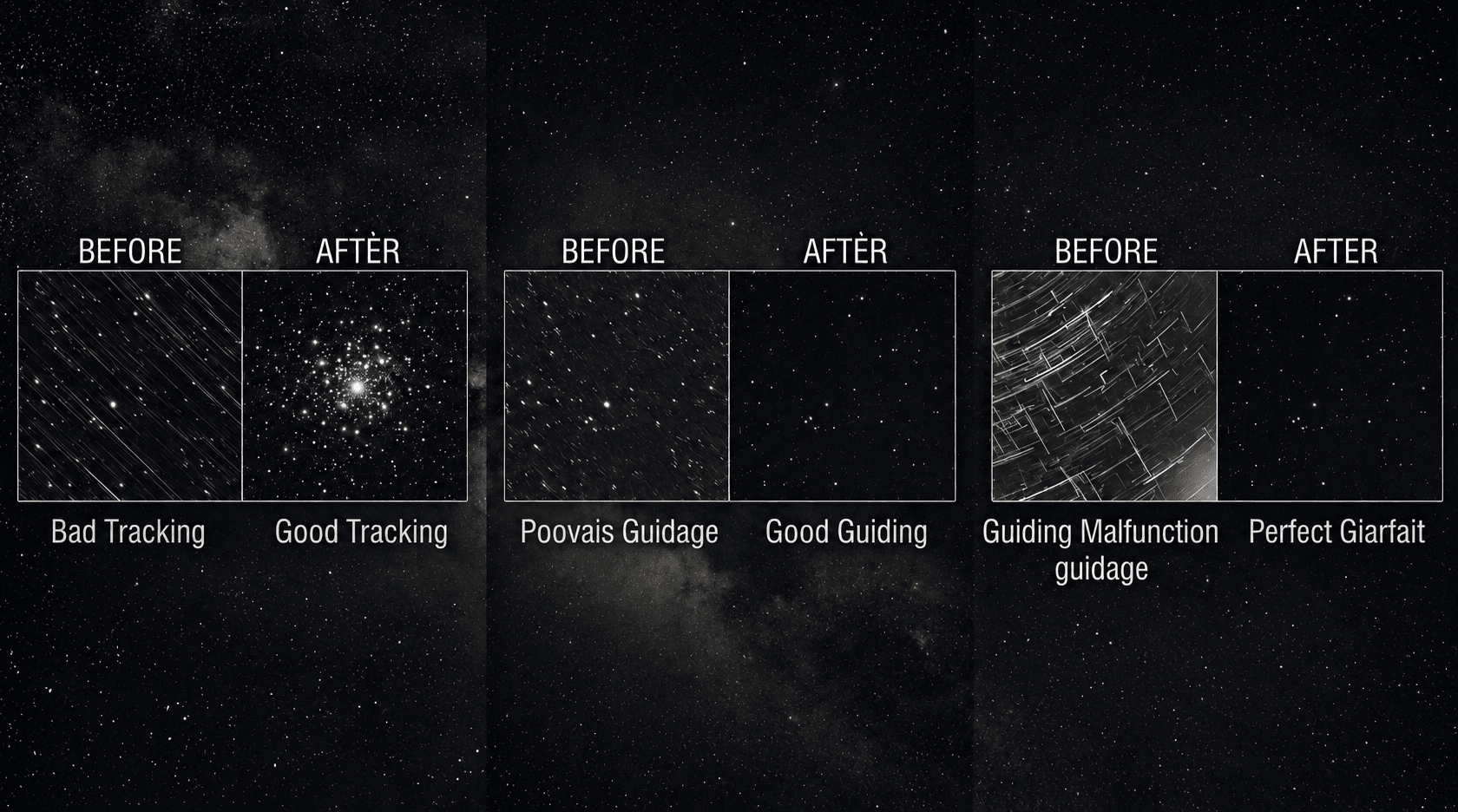
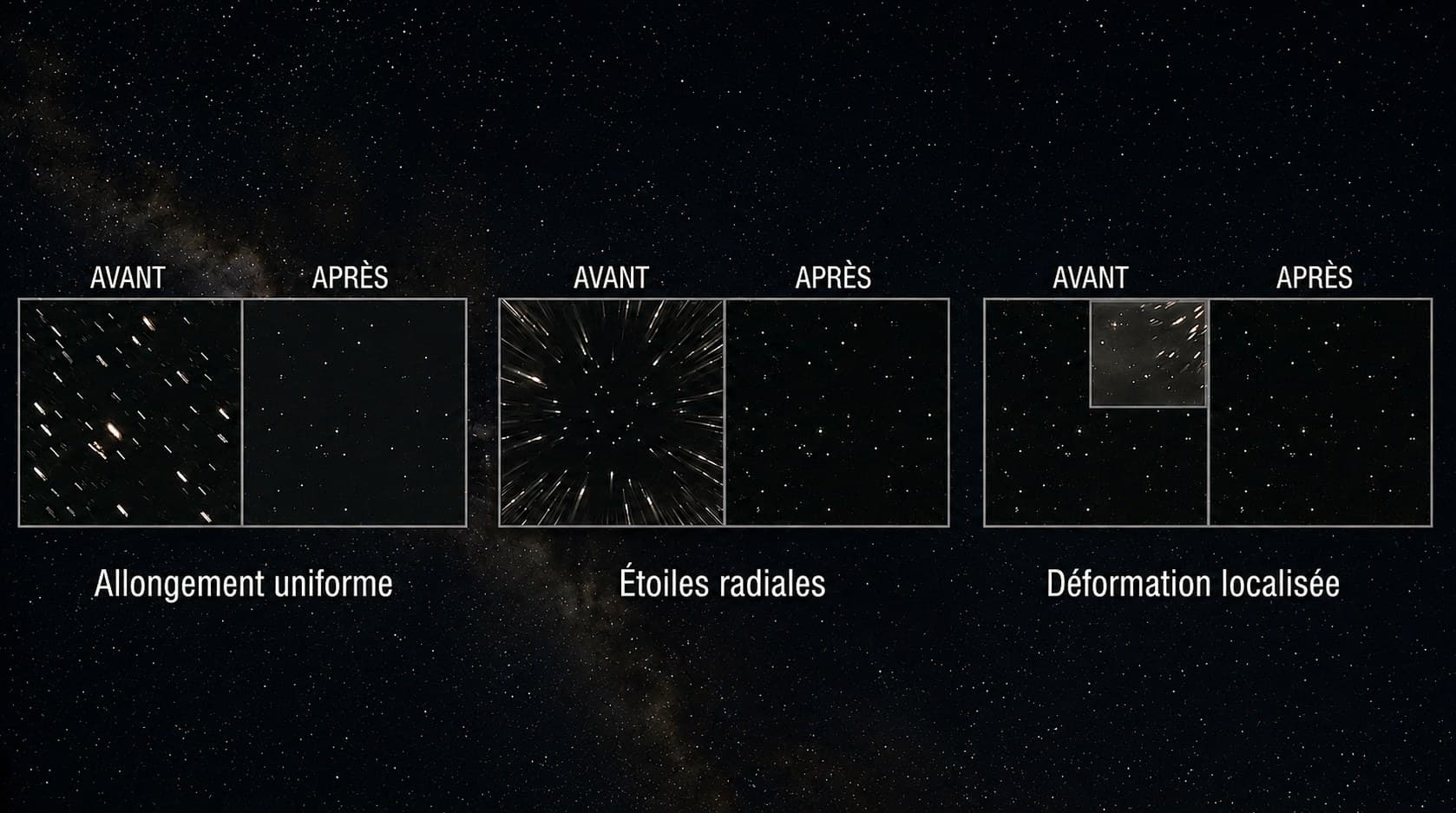
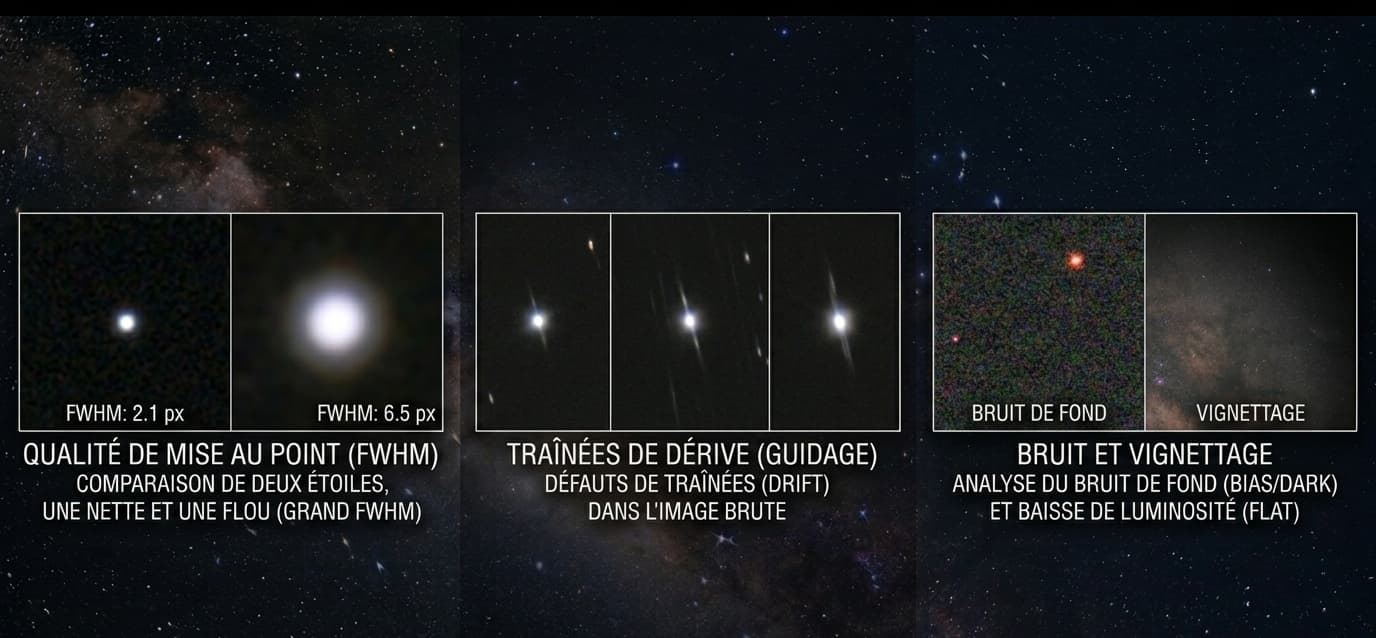
The diagnosis comes down to one dominant point: star shape. The field center is clean (FWHM 1.37/1.14 px, elong 1.20), but as soon as you move outward the Moffat measurements give elongations of 3.2 to 4.7, up to 10.63 top right. This pattern does not carry the signature of a field aberration: backfocus error or coma would produce symmetric radial degradation with steadily rising FWHM, whereas here the minor axes stay at 0.4-0.5 px, meaning thin streaks rather than spread ovals. The most likely reading is tracking drift during the 300s, all the more visible because 3.148 arcsec/px sampling makes every star tiny.
An honest caveat is needed: this is a single sub, the edge zones contain few usable stars, TL has none at all, and several panel thumbnails show blends or noise that inflate the fit. The 10.63 TR value is very likely a fit artifact on two merged stars. So confirm across several subs before concluding definitively.
The rest is healthy. Comparison with the DSS validates all the nebulosity, including the diffuse filament on the left and the dark regions: nothing to strip out as a gradient. The only other measurement is a 6% radial illumination falloff, purely instrumental and trivially corrected with flats.
Priority actions
- Check polar alignment and PHD2 guiding graphs before the next session
- Shorten subs to 120-180s to limit drift and compensate with frame count
- Confirm the elongation across several subs before touching anything mechanical, a single-sub measurement stays fragile
- Shoot a set of flats to correct the 6% radial falloff
- Consider a gain closer to unity on the ASI585MM for more dynamic range