Astrophotography diagnosis of 68 Cygni: Sensor tilt, light pollution gradient and 2 others
Processed35×300s05 oct. 2026
The Doc examined this image of 68 Cygni (processed, 35×300s). Estimated overall technical quality: 7/10. 4 defects found: Sensor tilt (severity 3/5), Light pollution gradient (severity 3/5), Tracking drift (severity 2/5), Background chroma noise (severity 2/5).

Info
- Cible
- 68 Cygni
- Date
- 05 oct. 2026, 20:14
- Lune
- Gibbeuse croissante 75.1% (sous l'horizon)
- Site
- Bortle 2 · rural typique (VIIRS)
- Position
- 21h18m33s · +43°56'20"
Near-ideal conditions: Bortle 2 and the Moon below the horizon, 118 deg from the target, so no lunar contribution is possible. On a faint emission nebula like the Ha wisps around 68 Cygni, this is exactly the sky you want: the background is dark, the red signal comes through without a narrowband filter, and a dual-band is not essential here. The measured gradient therefore does not come from urban skyglow but from local stray light or an incomplete background extraction in processing. With such a site, the real lever is integration time: 2h55 is short for this field, and doubling or tripling total exposure will transform the faint extensions.
Setup
- Type d'image
- Traitée
- Télescope
- ZWO AM3
- Caméra
- ZWO ASI294MC Pro
- Exposition
- 35×300s
- Phase de lune
- 30%
- FOV
- 1.14°
Coherent combination: 430mm of focal length on an ASI294MC Pro gives 2.21"/px and a 1.14 deg field, slightly tight for this very extended region of Cygnus but well suited to isolating the wisps around 68 Cygni. Sampling is slightly undersampled, which explains a central FWHM of only 2.57px: you are limited by optics and tracking, not by seeing. On settings, gain 119 and -10C are healthy, and 300s is a reasonable exposure. However e_margin=1.68 with a Bowley skew of 0.55 shows a background barely lifted off the black point: under Bortle 2 in broadband this is expected, but you are not clearly sky-limited, so longer exposures or more subs will directly add SNR.
The diagnosis in detail
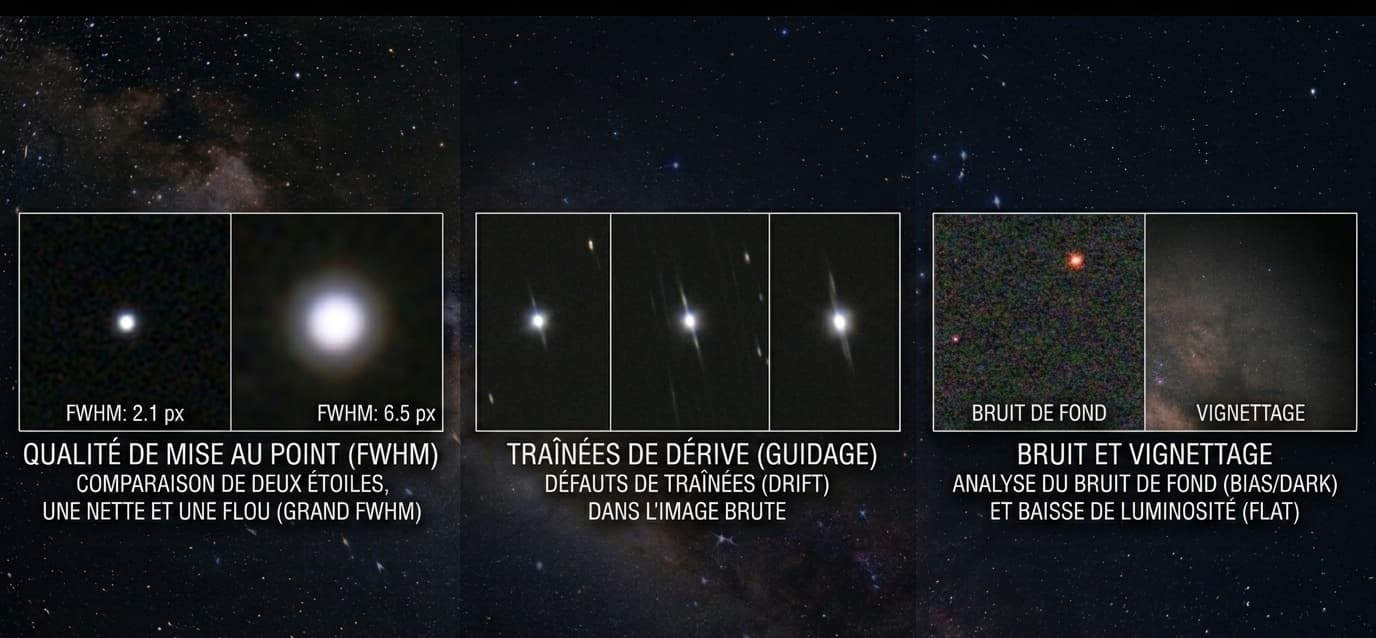
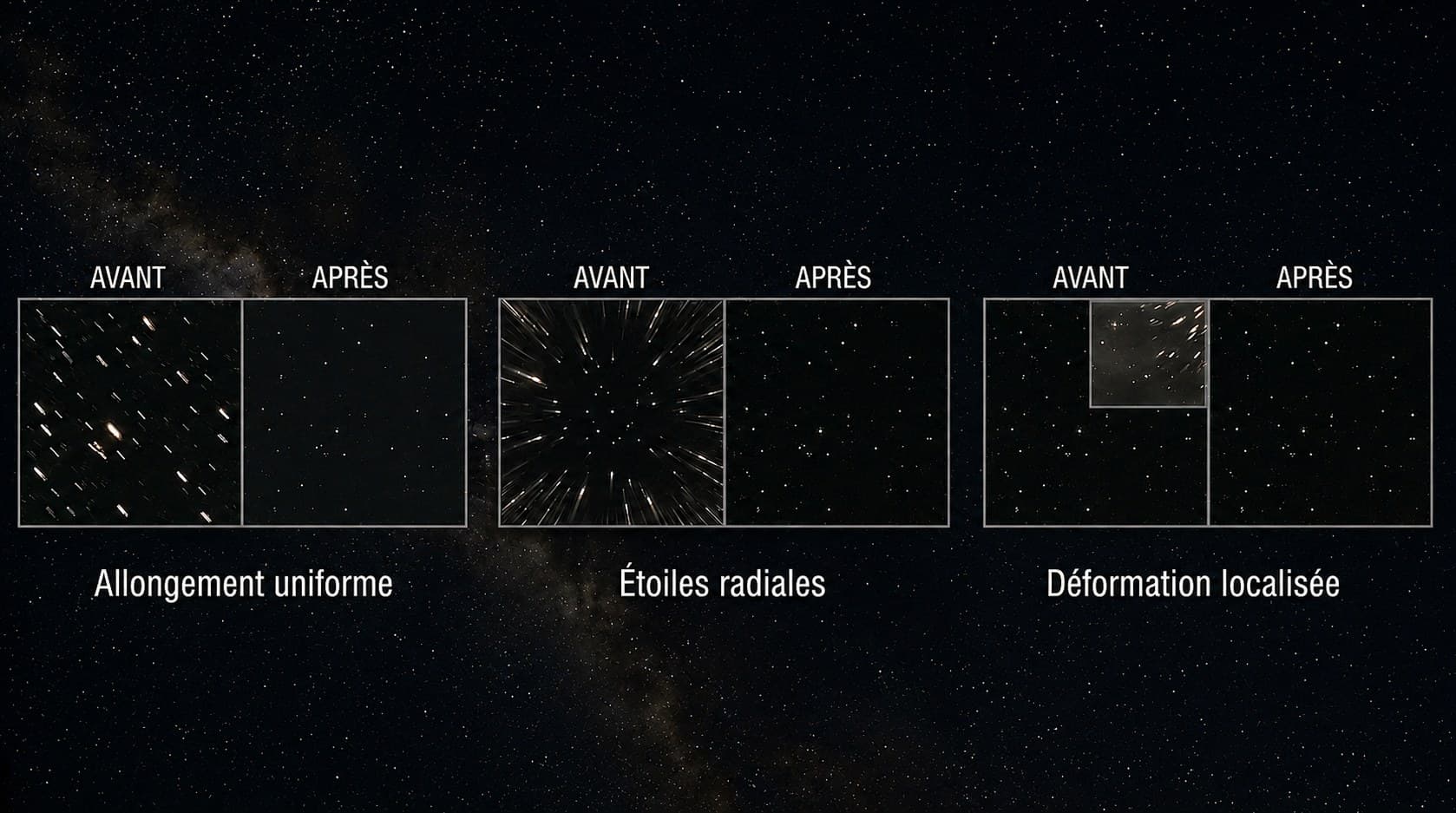
The hard point is optical. The PSF panel shows a clean center (FWHM 2.57px, elong 1.13) while the top-left and bottom-right corners climb to 3.82 and 3.05px with elongations of 1.46 and 1.39, whereas the top and bottom edges stay perfectly pinpoint (elong 1.03 and 1.08). This single-axis degradation, with a horizontal asymmetry of 0.132 against 0.022 vertical, is the signature of tilt rather than field curvature, which would degrade all four corners symmetrically.
A tracking component sits on top of it: central elongation of 1.13 exceeds the measured field floor (1.03) and PA dispersion stays low (24.4 deg), so a common stretch direction runs across the whole frame. It is modest and invisible to the eye on the preview, but it adds to the tilt in the corners and degrades overall sharpness. Order of attack: fix train coplanarity first, tracking next.
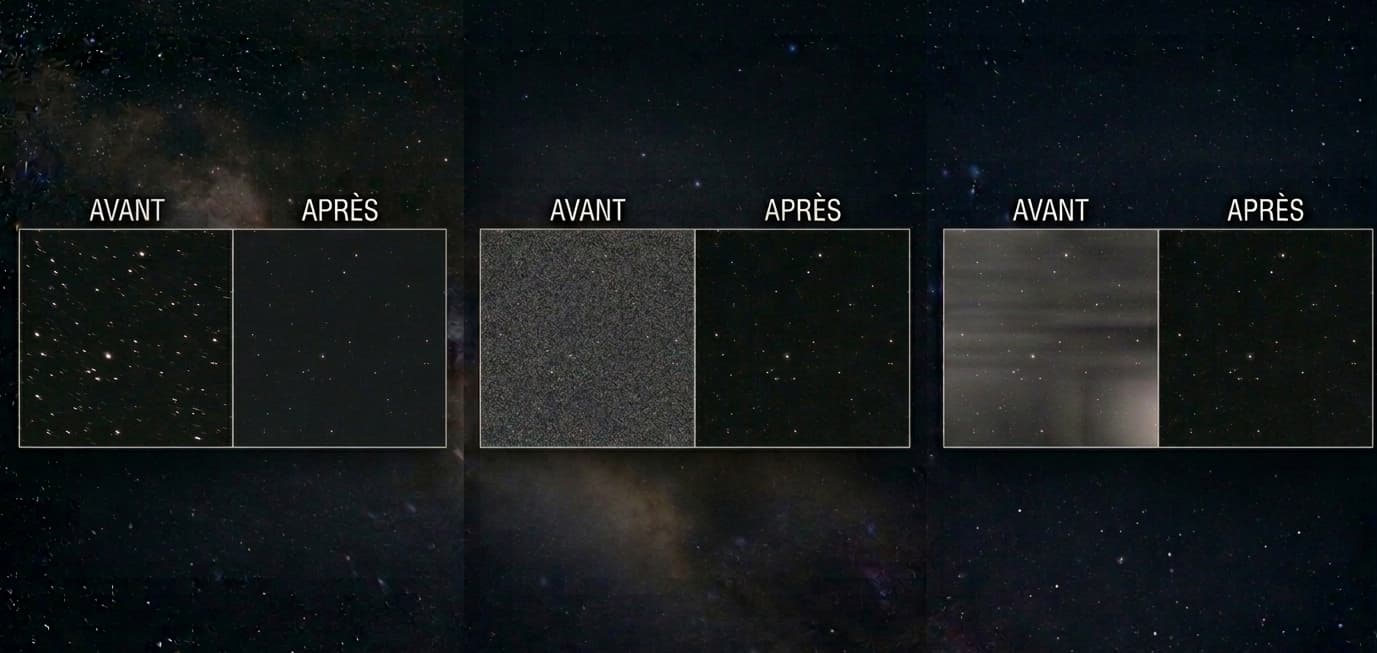
On the background, the DSS validates the Ha nebulosity at the top and bottom of the field, so it is not an artifact. But the diagonal ramp measured at 17% does not match it and is an illumination residual, to be redone with a careful background extraction using sample points placed away from nebulosity. The chromatic mottling in the background simply reminds that 2h55 is short for this faint field.
Priority actions
- Fix the sensor tilt: check imaging train coplanarity and iterate with an adjustable tilt plate
- Redo gradient extraction (GraXpert AI or DBE) on the linear image, excluding Ha areas from sampling
- Extend total integration beyond 6h to strengthen background SNR and reduce chroma noise
- Refine polar alignment and review the guiding log to remove the residual drift