Astrophotography diagnosis of Barnard 144 Panel 3: Light pollution gradient
MasterH 3nm50x300s27 juil. 2026
The Doc examined this image of Barnard 144 Panel 3 (master, H 3nm, 50x300s). Estimated overall technical quality: 7/10. 1 defect found: Light pollution gradient (severity 3/5).
&w=1920&q=75)
Info
- Cible
- Barnard 144 Panel 3
- Date
- 27 juil. 2026, 20:49
- Lune
- Croissant décroissant 2.9% (16° d'alt., 64.3° de la cible)
- Site
- Bortle 5 · banlieue résidentielle (saisi)
- Position
- 20h09m03s · +35°38'42"
Favourable conditions for this target. The actual moon context is a waning crescent at 2.9% illumination, 16 degrees above the horizon and 64 degrees from the target: the lunar contribution is negligible, so no moon gradient applies here. The entered Bortle 5 remains the limiting factor, but a 3nm Ha filter rejects most of that pollution, which matches the very low measured background. The residual 57% gradient at 17 degrees therefore points to a local light source or a modest target altitude late in the session. All else equal, shooting closer to the meridian will flatten that ramp.
Setup
- Type d'image
- Master
- Télescope
- Askar SQA70 Pro
- Caméra
- QHYminiCam8M
- Filtre
- H 3nm
- Monture
- TeSeek HM-17 PE
- Exposition
- 50x300s
- Phase de lune
- Gibbeuse croissante (97 %)
- FOV
- 1.86°
The setup fits the target well. At 338.9 mm focal length the 1.86 degree field suits a Barnard 144 panel, an extended region best covered as a mosaic: the framing is full and usable. Sampling at 1.765 arcsec/px is comfortable for typical seeing, and the measured 2.3 px FWHM, about 4 arcsec, confirms nothing is lost in resolution. The 3nm Ha is the right pick for Cygnus nebulosity under Bortle 5. On exposure, the 1.88 background-to-black-point margin and 19% dark clipping would flag underexposure in broadband, but at 300s through a narrow filter that is expected and not penalising: 50x300s gives a healthy 4h10 of integration.
The diagnosis in detail
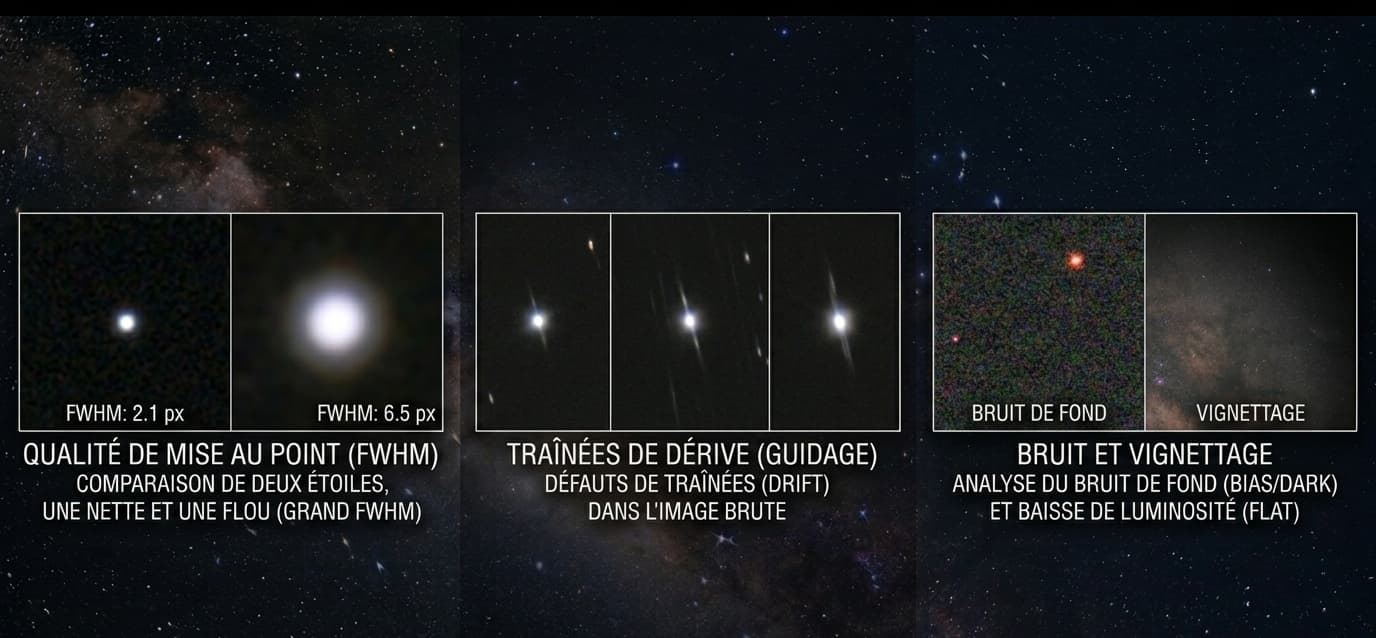
The PSF inspection is excellent. All nine zones give FWHM between 2.24 and 2.33 px with a corner/centre ratio of 1.009 and horizontal and vertical asymmetries of 0.03 and 0.008: the field is flat edge to edge, the sensor is square to the optical axis and backfocus is correct. Elongations of 1.04 to 1.08 stay at the field floor, ruling out any tracking or guiding component. On the panel the cyan ellipses sit cleanly on round stars in the four corners as well as at centre.
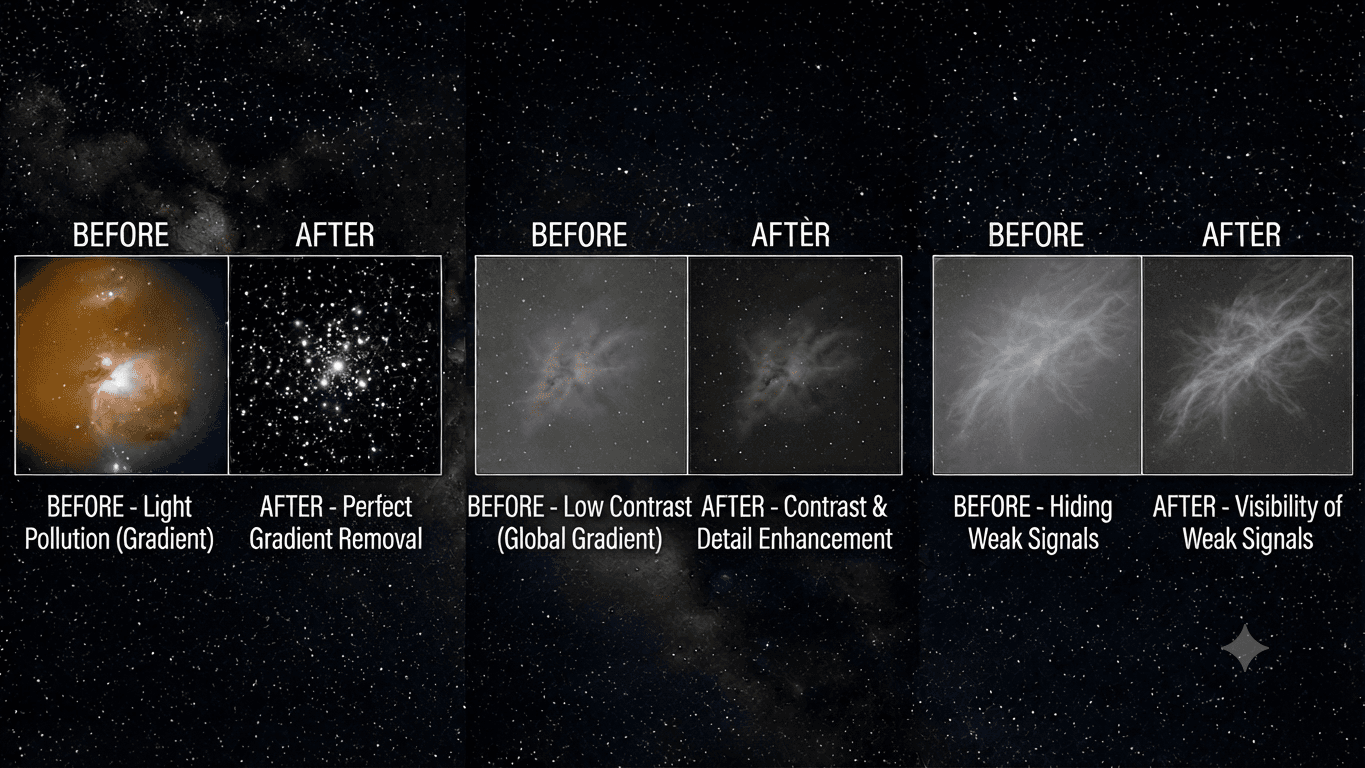
The one real defect is a background gradient. The illumination measurement gives a 57% amplitude plane oriented at 17 degrees, dominating the radial component six to one, with low azimuthal anisotropy: that is the signature of oriented pollution, not vignetting. Positional comparison with the DSS confirms this rise toward the upper right matches no real structure, while the wisps and dark clouds in the field do appear in the reference.
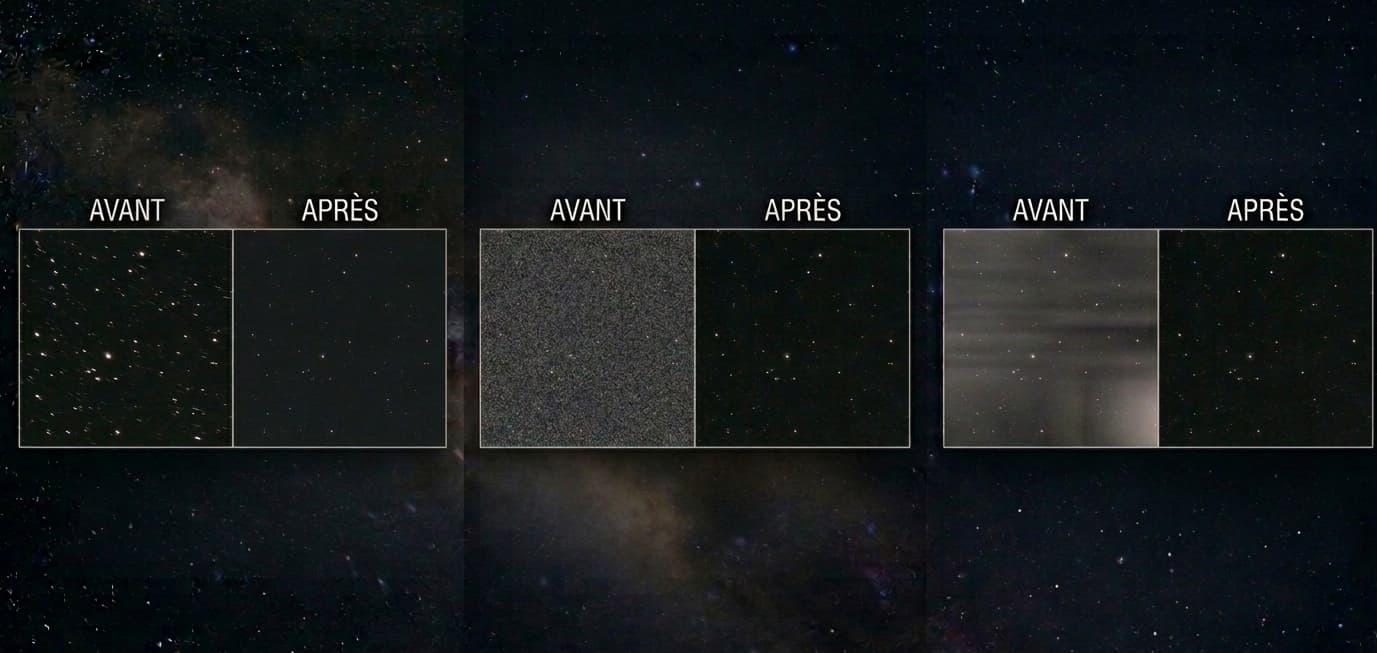
In practice the master is healthy: a careful gradient removal before stretching is all it needs to free the fine Ha wisps already present in the data.
Priority actions
- Remove the gradient on the master with GraXpert or DBE before any non-linear stretch
- Place background samples away from the Ha wisps so the nebulosity is not flattened
- Extend integration if you want to bring out the faintest Barnard 144 extensions
- Favour higher altitude windows to reduce the background ramp at capture time