Astrophotography diagnosis of LBN 576: Light pollution gradient, noise / underexposure and 1 other
Master12×300s19 oct. 2026
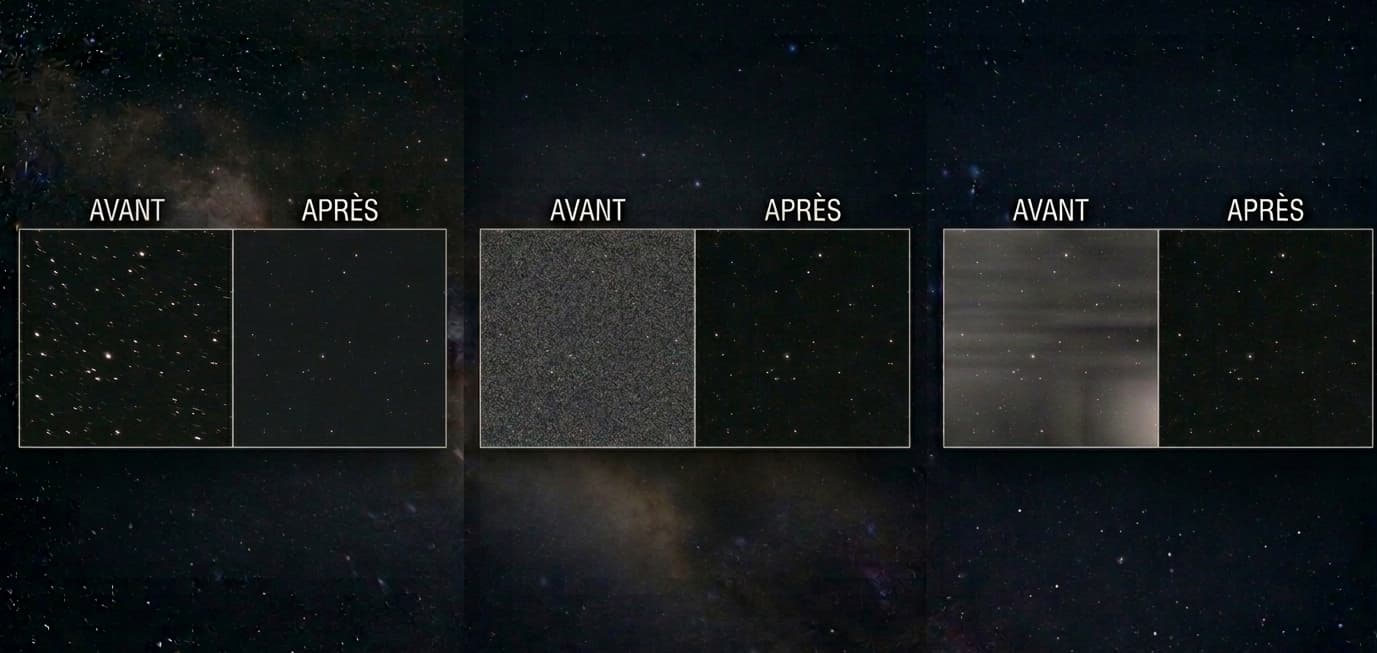
The Doc examined this image of LBN 576 (master, 12×300s). Estimated overall technical quality: 5/10. 3 defects found: Light pollution gradient (severity 3/5), Noise / underexposure (severity 3/5), Tracking drift (severity 2/5).

Info
- Cible
- LBN 576
- Date
- 19 oct. 2026, 19:50
- Lune
- Croissant décroissant 39.3% (20.2° d'alt., 91.3° de la cible)
- Site
- Bortle 4 · transition rural/banlieue (saisi)
- Position
- 0h01m06s · +62°12'06"
Moderately favourable conditions. Bortle 4 is fine for broadband, but the gibbous Moon (62% declared, 39% per the computed context) sitting 20 degrees above the horizon adds a background veil even at 91 degrees from the target, and that largely explains the measured ramp and the thin background-to-black-point margin. With 2.5 arcsec seeing, the measured FWHM around 4.5 px (about 6.5 arcsec) sits well above what the sky allowed, so the limiting factor is the tracking, not the atmosphere. For a broadband nebulosity this faint, aim for a moonless window with the target higher in the sky.
Setup
- Type d'image
- Master
- Télescope
- C11+Hyper+Uranus
- Caméra
- Poseidon-C PRO
- Exposition
- 12×300s
- Phase de lune
- Gibbeuse croissante (62 %)
- Seeing
- 2.5
- FOV
- 2.42°
The setup is coherent on paper: 540mm of focal length gives 1.44 arcsec/px, a comfortable sampling for 2.5 arcsec seeing, and a 2.42 degree field that comfortably frames LBN 576. The corners stay clean (corner/centre FWHM ratio 1.08), so the Hyperstar corrector is doing its job. Settings are healthy: gain 125, offset 50 with no dark clipping, sensor at -20C. That said, 300s only yields a background margin of 1.39, far from the sky-limited regime: under a Bortle 4 sky with a monochrome camera and no narrowband filter, you can push to 420 or 600s per sub if guiding allows, or simply stack many more subs.
The diagnosis in detail
The central issue with this master is the signal deficit. With 12 subs of 300s, one hour in total on a very diffuse reflection nebulosity, the background stays noise-dominated and no LBN 576 structure stands out. The histogram measurement confirms it: an e_margin of 1.39, far below the sky-limited threshold of 5 to 10. This is not a technical fault but a matter of cumulative exposure time.
On star shape, the aberration inspector is clear: elongation is already present at centre (1.15 against a field floor of 1.02) and position angles stay grouped within ten degrees across all nine zones. The corner/centre FWHM ratio of 1.078 rules out any field aberration. So this is a tracking or guiding drift, moderate but systematic. On a C11 at 540mm, differential flexure and imperfect polar alignment are the most likely suspects.
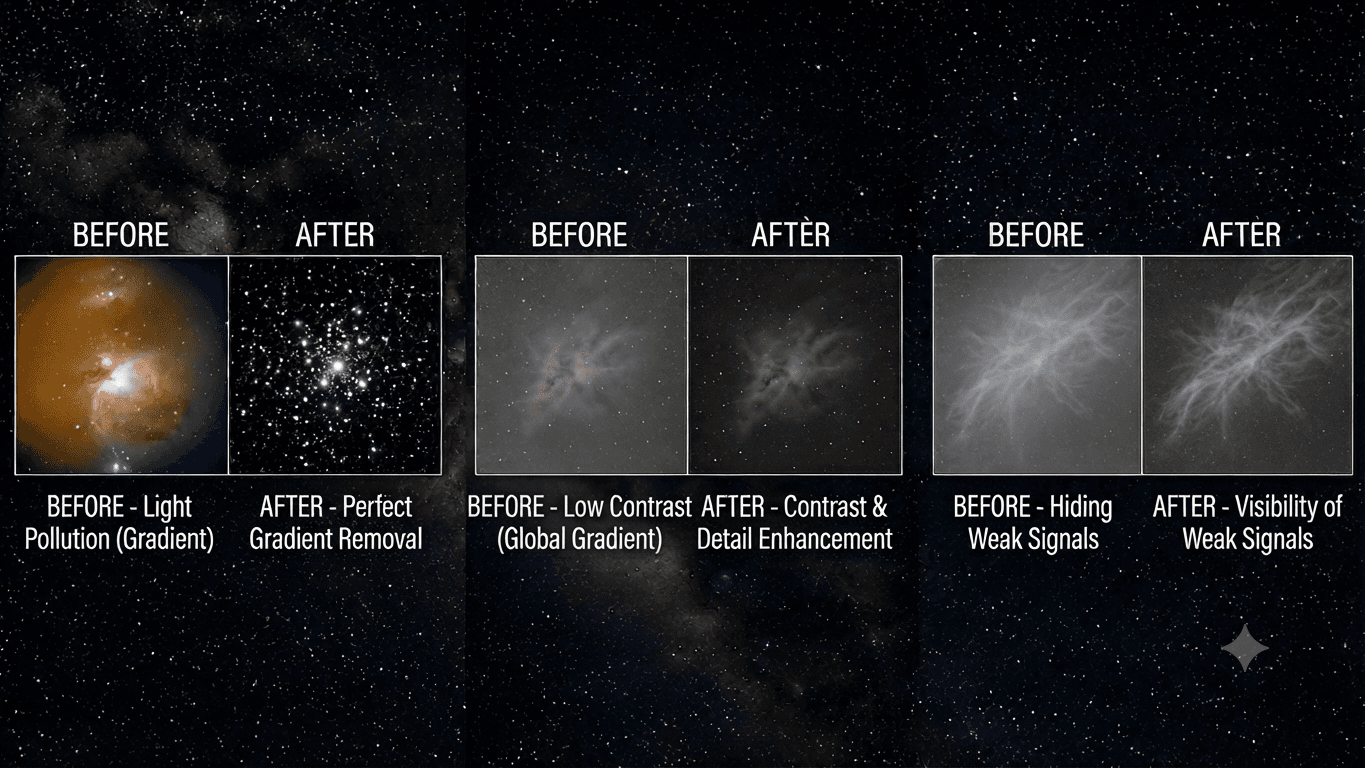
Finally, the background carries a 22% linear ramp oriented west, perfectly planar (R2=0.99) with no radial component. The low gibbous Moon contributes as much as residual light pollution. That part is fully fixable in post, unlike the first two points.
Priority actions
- Accumulate at least 5 to 8 hours of integration on LBN 576 to lift the nebulosity out of the noise
- Check polar alignment and review the PHD2 log to correct the drift measured at field centre
- Remove the 22% background ramp with GraXpert or DBE before any stretch
- Favour a moonless window for the next sessions on this faint target
- Test whether 420 to 600s subs stay usable once the guiding is cleaned up