Astrophotography diagnosis of M 31: Light pollution gradient and tracking drift
MasterH30x30023 sept. 2026
The Doc examined this image of M 31 (master, H, 30x300). Estimated overall technical quality: 6/10. 2 defects found: Light pollution gradient (severity 3/5), Tracking drift (severity 2/5).

Info
- Cible
- M 31
- Date
- 23 sept. 2026, 06:16
- Lune
- Croissant décroissant 12.8% (15.4° d'alt., 74.7° de la cible)
- Site
- Bortle 7 · périurbain pollué (saisi)
- Position
- 0h44m43s · +41°27'35"
Conditions were broadly favorable despite the Bortle 7 sky. The Moon, a 12.8% crescent 74.7 degrees from the target, contributes almost nothing: the measured gradient therefore comes from urban light pollution, not from it. The H-alpha filter is exactly the right call in this context, crushing most of the artificial skyglow and allowing 300s subs without saturating the background. The flip side shows in the histogram: the background-to-black-point margin of 1.94 is very low, but that is normal behavior for a narrow H-alpha filter, not genuine underexposure. In Bortle 7 on the HII regions of M31, this strategy is the right one, it simply needs more total integration.
Setup
- Type d'image
- Master
- Télescope
- Celestron Edge 11
- Caméra
- ZWO ASI2600MM Duo
- Filtre
- H
- Monture
- iOptron CEM70
- Exposition
- 30x300
- Phase de lune
- Waxing gibbous (90 %)
A coherent but demanding setup. The Edge 11 paired with the ASI2600MM Duo gives a tight field that covers only a portion of M31's arms, which is clearly intentional here since the frame targets the HII regions of the northeastern arm rather than the whole galaxy: a valid choice in H-alpha, not a framing defect. Sampling with 7.52 micron pixels stays reasonable, and the measured FWHM of ~5.3 px shows you are not oversampled to the point of losing signal. At this focal length, however, the CEM70 is working near its limit: the measured drift reflects that constraint directly. 30x300s in H-alpha is a good start, but doubling the integration would clearly improve the signal to noise of the faintest filaments.
The diagnosis in detail
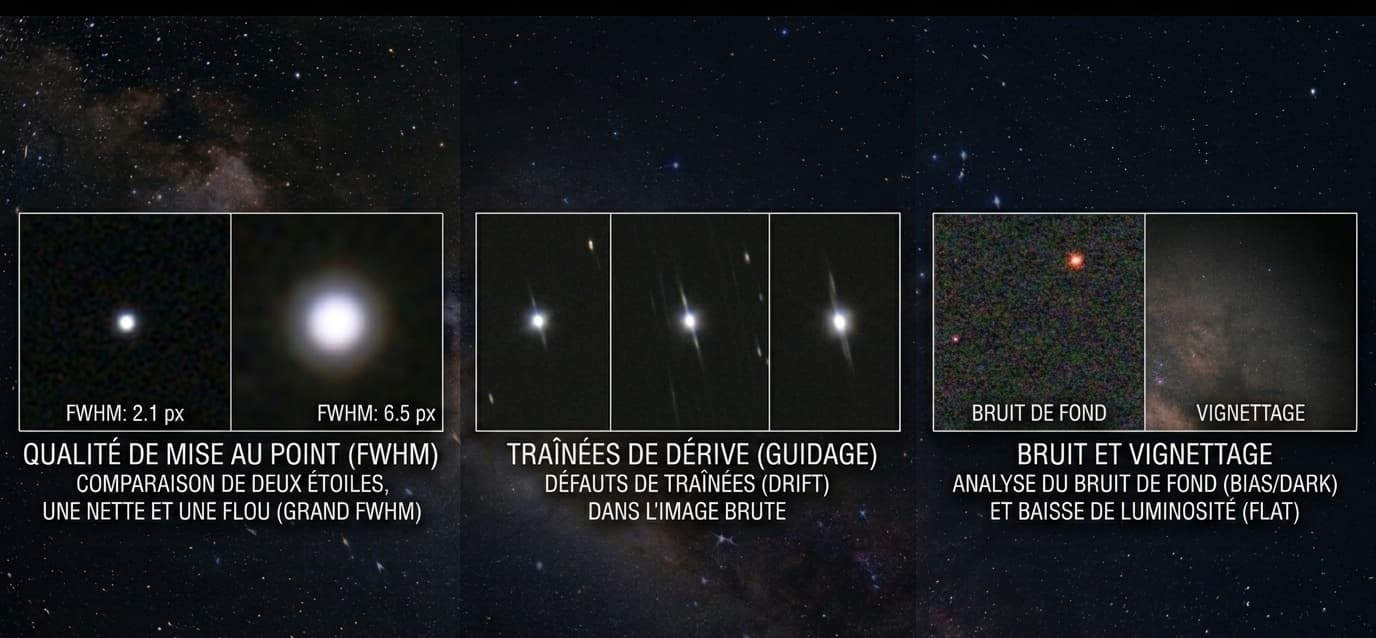
Only two findings, and they are independent. The first is optical in the broad sense: the PSF panel shows a remarkably uniform field, with FWHM between 5.03 and 5.53 px from corners to center, a corner/center ratio of 1.031 and near-zero horizontal and vertical asymmetry. In other words the optical train is well aligned and backfocus is correct. But the 1.20 elongation reaches all the way to the center, with a position angle stable to within 3.3 degrees across the whole field. An optical aberration never stretches the center that way: the signature is one of motion, hence tracking.
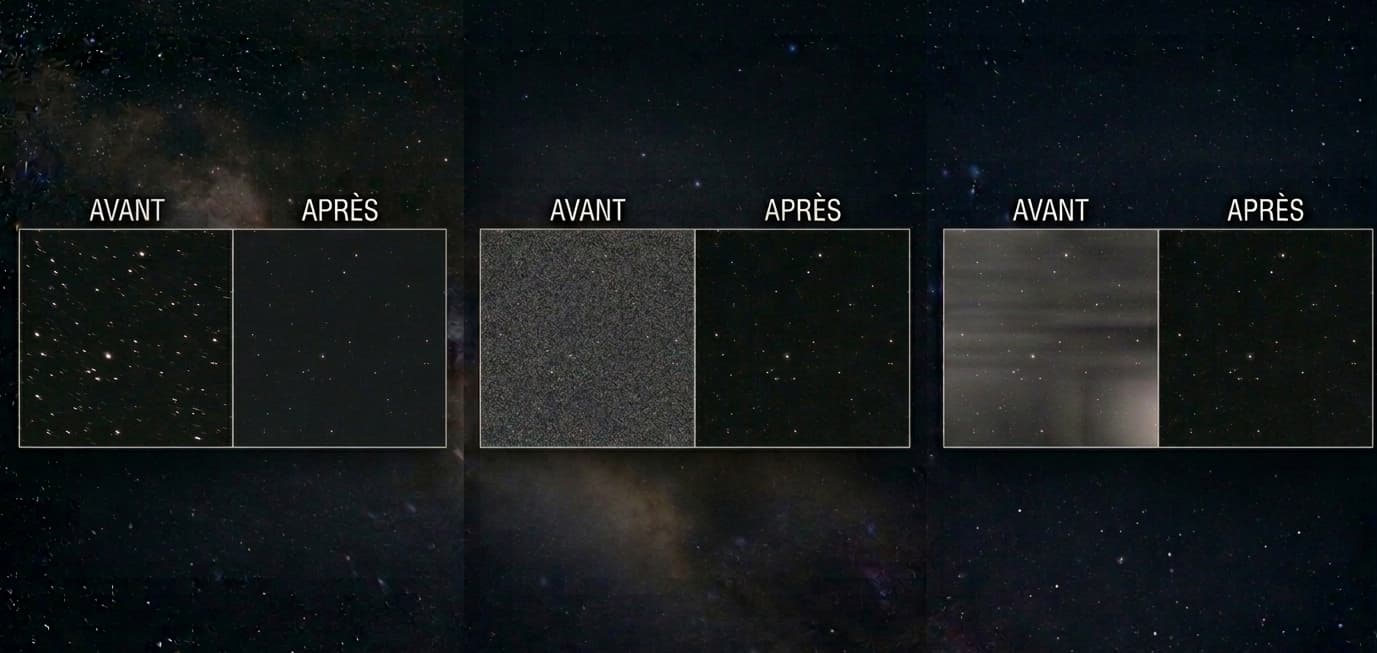
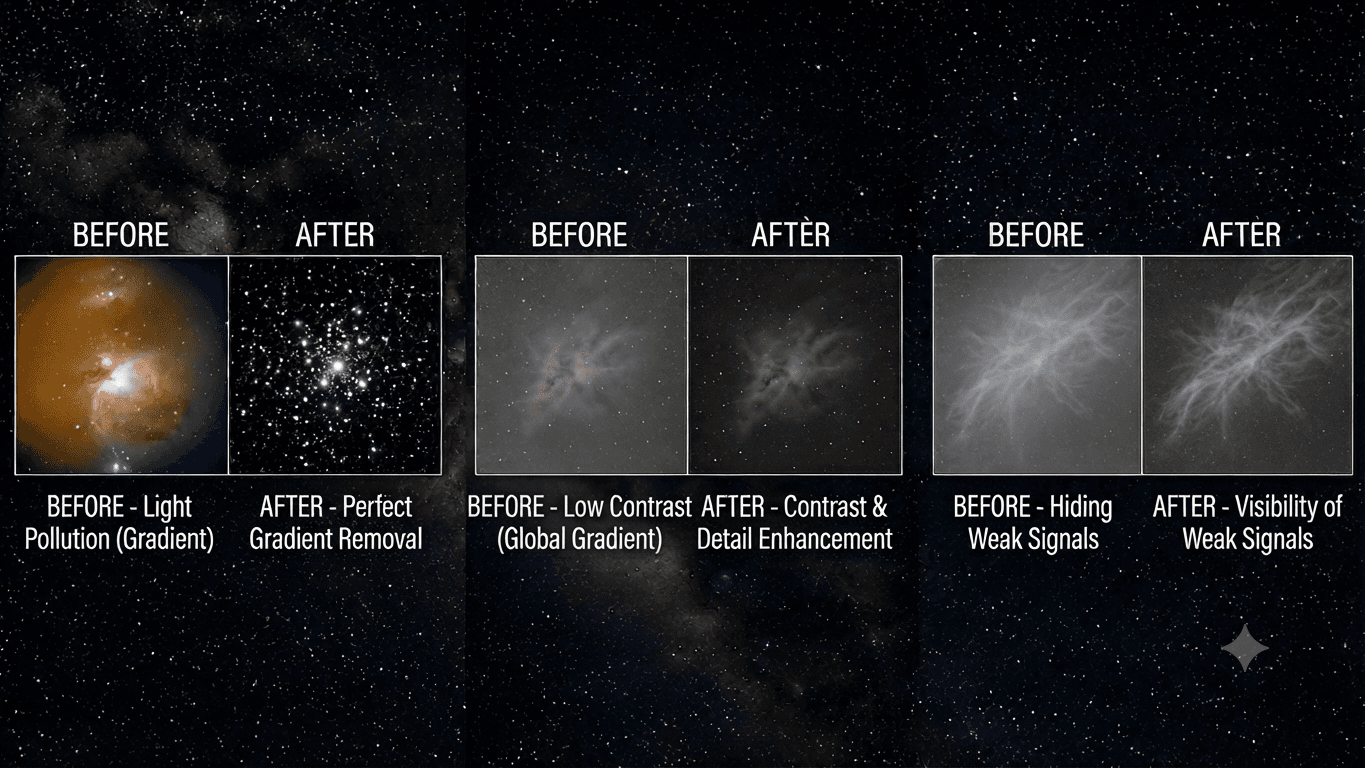
The second is the sky background. The plane model explains 78% of the background variance and dominates the radial profile by a factor of 25, which rules out residual vignetting or a mismatched flat. With a 37% amplitude oriented west-southwest and the Moon essentially absent, the source is ground-level light pollution.
The order of operations is clear: the gradient can be corrected in post with no loss, while tracking drift can only be fixed at acquisition. So polar alignment and guiding are what to work on for the next session.
Priority actions
- Apply a gradient extraction (GraXpert or DBE degree 1) on the master before any stretch
- Redo a careful polar alignment and check the PHD2 guiding RMS, target under 0.6 arcsec
- Double the integration time to strengthen the faintest H-alpha filaments
- Enable generous dithering between subs to make background subtraction easier