Astrophotography diagnosis of M27: Sensor tilt, light pollution gradient and 2 others
ProcessedUV ir cut60x5s
The Doc examined this image of M27 (processed, UV ir cut, 60x5s). Estimated overall technical quality: 7/10. 4 defects found: Sensor tilt (severity 2/5), Light pollution gradient (severity 2/5), Clipped stars (severity 2/5), Background chroma noise (severity 2/5).

Info
- Cible
- M27
- Site
- Bortle 3 · rural peu pollué (VIIRS)
- Position
- 19h59m36s · +22°43'12"
Very favorable conditions: Bortle 3 and a 5% moon give a naturally dark sky background, exactly what a fine planetary nebula like M27 needs in broadband with a simple UV/IR cut. The measured 14% gradient is therefore probably not urban in origin but rather stray light entering the open Flextube tube, or low-altitude scattering. With a sky like this, the real limiting factor is not the sky but total time: 5 cumulative minutes under Bortle 3 wastes enormous potential. Make the most of these moonless nights and aim for several hours.
Setup
- Type d'image
- Traitée
- Télescope
- Skywatcher Dobson Flextube 305/1500
- Caméra
- Pegasus astro smarteye
- Filtre
- UV ir cut
- Monture
- Dobson
- Exposition
- 60x5s
- Phase de lune
- 5%
- FOV
- 18.0'
The 305/1500 at f/4.9 over a 0.30 degree field suits M27 well, the nebula filling about a third of the frame: comfortable framing with room for the outer ansae. The measured FWHM around 3.1 to 3.9 px indicates fairly fine sampling, so seeing and tracking are the limits, not the optics. The weak point is the Dobson mount: 5 s per sub is a sound choice to avoid field rotation and drift, but it demands many subs to build signal. The UV/IR cut is the right call here; since M27 emits strongly in OIII and Ha, a dual-band could strengthen ansae contrast if you invest more time on it.
The diagnosis in detail
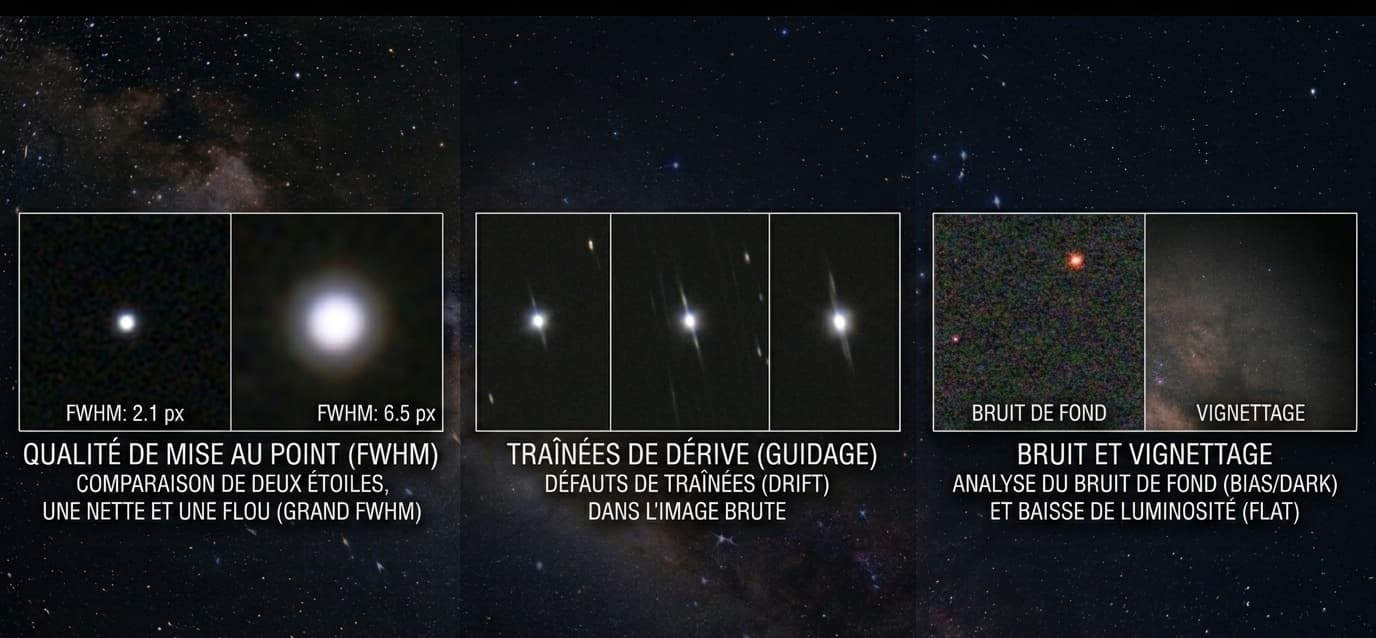
The headline finding is positive: the PSF plate shows round, regular stars across the whole field, with an elongation floor of 1.02 and corners never exceeding 1.10. For a 305 mm Newtonian on a Dobson mount, that is a solid result, showing collimation and focus are good and that 5 s subs effectively neutralize drift.
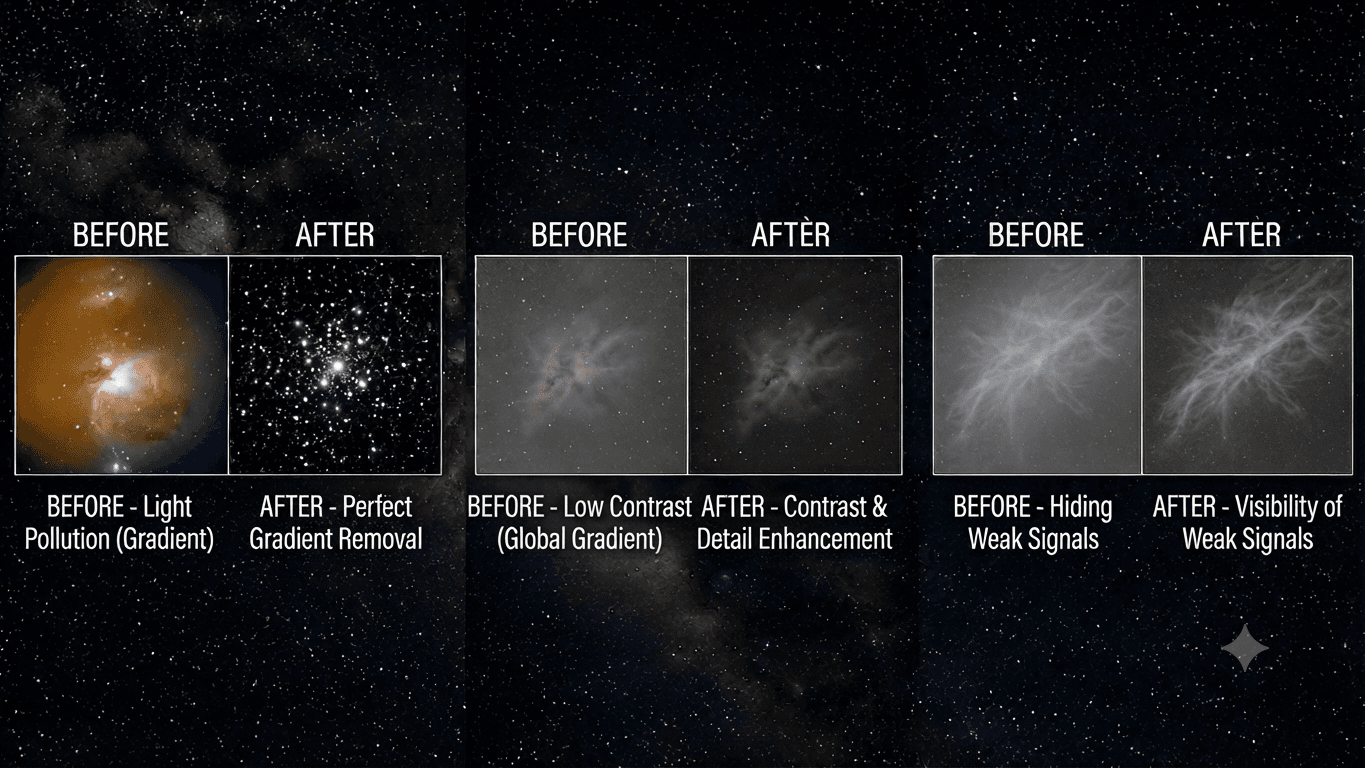
The two measured defects are second order and share a mechanical or environmental origin. The tilt, 0.11 vertical asymmetry between opposite corners with a corner/center ratio of 1.26, points to a slight squareness error in the optical train, typically play in the Crayford or unevenly tightened rings. The 14% gradient oriented at 313 degrees, very well modeled by a plane, signals grazing stray light in an open tube rather than urban pollution given Bortle 3.
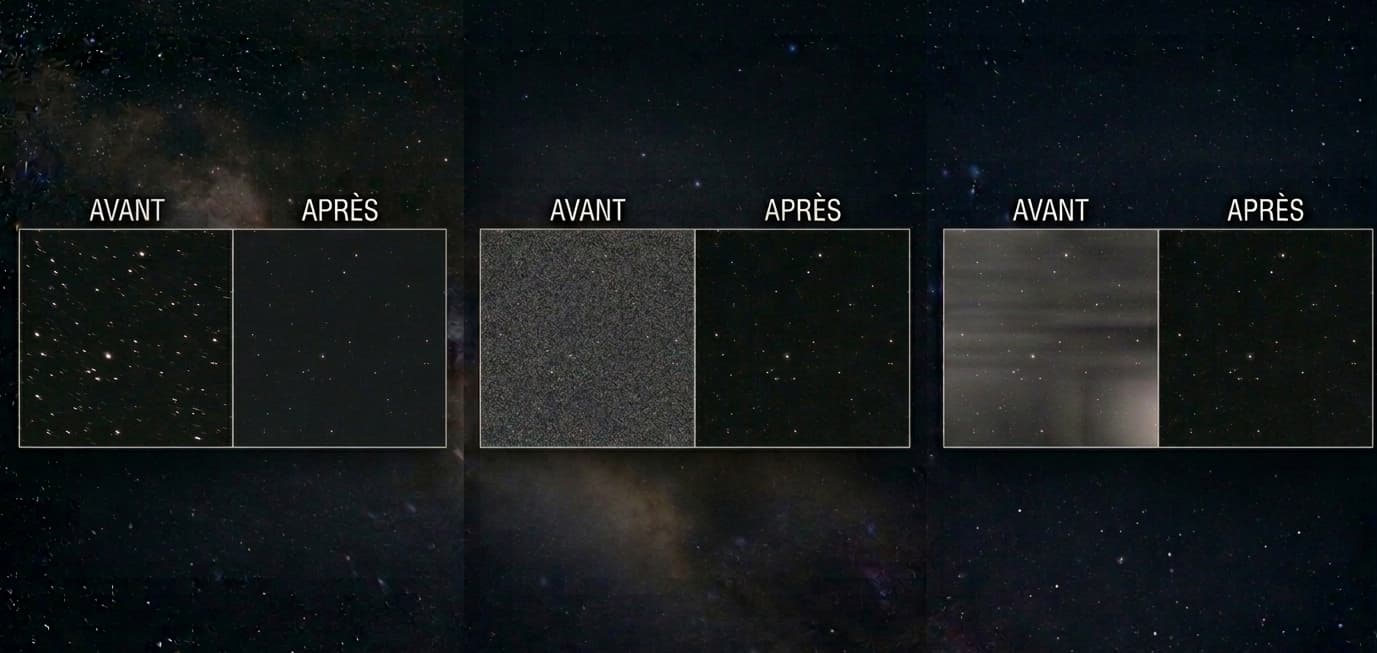
The rest comes down to exposure time: 5 cumulative minutes explain the background chroma noise and force a tight stretch, which clips the cores of bright stars. Multiplying integration by twenty would simultaneously solve the noise, allow a gentler stretch and preserve stellar colors.
Priority actions
- Massively increase total integration, aim for several hours of 5 s subs rather than 5 minutes
- Remove the residual gradient with GraXpert or DBE on the linear image, before stretching
- Fit a shroud or light shield on the open Flextube tube to block stray light
- Check focuser tightening and play to correct the slight measured tilt
- Soften the highlight curve to preserve the color of stellar cores