Astrophotography diagnosis of Draco Triplet: Sensor tilt, clipped stars and 1 other
ProcessedB, G, R, UV/IR cutUV/IR cut 60×180s · B 21×180s · G 24×180s · R 24×180s (total ~6.5 h)22 mai 2026
The Doc examined this image of Draco Triplet (processed, B, G, R, UV/IR cut, UV/IR cut 60×180s · B 21×180s · G 24×180s · R 24×180s (total ~6.5 h)). Estimated overall technical quality: 7/10. 3 defects found: Sensor tilt (severity 2/5), Clipped stars (severity 2/5), Background chroma noise (severity 2/5).
&w=1920&q=75)
Info
- Cible
- Draco Triplet
- Date
- 22 mai 2026, 00:00
- Position
- 15h39m36s · +59°19'48"
The 71% Moon has little impact on this broadband LRGB project on a galaxy trio, since the f/8 RC targets a compact object far from the Moon and the background stays well controlled. No declared light pollution and a dark background suggest a decent sky, but the background-to-black-point margin (e_margin 1.65) remains low for broadband under a gibbous Moon: the SNR of faint extensions and chroma noise suffer. For this kind of target, favoring moonless nights would clearly improve depth on the spiral arms of NGC 5985 and surrounding IFN.
Setup
- Type d'image
- Traitée
- Télescope
- GSO 10" f/8 Ritchey-Chretien Carbon Truss Tube
- Caméra
- QHYCCD QHY9M
- Filtre
- B, G, R, UV/IR cut
- Monture
- iOptron CEM120
- Exposition
- UV/IR cut 60×180s · B 21×180s · G 24×180s · R 24×180s (total ~6.5 h)
- Phase de lune
- 71%
- Notes
- Logiciels : PixInsight
- FOV
- 42.0'
The 10" f/8 RC (2000mm) paired with the QHY9M gives a 0.70° field, well suited to the Draco Triplet, which fits comfortably centered with margin. Sampling is tight (around 0.55"/px), so rather oversampled for typical seeing: the measured FWHM of 3.0-3.8 px confirms you are seeing/tracking limited, not optics limited, which is healthy. The very slight tilt noted suggests improving the flatness of the optical train at the RC focus. LRGB filters are appropriate for broadband galaxies.
The diagnosis in detail
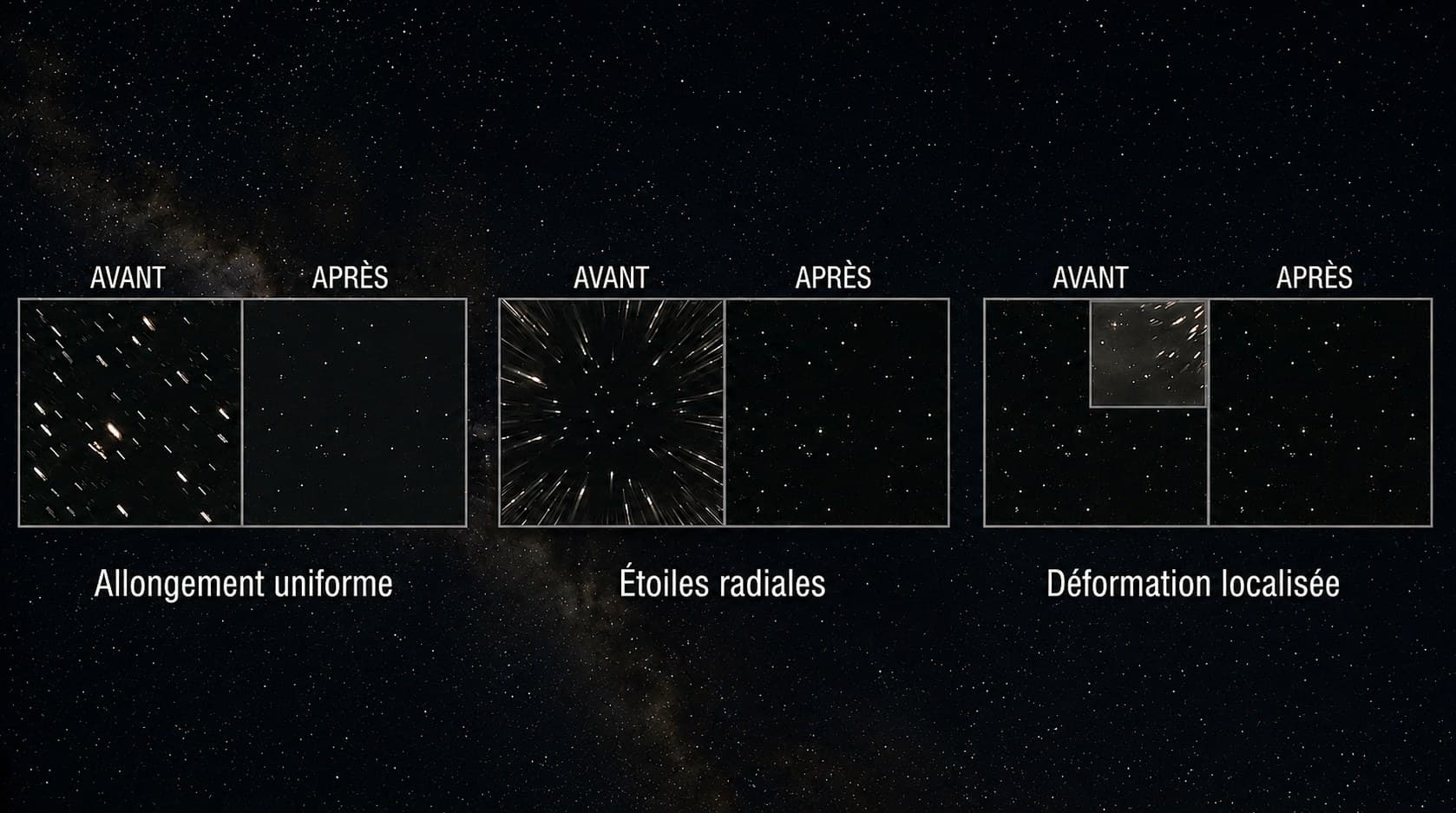
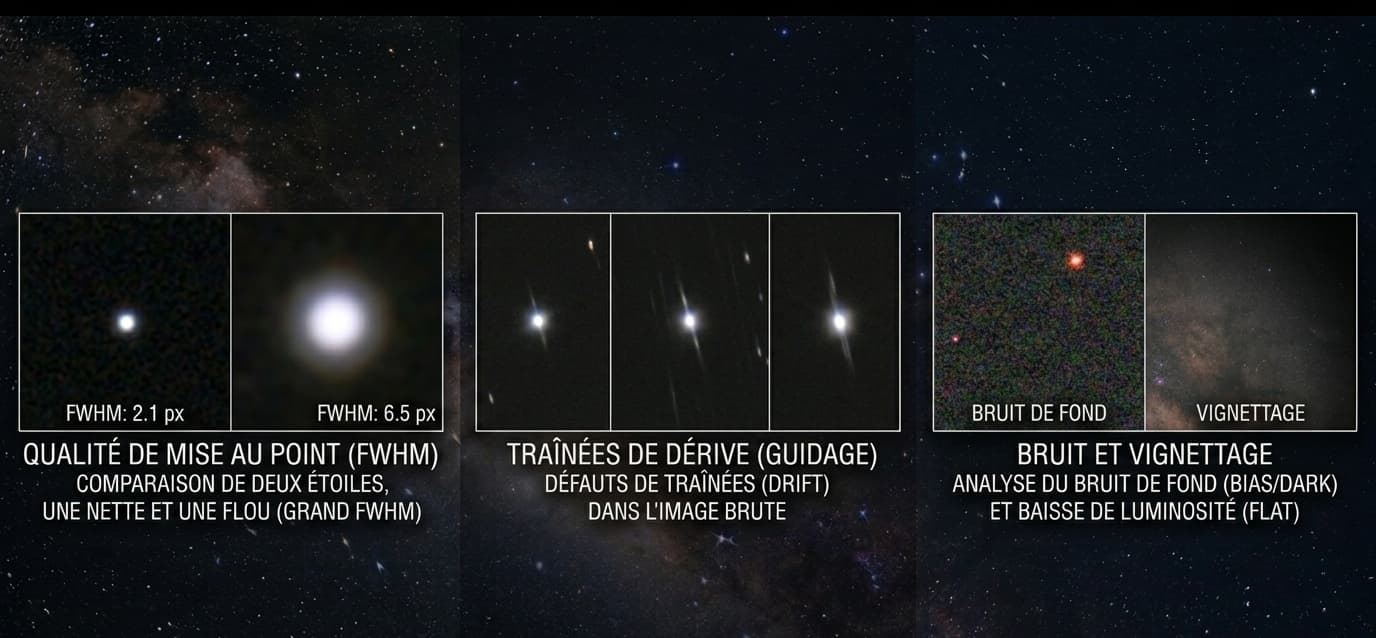
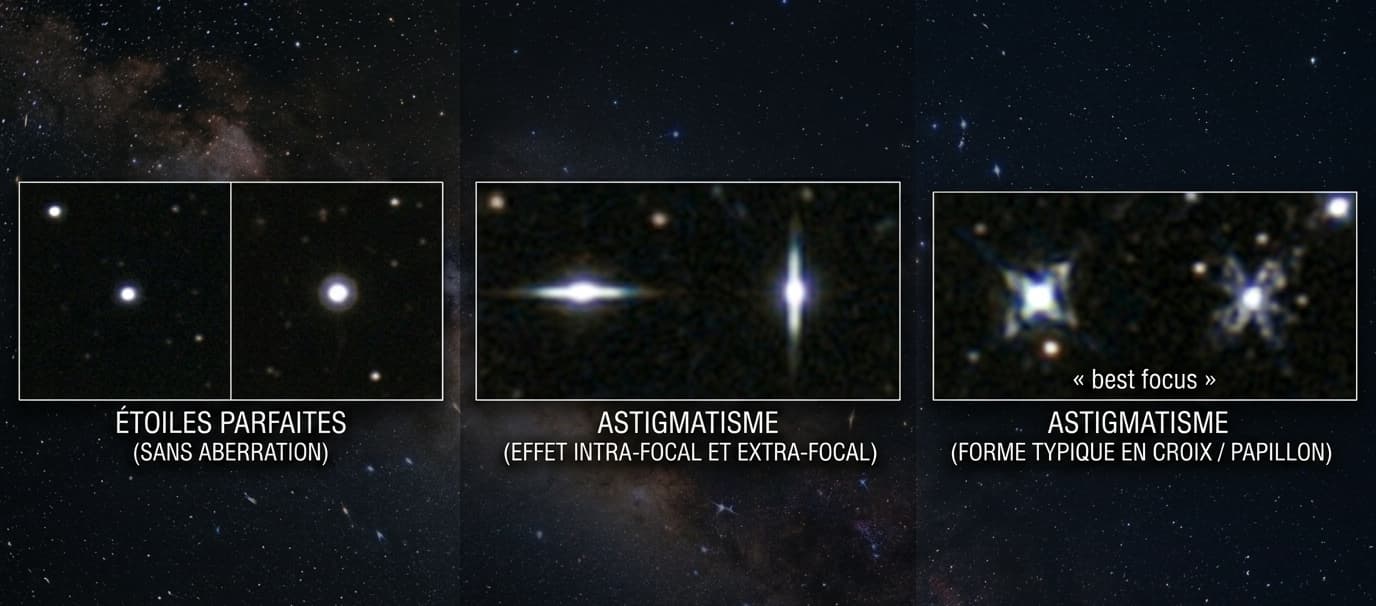
Optically and on tracking, the image is very clean: the aberration inspector gives a central elongation of 1.03 (floor 1.02) and a PA dispersion of 25 degrees, meaning essentially round stars. The tilt pre-verdict rests on a corner/center ratio of 1.20 (TR 3.77 px versus 3.07 in TL), but with all elongations staying under 1.05, the defect is real but marginal: simply attending to flatness at the RC focus will bring it within tolerance. The CEM120 tracking is excellent, with no drift or oscillation signature.
On processing, two points limit the rendering. A few bright stars have clipped white cores due to the lack of short layers, stripping the star field of its B-V hues. Above all, inspecting the background areas reveals slight chromatic mottling, a direct consequence of still-short color signal (21-24 subs per channel) and a low background-to-black-point margin (1.65). This chroma noise is the most improvable factor.
Comparison with the DSS confirms that all structures (the three galaxies, the faint companions, the background galaxies) are real, with no gradient or instrumental artifact to report in the background.
Priority actions
- Reduce background chroma noise (NoiseXTerminator/TGVDenoise on chrominance) and neutralize the background first
- Add integration time per color channel to boost SNR and reduce the mottling
- Improve the flatness of the optical train at the RC focus to resolve the slight corner tilt
- Capture a few short exposures per filter to rebuild the cores of bright stars