Astrophotography diagnosis of Filamentary Nebula: Astigmatism and sensor tilt
RawOXY150s16 sept. 2026
The Doc examined this image of Filamentary Nebula (raw, OXY, 150s). Estimated overall technical quality: 7/10. 2 defects found: Astigmatism (severity 2/5), Sensor tilt (severity 2/5).
&w=1920&q=75)
Info
- Cible
- Filamentary Nebula
- Date
- 16 sept. 2026, 05:27
- Lune
- Gibbeuse décroissante 74.6% (sous l'horizon)
- Site
- Bortle 5 · banlieue résidentielle (VIIRS)
- Position
- 20h47m24s · +30°58'50"
Favourable conditions for this target. The Moon is below the horizon during the exposure, so no lunar contribution despite a 74.6% waning gibbous phase and a 96.2 deg separation, which explains the very clean background and the absence of any oriented gradient (plane amplitude measured at just 1%, R2=0.01). Bortle 5 stays perfectly manageable in OIII: the narrowband filter cuts most of the residual light pollution, and the Veil is an ideal emission target in this context. Under this sky you can keep stacking subs without worrying about the background; most of the gain will come from total integration time rather than from chasing a darker site.
Setup
- Type d'image
- Brut
- Télescope
- EPSILON 160ED
- Caméra
- QHY268M
- Filtre
- OXY
- Exposition
- 150s
- Phase de lune
- Waxing crescent (23 %)
- FOV
- 1.68°
Setup very well matched to the target. At 796mm focal length and f/5, the 1.68 deg field frames the western Veil (NGC 6960 around 52 Cygni, visible at the bottom of the image) convincingly, even if the whole complex extends well beyond: this is either a mosaic panel or a deliberate section choice. Sampling at 0.974 arcsec/px is slightly oversampled for typical seeing, but the Epsilon 160ED supports it and it leaves room for binning 2 during processing. On the settings side, gain 56 and offset 35 are healthy, with no problematic dark clipping (1.04%). The low background to black point margin (e_margin 2.32) is NORMAL in OIII at 150s, do not fix it by raising gain. One thing to watch: sensor temperature at 0C, drop to -10C to limit dark current.
The diagnosis in detail
The sub is healthy on the essentials. The background follows a rotational symmetry (radial falloff of only 6%, plane/radial dominance 0.01, zero azimuthal anisotropy), so there is no oriented pollution or gradient to fix: it is simply normal optical vignetting before flats, which your calibration will absorb. The faint filaments at top right and the bottom arc match the DSS reference point for point: real signal, not artefacts.
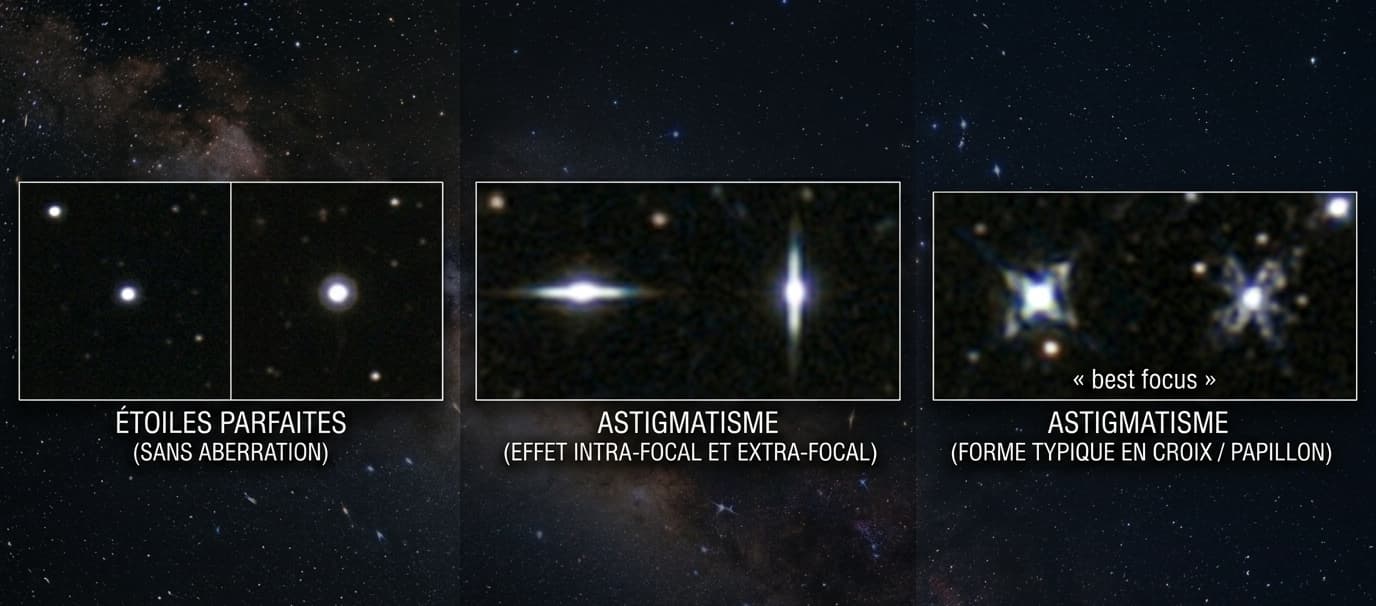
The only real issue is star shape at the periphery. The centre is excellent (FWHM 3.97 px, elong 1.11 against a field floor of 1.07), but elongation rises to 1.24 on the left edge, 1.31 on the right and 1.33 in the bottom-left corner. FWHM itself only climbs 16% from centre to corner: the classic signature of field astigmatism, not of edge defocus. On top of that sits a tilt component, revealed by a horizontal FWHM asymmetry of 0.252 against 0.09 vertically: the left side of the sensor is clearly more degraded than the right.
In practice both are addressed in the same place: the imaging train. Start with the mechanics (tightening, measured backfocus, focuser play) before suspecting the corrector. On a stacked integration these edge defects will remain visible, stacking will not average them out.
Priority actions
- Check even tightening and the exact mechanical backfocus of the imaging train (corrector, filter holder, adapter) before the next session
- Correct tilt on the left side of the sensor if an adjustment plate is available, then shoot a control aberration panel
- Lower sensor temperature to -10C instead of 0C to limit dark current
- Keep the 150s OIII exposure and favour longer total integration rather than raising gain