Astrophotography diagnosis of Filamentary Nebula: Tracking drift and sensor tilt
RawOXY150s11 août 2026
The Doc examined this image of Filamentary Nebula (raw, OXY, 150s). Estimated overall technical quality: 6/10. 2 defects found: Tracking drift (severity 3/5), Sensor tilt (severity 2/5).
&w=1920&q=75)
Info
- Cible
- Filamentary Nebula
- Date
- 11 août 2026, 08:42
- Lune
- Gibbeuse croissante 97.5% (sous l'horizon)
- Site
- Bortle 5 · banlieue résidentielle (VIIRS)
- Position
- 20h47m25s · +30°59'57"
Favorable conditions for this target. The Moon is below the horizon, so no lunar contribution is expected despite the high phase: that factor can be ruled out. Bortle 5 is an average site, but in OIII on a supernova remnant the narrowband filter kills most urban light pollution, which the measured background confirms (plane gradient of only 1%, R² 0.01, so no usable orientation). The one thing to watch is the 5.4 px central FWHM, about 5.3" at your sampling: part of it comes from the drift, the rest from seeing. On a steadier night you would gain a lot of detail on the filaments.
Setup
- Type d'image
- Brut
- Télescope
- EPSILON 160ED
- Caméra
- QHY268M
- Filtre
- OXY
- Exposition
- 150s
- Phase de lune
- Waning crescent (3 %)
- FOV
- 1.68°
The Epsilon 160ED at 796mm f/5 with the QHY268M suits the Veil very well: 1.68° of field frames NGC 6960 and its southern filament cleanly, and the DSS confirms nothing essential is cut off. Sampling at 0.974"/px is a bit fine for average seeing, so binning 2 in processing would buy SNR with no real loss of detail. On settings: gain 56 and offset 35 are sensible on this sensor, and above all the 3.43% dark clipping with e_margin at 2.32 is not a sign of underexposure here, it is normal behavior for a narrow OIII exposure on a dark background. Sensor temperature at -4°C is on the high side though: go down to -10 or -20°C to limit dark current and make your darks more reliable.
The diagnosis in detail
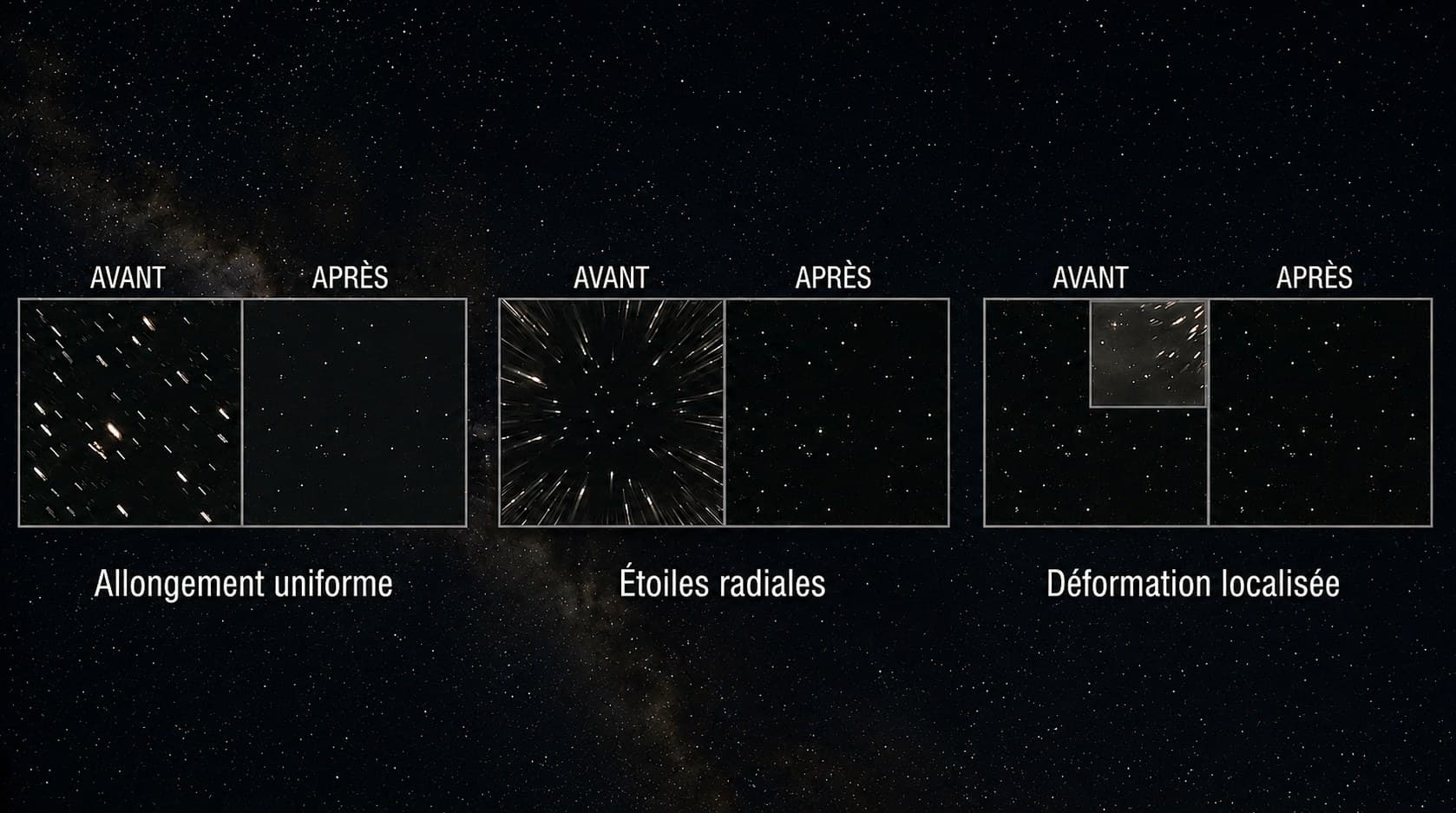
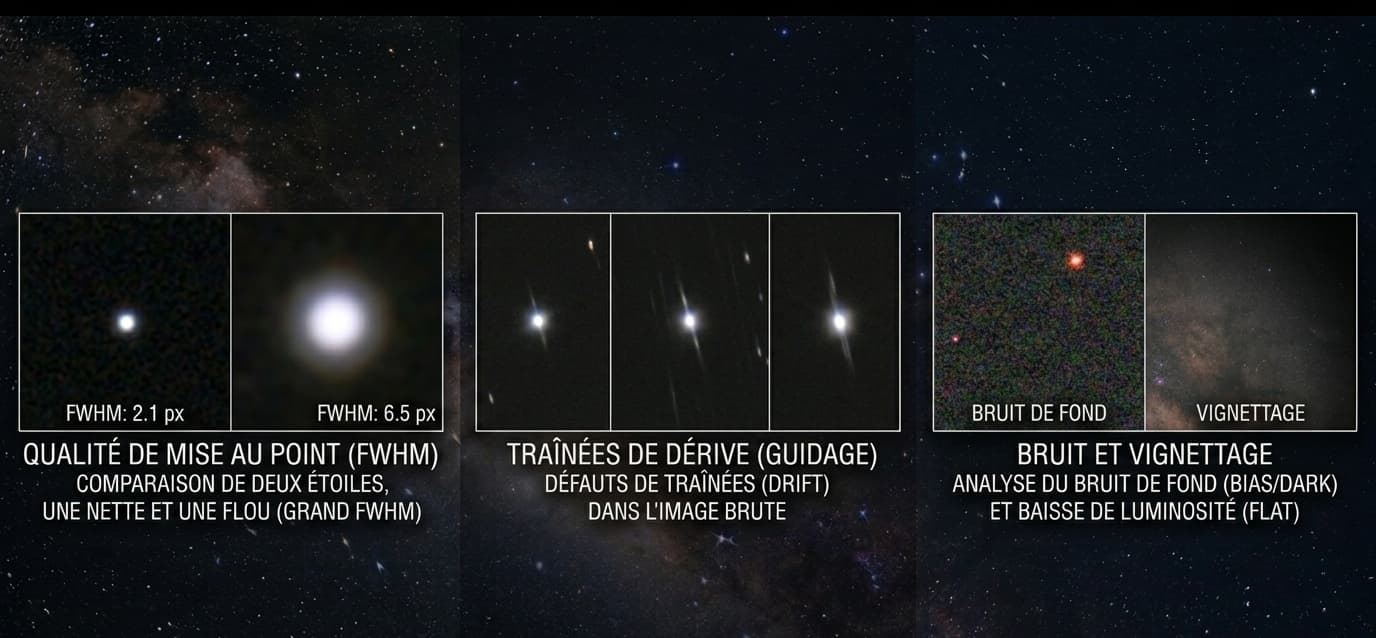
The dominant issue is star shape. The elongation is not confined to the edges, it is already present at the center of the field (1.15 against a 1.05 floor) and the major axes all point in a similar direction, with only 18.9° of spread. A field aberration would instead leave a clean center and degrade radially: here the cause is mechanical, the mount drifted during the 150s.
A second, subtler component sits on top. FWHM is consistently larger on the left (6.3 to 6.5 px) than on the right (4.9 px), while the vertical axis is nearly symmetric. This single-axis asymmetry, with an intermediate center, is the classic signature of a tipped focal plane. It stays moderate, about 30% spread, and is fixed by a mechanical adjustment rather than a full rebuild of the optical train.
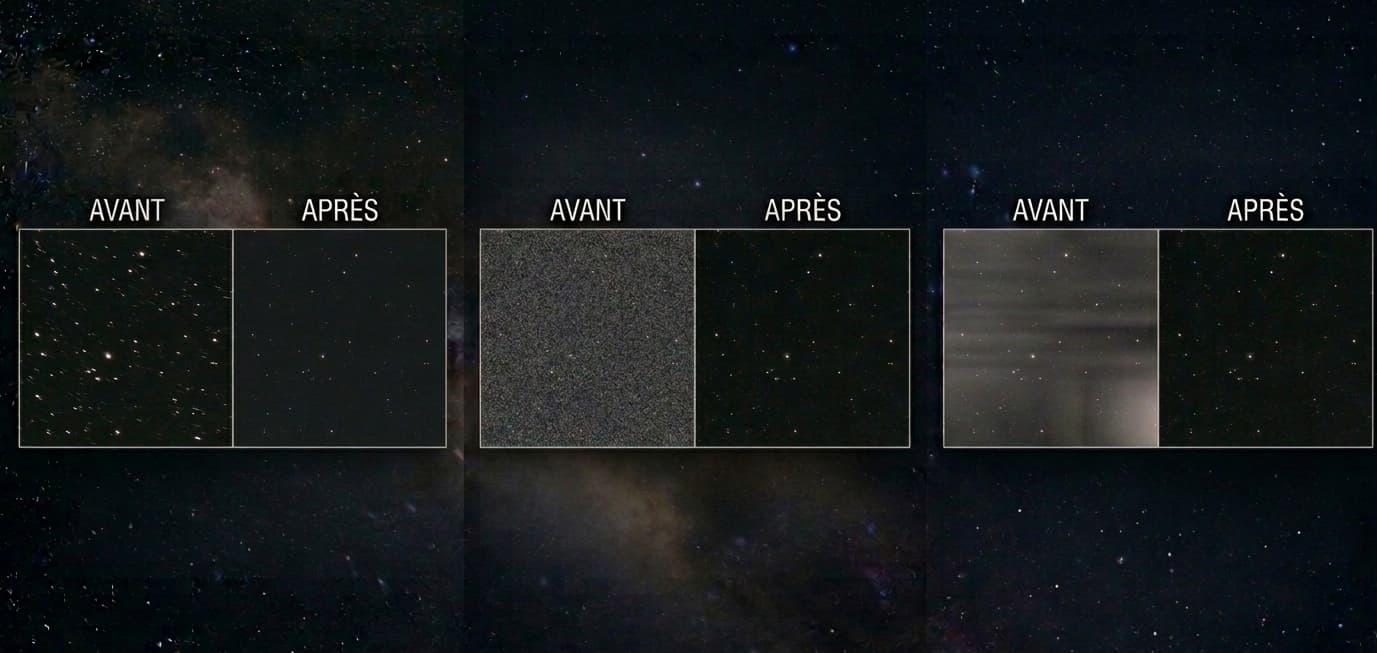
The rest is healthy: the measured background is radially symmetric with only a 7% falloff toward the edges, with no oriented gradient, and the visible nebulosity matches the DSS filaments exactly. This sub is stackable as is, but you will get a far better result by fixing the tracking first.
Priority actions
- Redo polar alignment and check the PHD2 guiding RMS before the next session, that is the most immediate gain in star sharpness
- Adjust optical train tilt with an adjustable tilt ring, iterating on the left/right FWHM asymmetry
- Cool the sensor to -10 or -20°C and reshoot darks at that setpoint
- If drift persists despite good polar alignment, shorten subs to 90-120s to limit the trailing