Astrophotography diagnosis of HIP 106890_biss: Sensor tilt and tracking drift
Raw300s17 juil. 2026
The Doc examined this image of HIP 106890_biss (raw, 300s). Estimated overall technical quality: 7/10. 2 defects found: Sensor tilt (severity 3/5), Tracking drift (severity 2/5).
&w=1920&q=75)
Info
- Cible
- HIP 106890_biss
- Date
- 17 juil. 2026, 22:22
- Lune
- Gibbeuse décroissante 83.9% (sous l'horizon)
- Site
- Bortle 2 · rural typique (VIIRS)
- Position
- 21h36m29s · +57°32'40"
Exceptional sky: Bortle 2 (VIIRS) gives a very dark background and excellent SNR potential on this emission target. The Moon is below the horizon (waning gibbous at 83.9% but at 115.6deg and not risen): no lunar contamination possible, moon gradient excluded. Near-optimal conditions for a long Hα session on IC 1396; you can stack many 300s subs with no pollution concern. The only limiting factor is mechanical (tracking/tilt), not the sky.
Setup
- Type d'image
- Brut
- Télescope
- EQMod Mount
- Caméra
- ZWO ASI585MM Pro
- Exposition
- 300s
- Phase de lune
- Premier croissant (11 %)
- FOV
- 1.70°
Consistent setup for IC 1396. At 375mm focal length, the 1.70deg field frames the Elephant's Trunk and its surroundings well, with margin. The 1.595 arcsec/px sampling is comfortable and well matched to typical seeing (neither over- nor under-sampled), confirmed by center FWHM around 1.6-1.9px. On settings: gain 252 is high but the histogram shows no clipping (0% dark, 0% saturated), offset 15 holds the shadows, and cooling to -15C is healthy. The e_margin of 1.93 is low but NORMAL in narrowband Hα: the background logically stays low, no need to lengthen the exposure.
The diagnosis in detail
This Hα sub starts from an excellent baseline: Bortle 2 sky, controlled exposure (no clipping, cooling at -15C), and well-calibrated sampling. The dark nebulosity and gas wisps visible match the real structure confirmed by the DSS (IC 1396 / Elephant's Trunk), so this is not a gradient artifact. The measured background shows a radial darkening of +19% (optical vignetting) but, on a raw sub, that is normal before flats: it is not reported as a defect.
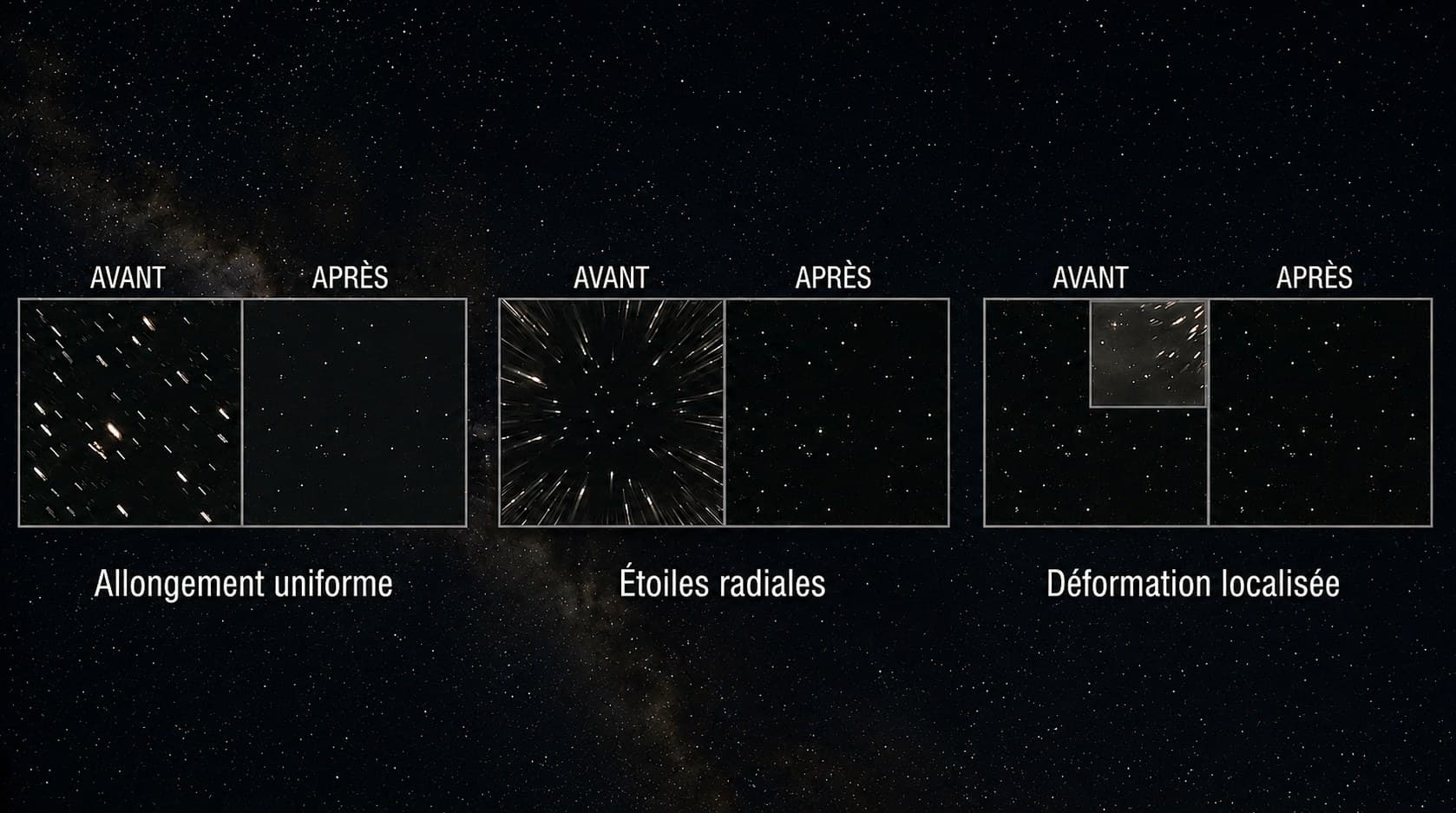
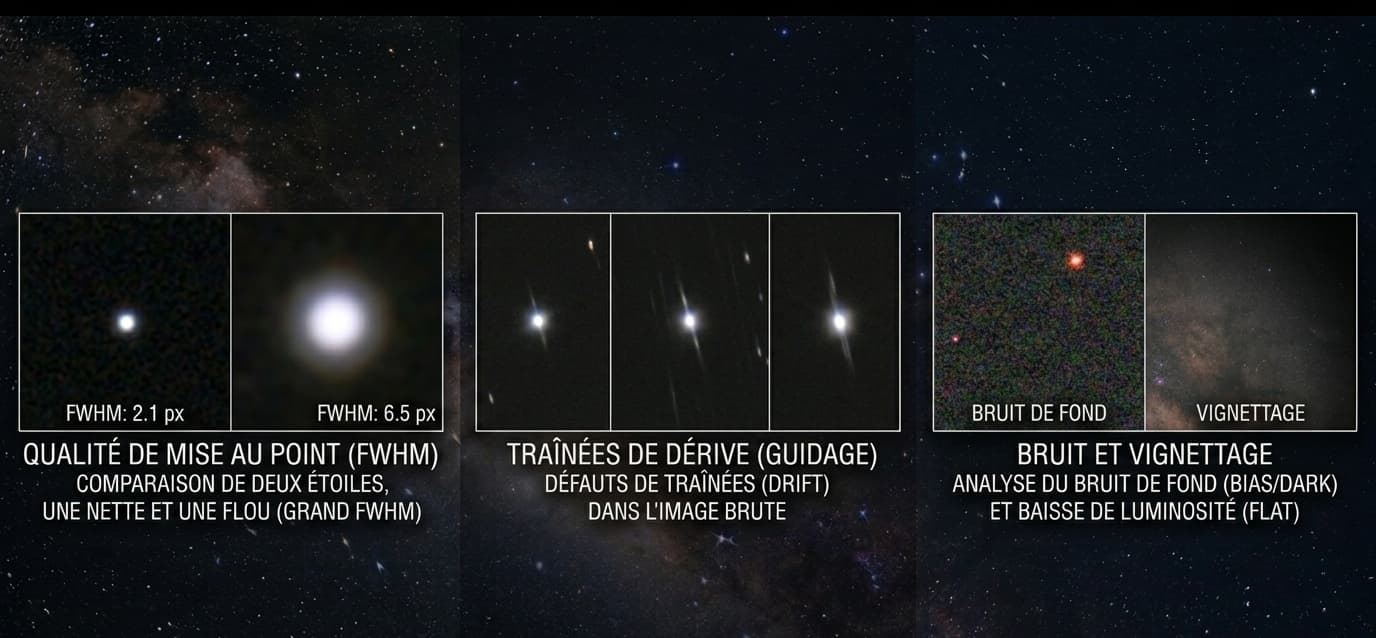
The two real points of attention come from star shape, revealed by the PSF panel. First a sensor tilt: the bottom of the field (BL elong 1.35, BR 1.30) is clearly more bloated than the top (TL/TR 1.08), with a horizontally dominant FWHM asymmetry and a corner/center ratio of 1.27. Then a slight tracking drift, elongation persisting to the center (1.14 vs a floor of 1.08) with consistent orientation (PA dispersion 23deg).
Priority goes to the tilt adjustment, which has the most visible impact at the field edges; the drift stays subtle on this single exposure but is worth confirming and tightening across the series. The potential of this target under this sky is excellent once these two points are corrected.
Priority actions
- Adjust the sensor tilt (push-pull plate) until the 4 corners' FWHM match, re-measuring on a test sub
- Evenly tighten every joint of the imaging train to remove mechanical slack
- Refine polar alignment and enable/optimize autoguiding to remove residual drift over 300s
- Acquire flats to correct the optical vignetting (+19%) during processing