Astrophotography diagnosis of HIP 106890: Sensor tilt
Master42×300s13 juil. 2026
The Doc examined this image of HIP 106890 (master, 42×300s). Estimated overall technical quality: 7/10. 1 defect found: Sensor tilt (severity 3/5).
&w=1920&q=75)
Info
- Cible
- HIP 106890
- Date
- 13 juil. 2026, 01:52
- Lune
- Gibbeuse croissante 97.4% (sous l'horizon)
- Site
- Bortle 2 · rural typique (VIIRS)
- Position
- 21h38m58s · +57°28'01"
Excellent conditions for this emission target: Bortle 2 and the Moon below the horizon (no moon glow despite the 97% gibbous phase). The sky background is very dark and even, which explains the absence of any measured gradient or vignetting. On a Ha nebula under this sky you are limited by seeing and signal, not by the background: nothing to change on the sky side, this is a night to exploit fully with a long stack.
Setup
- Type d'image
- Master
- Télescope
- EQMod Mount
- Caméra
- ZWO ASI585MM Pro
- Exposition
- 42×300s
- Phase de lune
- Dernier croissant (3 %)
- FOV
- 1.70°
Setup consistent with the target: at 375 mm focal length the 1.70 deg field frames a fragment of IC 1396 well, and the 1.60 arcsec/px sampling is comfortable for wide nebular fields (central FWHM ~2.3 px, well resolved, no oversampling). Gain 200 and cooling to -12.5C are healthy. The background/black-point margin e_margin=2.62 and 45% dark clipping would flag underexposure in broadband, but in narrow Ha this faint background at 300s is NORMAL: do not worry, keep stacking 300s subs.
The diagnosis in detail
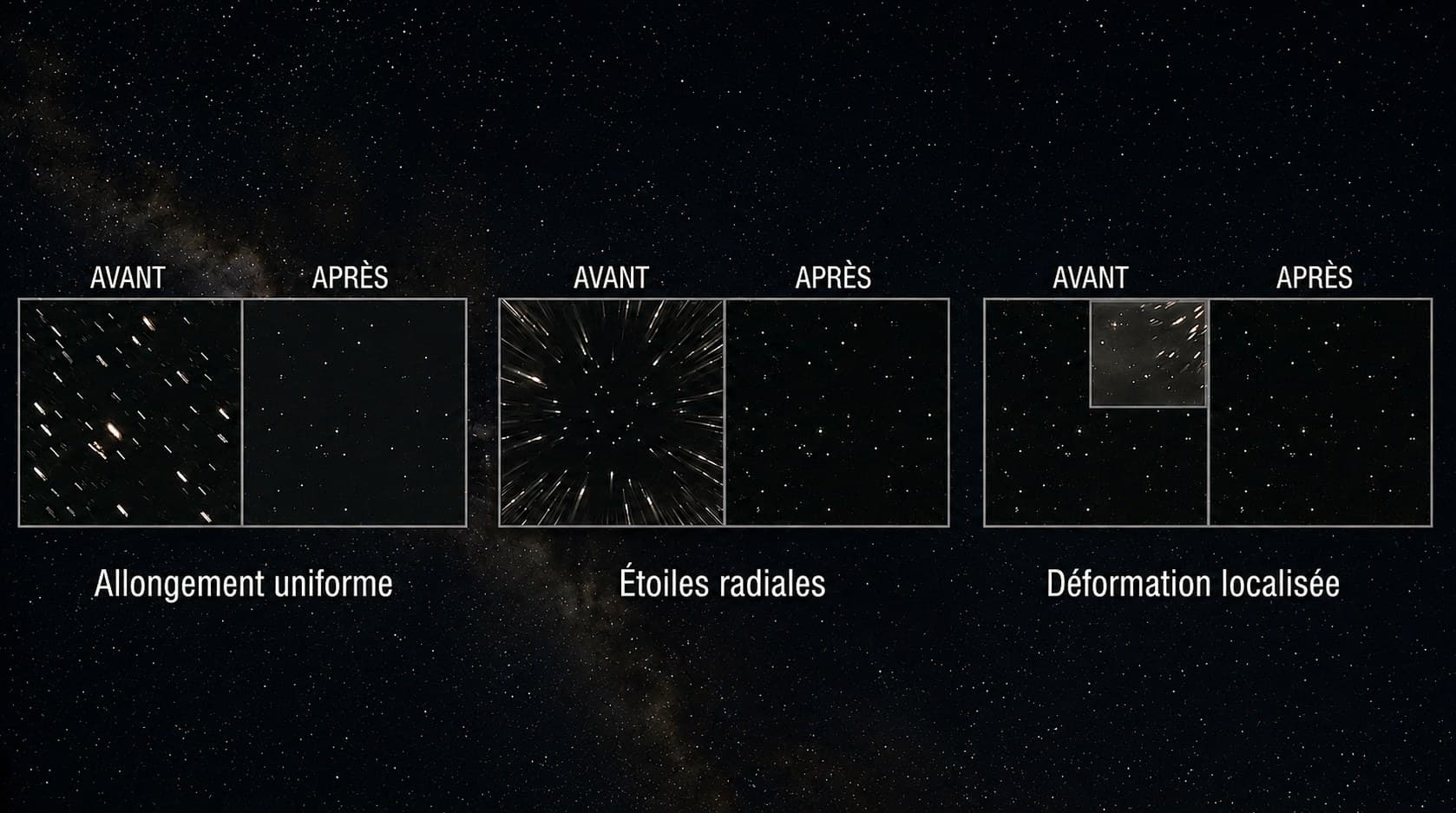
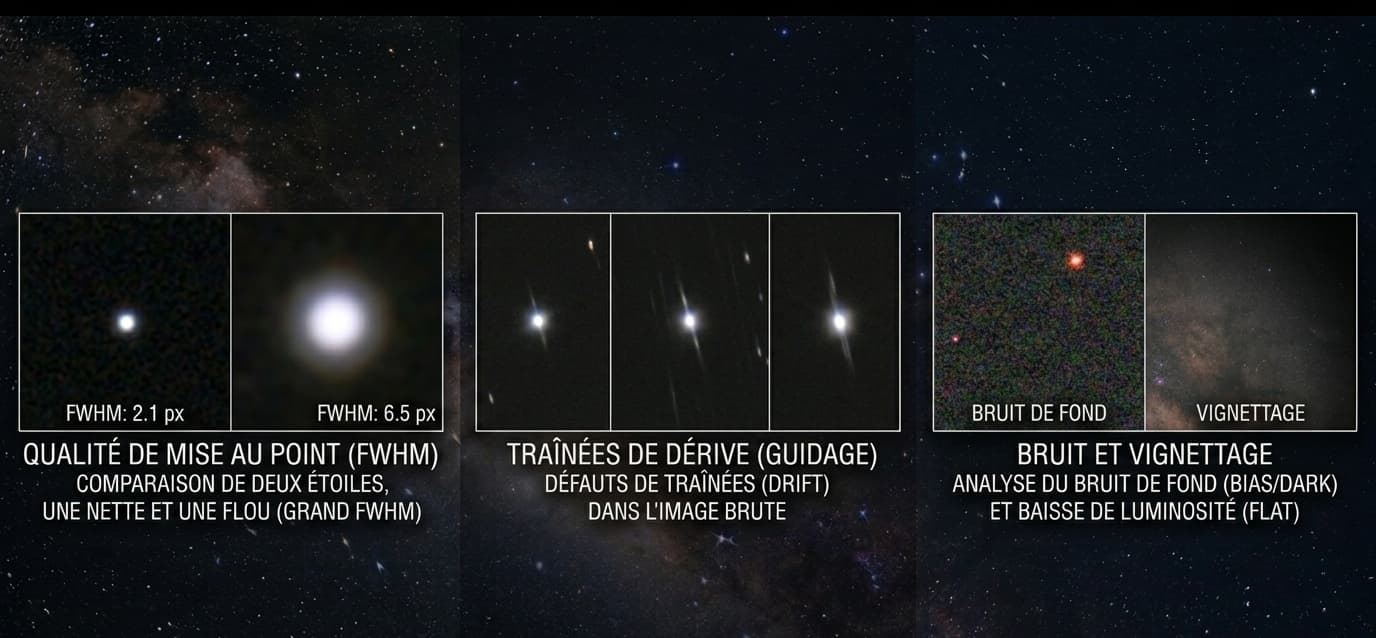
This Ha master is well made. The Moffat measurements put the center at elongation 1.12 for a field floor of 1.08, with PA scattered at 22 deg and near-zero elongation at the core: tracking and guiding are therefore clean, with no mount drift or oscillation. The central FWHM of 2.33 px (~3.7 arcsec) is consistent with seeing and sampling, with no focus miss.
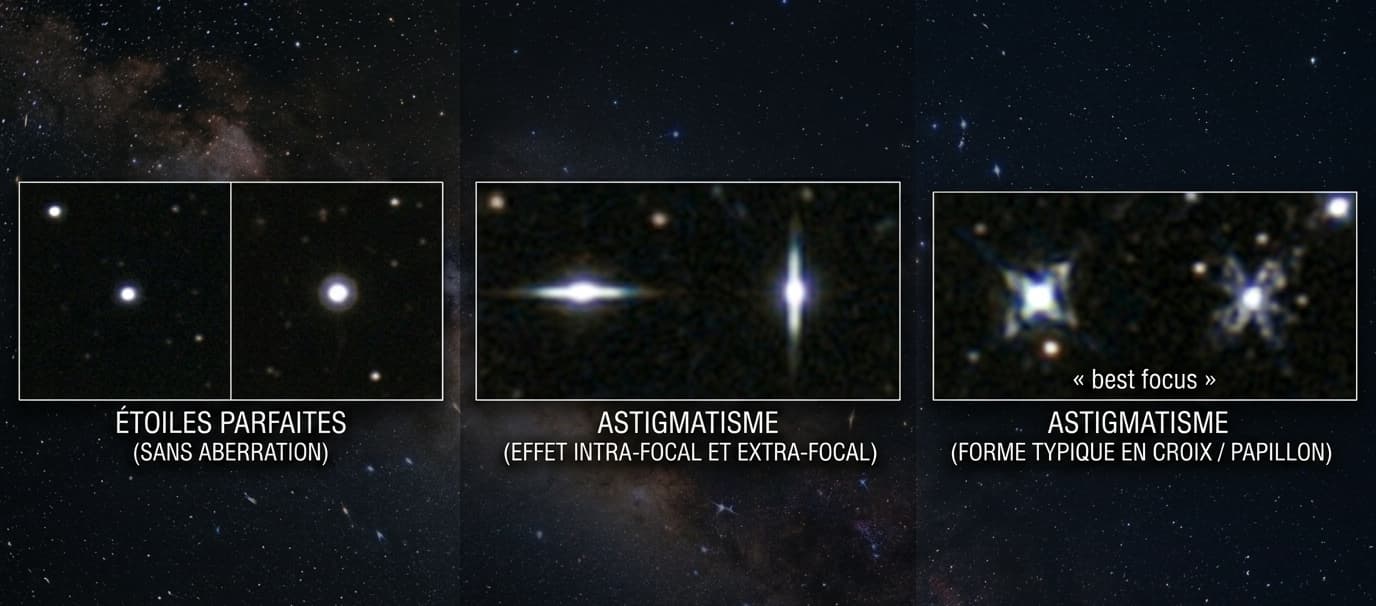
The only real defect is optical and mechanical: a tilt of the sensor plane. The degradation is clearly asymmetric, carried by the top-left diagonal (TL elongation 1.33, left edge 1.19) while the opposite bottom-right corner stays at 1.10. This single-axis asymmetry (0.135 horizontal versus 0.014 vertical) rules out simple symmetric field curvature and a backfocus error, which would degrade all four corners equally. It is a tilt to correct in the imaging train.
On calibration and sky background, nothing to report: no walking noise, banding, amp glow or donuts, and the background map confirms the luminance variation comes from real nebulosity, not an artifact. Once the tilt is corrected, this setup will deliver homogeneous edge-to-edge stars.
Priority actions
- Correct the sensor tilt (tilt ring / push-pull screws) by equalizing the top-left and bottom-right corners
- Revalidate with a new aberration panel until the four-corner elongation converges toward ~1.1
- Keep stacking 300s Ha subs to build signal, the faint background being normal in narrowband