Astrophotography diagnosis of NGC 6960: Sensor tilt
Raw300s10 juil. 2026
The Doc examined this image of NGC 6960 (raw, 300s). Estimated overall technical quality: 7/10. 1 defect found: Sensor tilt (severity 3/5).
&w=1920&q=75)
Info
- Cible
- NGC 6960
- Date
- 10 juil. 2026, 23:26
- Lune
- Gibbeuse croissante 83.4% (sous l'horizon)
- Site
- Bortle 2 · rural typique (VIIRS)
- Position
- 20h44m55s · +30°48'43"
Excellent conditions for this target: Bortle 2 sky and the Moon below the horizon during the exposure (90° separation, illumination irrelevant here since it had not risen). No lunar gradient expected, and the very dark background is ideal for capturing the faint filaments of the Veil. The small measured plane gradient (16%, oriented ~177°) is consistent with the Milky Way / field nebulosity rather than light pollution: nothing to fix upstream, a simple background extraction in processing will handle it. This is a reference night, worth using it to stack plenty of integration.
Setup
- Type d'image
- Brut
- Télescope
- EQMod Mount
- Caméra
- ZWO ASI585MM Pro
- Exposition
- 300s
- Phase de lune
- Dernier croissant (15 %)
- FOV
- 1.70°
Coherent setup: the ASI585MM Pro (1/1.2" sensor) with a 1.70° wide field frames the western part of the Veil around 52 Cygni well, and it is properly centered here. The sensor runs at -11.5°C, healthy cooling that limits dark current. In Hα (narrowband), the low background/black-point margin (e_margin 1.85 at 300s) is NORMAL and does not indicate underexposure: the background sits just above the black point with no dark clipping, exactly what you expect from a narrow filter under a dark sky. Gain 252 is high but the bright star does not clip dramatically; you could test a more moderate gain (unity) to gain dynamic range on 52 Cyg, otherwise 300s is a good compromise.
The diagnosis in detail
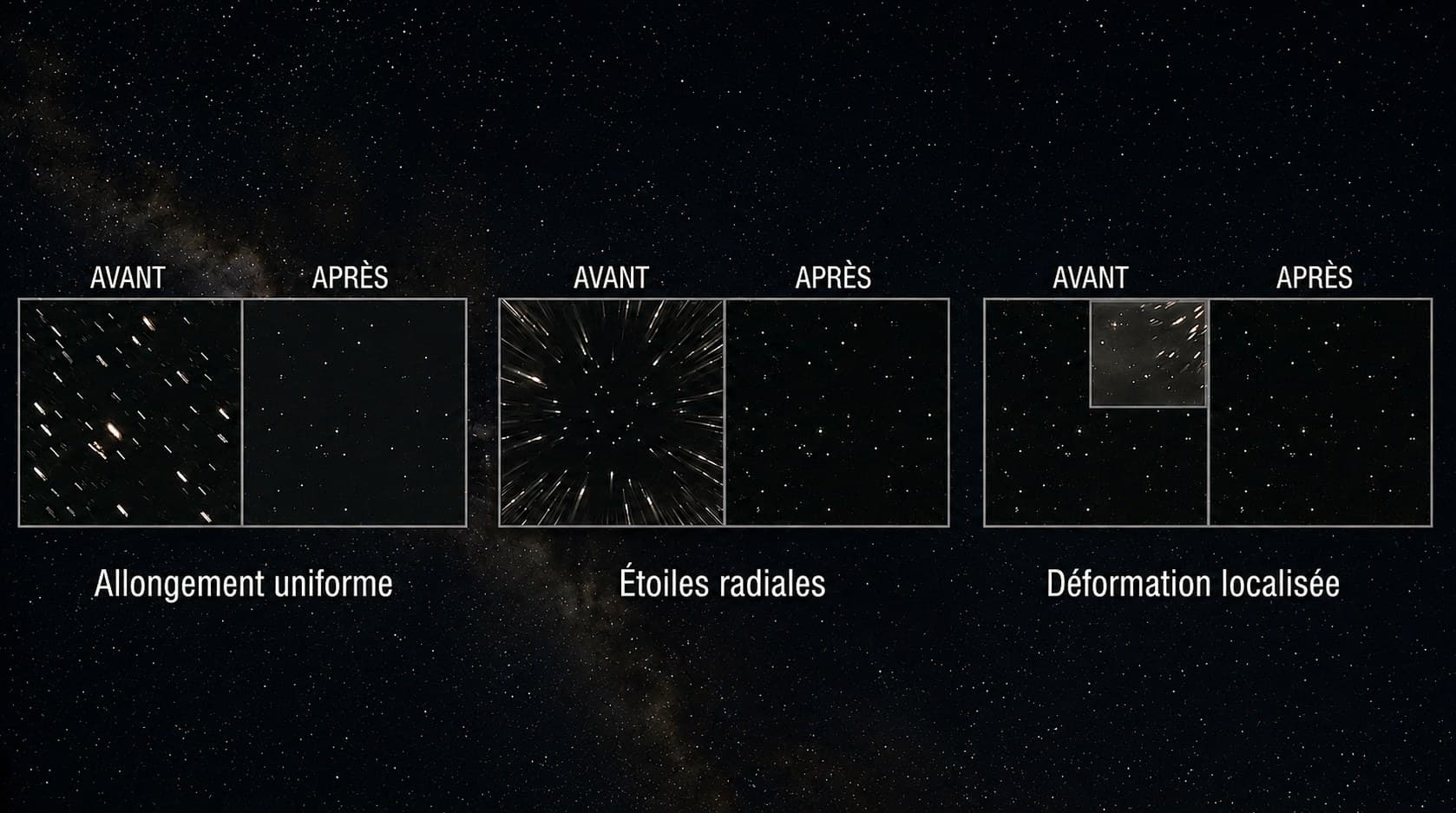
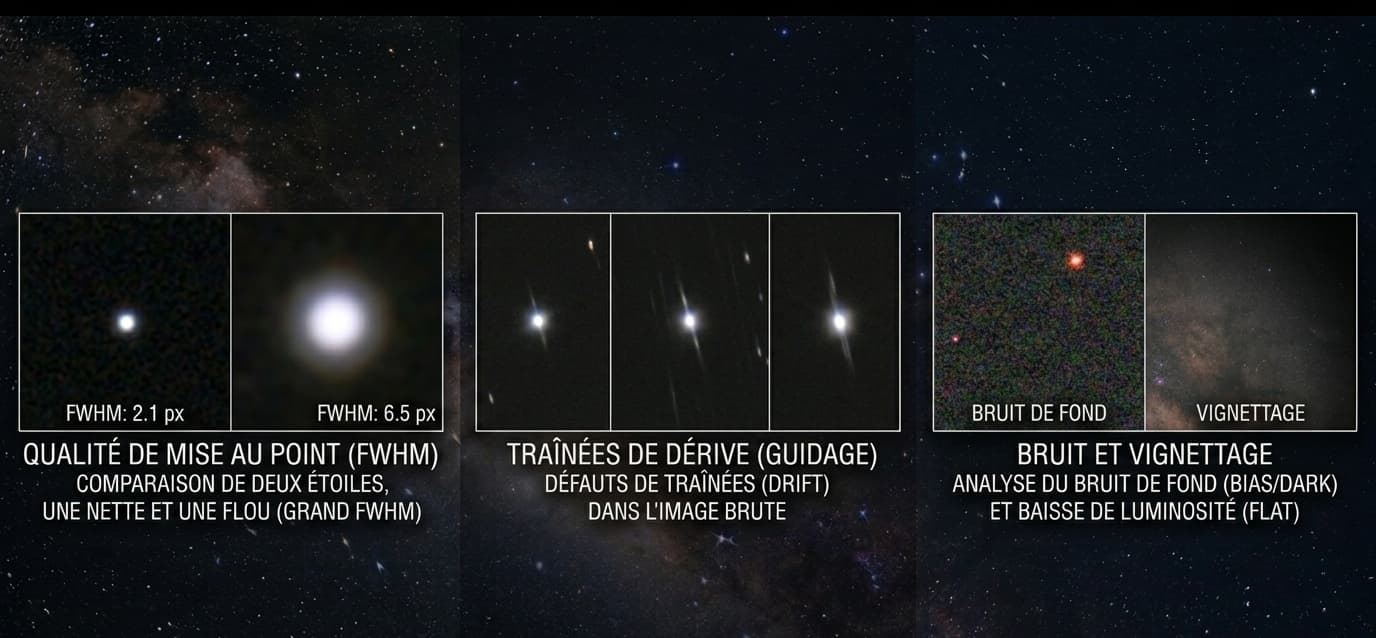
This sub is very well made. The Moffat measurements give tight, round stars at center (FWHM 2.54/2.15 px, elong 1.18 against a field floor of 1.05), which marks a successful focus and solid tracking over 300s, with no sign of drift or guiding oscillation (PA dispersion only 25°, no uniform directional elongation). The background is clean, with no visible amp glow or residual pattern on this sub.
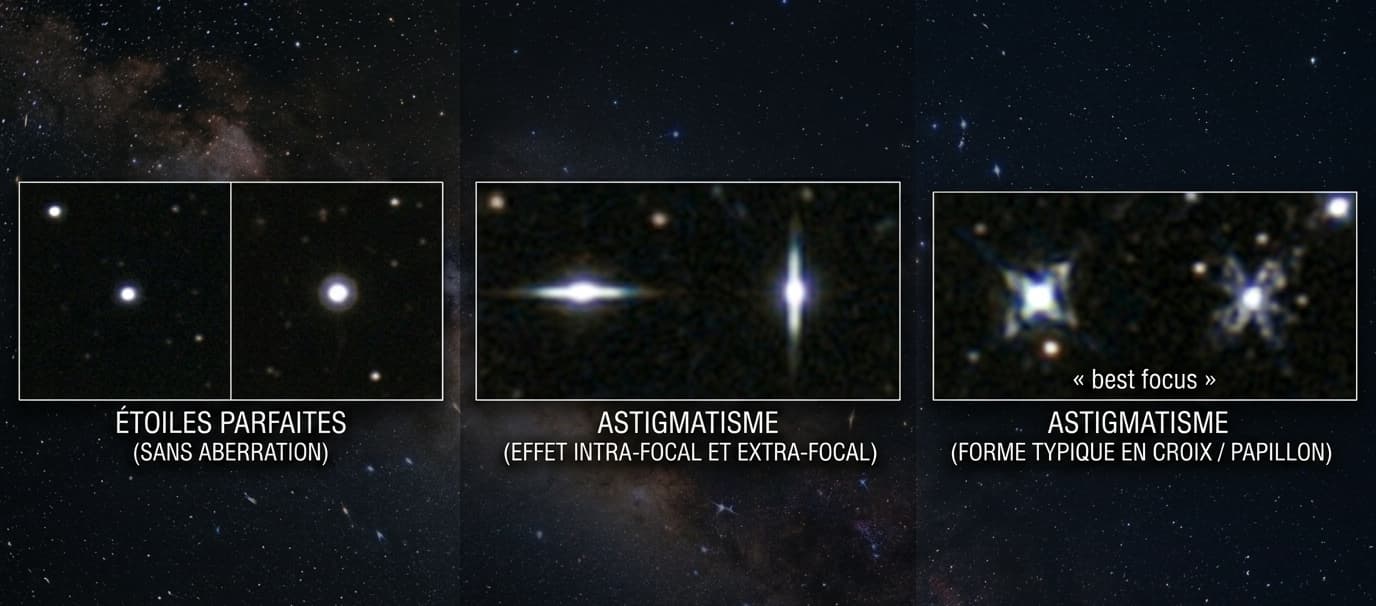
The only real defect is a sensor tilt, confirmed by the PSF panel: the degradation is not radially symmetric (which would point to backfocus/field curvature) but concentrated along the lower diagonal, the bottom-right corner reaching elong 1.5 and FWHM 3.44 px while the top corners stay at ~1.15 and ~2.55 px. The corner/center ratio of 1.36 and the vertical asymmetry (0.155 vs 0.029 horizontal) lock the diagnosis onto a tilted focal plane rather than a simple symmetric optical defect.
In practice, on a single sub the tilt stays moderate and the image is perfectly usable, but it will compound in stacking: the lower corners will remain permanently softer. A mechanical tilt adjustment before the rest of the session would fully recover the field.
Priority actions
- Correct the sensor tilt (evenly re-tighten the imaging train, then fine-tune with push-pull rings using the per-corner FWHM as a guide)
- Shoot a new aberration panel after adjustment to validate the homogeneity of all four corners before stacking the integration
- Take advantage of the moonless Bortle 2 sky to gather as many 300s subs as possible on the target