Astrophotography diagnosis of NGC 6992_biss: Sensor tilt and satellite trail
Raw300s11 juil. 2026
The Doc examined this image of NGC 6992_biss (raw, 300s). Estimated overall technical quality: 7/10. 2 defects found: Sensor tilt (severity 2/5), Satellite trail (severity 1/5).
&w=1920&q=75)
Info
- Cible
- NGC 6992_biss
- Date
- 11 juil. 2026, 22:28
- Lune
- Gibbeuse croissante 91% (sous l'horizon)
- Site
- Bortle 2 · rural typique (VIIRS)
- Position
- 20h56m03s · +30°47'20"
Excellent conditions: Bortle 2 and the Moon below the horizon (98° from the target, so no lunar pollution possible). On an emission nebula shot in Hα, this very dark sky guarantees excellent SNR and a nearly gradient-free background, confirmed by the background map (plane amplitude of only 4%). You are in an ideal case: nothing on the sky side limits acquisition, so you can push total integration without fear of stray gradients.
Setup
- Type d'image
- Brut
- Télescope
- EQMod Mount
- Caméra
- ZWO ASI585MM Pro
- Exposition
- 300s
- Phase de lune
- Dernier croissant (8 %)
- FOV
- 1.70°
Coherent setup for this target. The 1.70° field frames just the Eastern Veil with comfortable margins. The ASI585MM in Hα on this emission nebula is a sound choice, and the background only weakly lifted off the black point (e_margin 1.85) is NORMAL in narrowband at 300s, not a sign of underexposure: do not shorten the exposure. Gain 220 is high but with no clipping (0% saturated, 0% dark), so healthy on this sensor; offset 15 holds (no shadow clipping) and cooling at -10°C is fine. The small measured tilt is the only hardware setting to revisit.
The diagnosis in detail
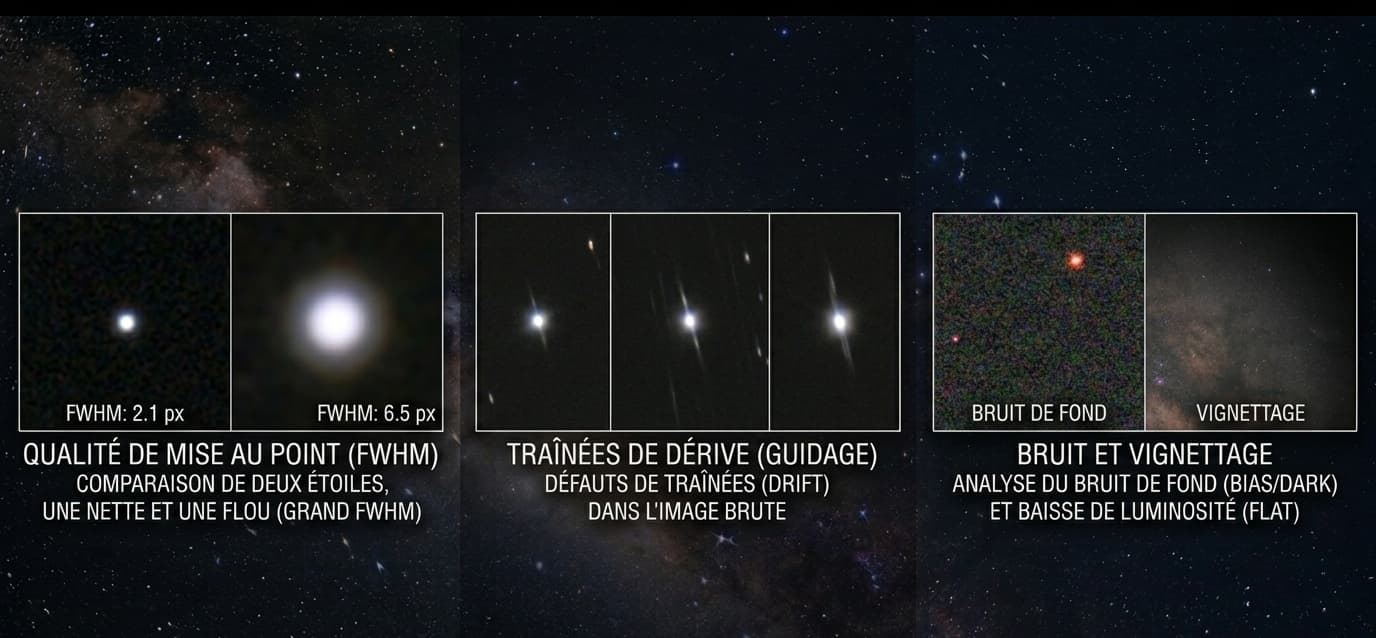
This 300s Hα sub is well made. The Moffat metrics give FWHM between ~2.0 and 3.0 px with elongations near the field floor (1.05 to 1.19), reflecting controlled tracking and focus: no drift, no oscillation, no focus blur. The sky background is flat (4% plane gradient, 0.01 anisotropy), consistent with Bortle 2 and no Moon.
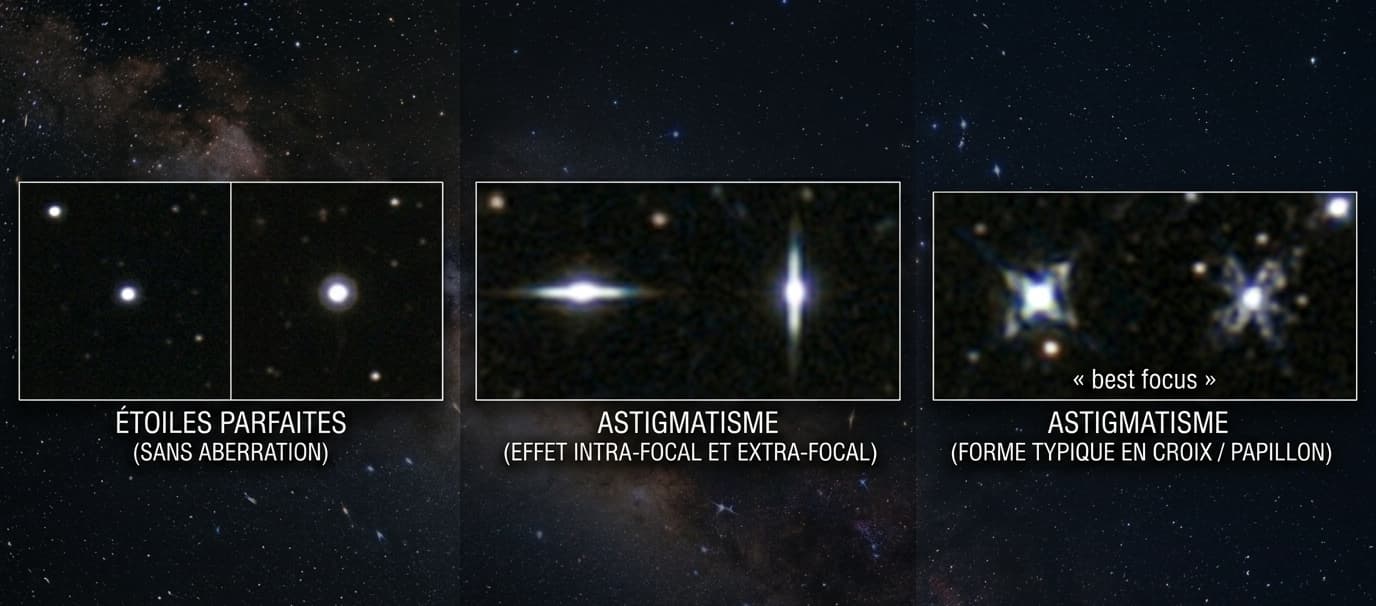
The only instrumental defect is a subtle sensor tilt revealed by the aberration inspector: the FWHM asymmetry is purely horizontal (0.206 vs 0.021 vertical), the left side being consistently more bloated than the right while the center stays sharp. This is not field curvature (which would be symmetric across the four corners) nor coma. The gap stays moderate (corner/center ratio 1.32) and the image remains fully usable, but a tilt adjustment would improve edge-to-edge uniformity.
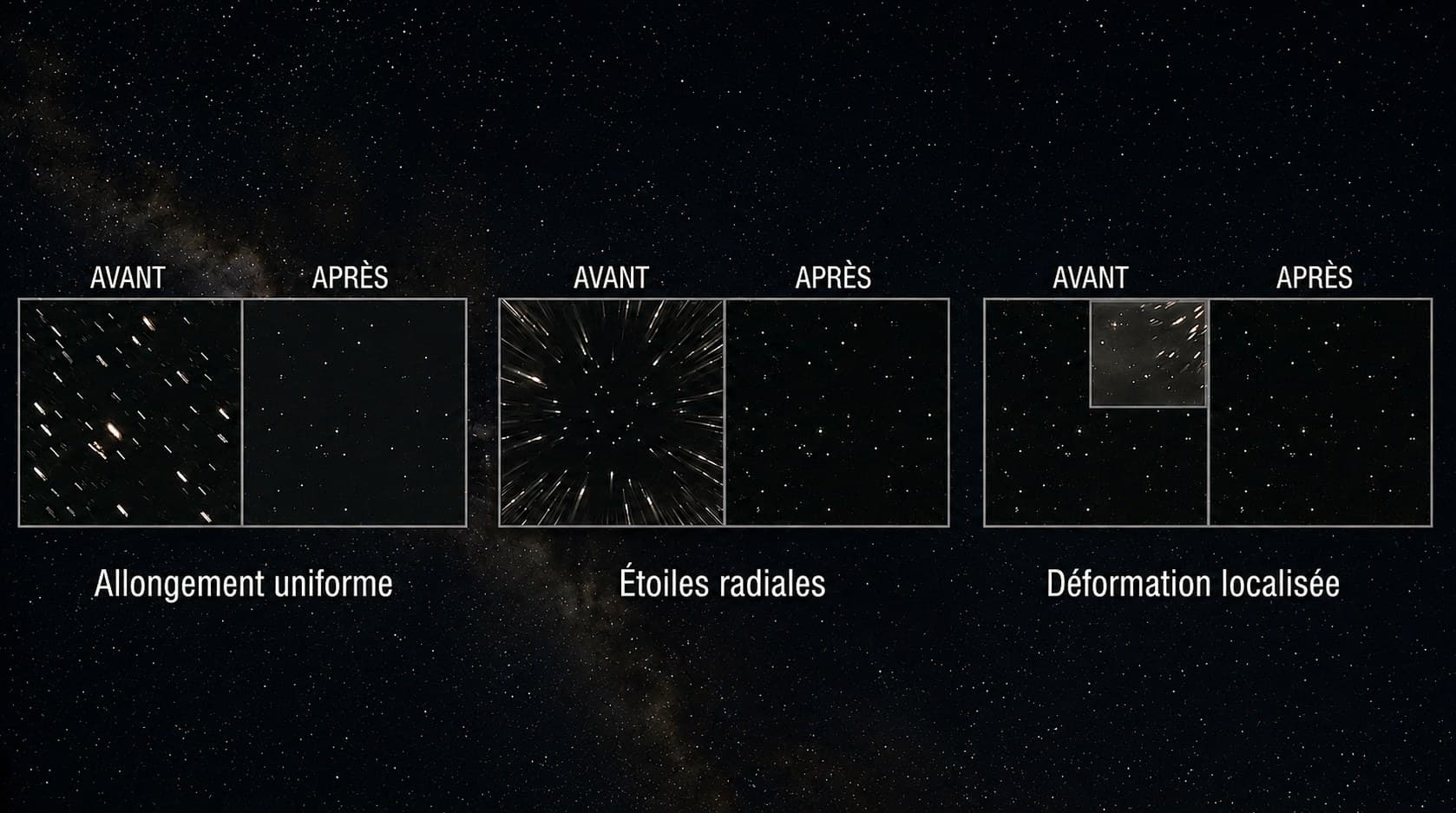
The satellite trail crossing the field is not a problem: on a stack with sigma rejection and dithering, it will vanish. In short, fix the tilt mechanically, stack normally, and this series promises a very good result.
Priority actions
- Adjust the sensor tilt (shims or a tilt plate) aiming to equalize FWHM between left and right edges
- Stack with sigma rejection and dithering to remove the satellite trail
- Keep integrating: the Moonless Bortle 2 sky lets you push total time with no gradient risk