Astrophotography diagnosis of NGC 6960: Sensor tilt
Raw300s11 juil. 2026
The Doc examined this image of NGC 6960 (raw, 300s). Estimated overall technical quality: 7/10. 1 defect found: Sensor tilt (severity 2/5).
&w=1920&q=75)
Info
- Cible
- NGC 6960
- Date
- 11 juil. 2026, 00:54
- Lune
- Gibbeuse croissante 84% (4° d'alt., 91° de la cible)
- Site
- Bortle 2 · rural typique (VIIRS)
- Position
- 20h44m55s · +30°48'43"
Bortle 2 sky: top-tier conditions, near-ideal SNR and background gradient, confirmed by a very clean background with no notable gradient (background map: plane 2%, radial +3%, both at low R², so nothing structural). The 84% gibbous Moon is declared only 4 deg above the horizon and 91 deg from the target: its impact is negligible here, all the more so since narrowband on an emission remnant like the Veil is barely sensitive to moonlight. Nothing to change on conditions, the window is excellent for stacking.
Setup
- Type d'image
- Brut
- Télescope
- EQMod Mount
- Caméra
- ZWO ASI585MM Pro
- Exposition
- 300s
- Phase de lune
- Dernier croissant (15 %)
- FOV
- 1.70°
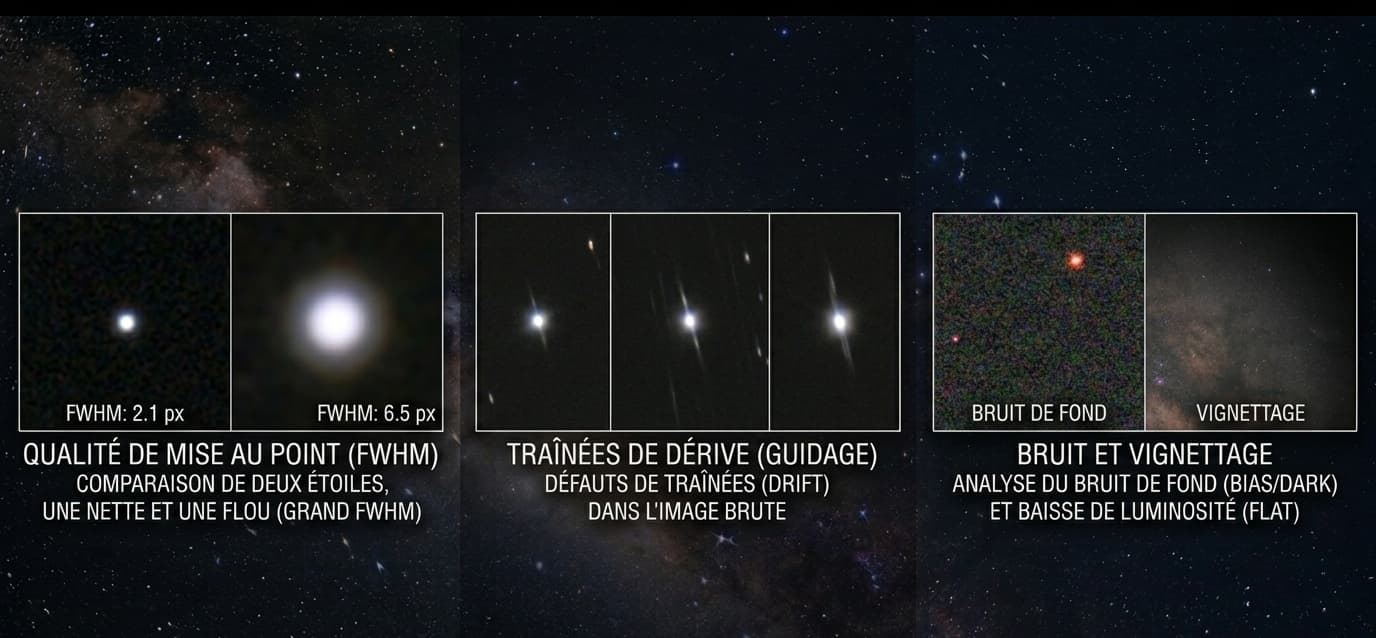
Setup consistent with the target: at 375 mm focal length, the 1.70 deg field frames the Broom (NGC 6960) with margin, and the 1.595"/px sampling is comfortable under standard seeing (measured FWHM ~2.3 px at center, well resolved). The ASI585MM at -14C is thermally healthy. Gain 252 is high: acceptable in mono narrowband to catch faint filaments, but watch the bright stars (52 Cygni saturates quickly). Offset 15 with no dark clipping (0%): sufficient. e_margin 1.89: background barely lifted off the black point, which is NORMAL in narrowband at 300s, do not raise exposure for that.
The diagnosis in detail
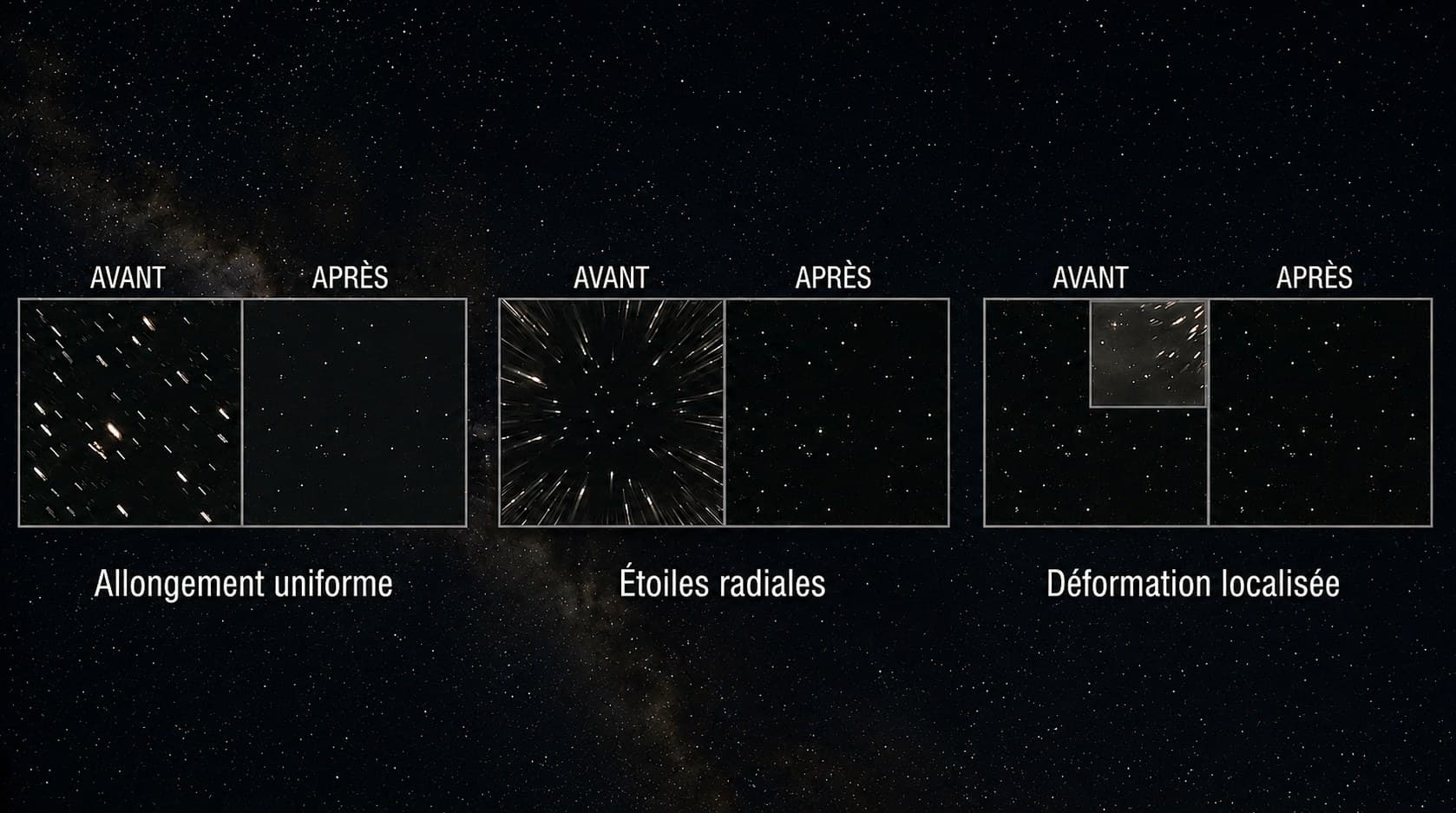
This sub is technically clean for a single frame. Tracking is good: center elong 1.08 right at the field floor (1.06), PA dispersion of 29.6 deg and no uniform directional stretch, so no mount defect (no drift, PE, or guiding oscillation). The Bortle 2 background comes out with no usable gradient and the background map flags no vignetting/flat/gradient candidate, consistent with the measurement.
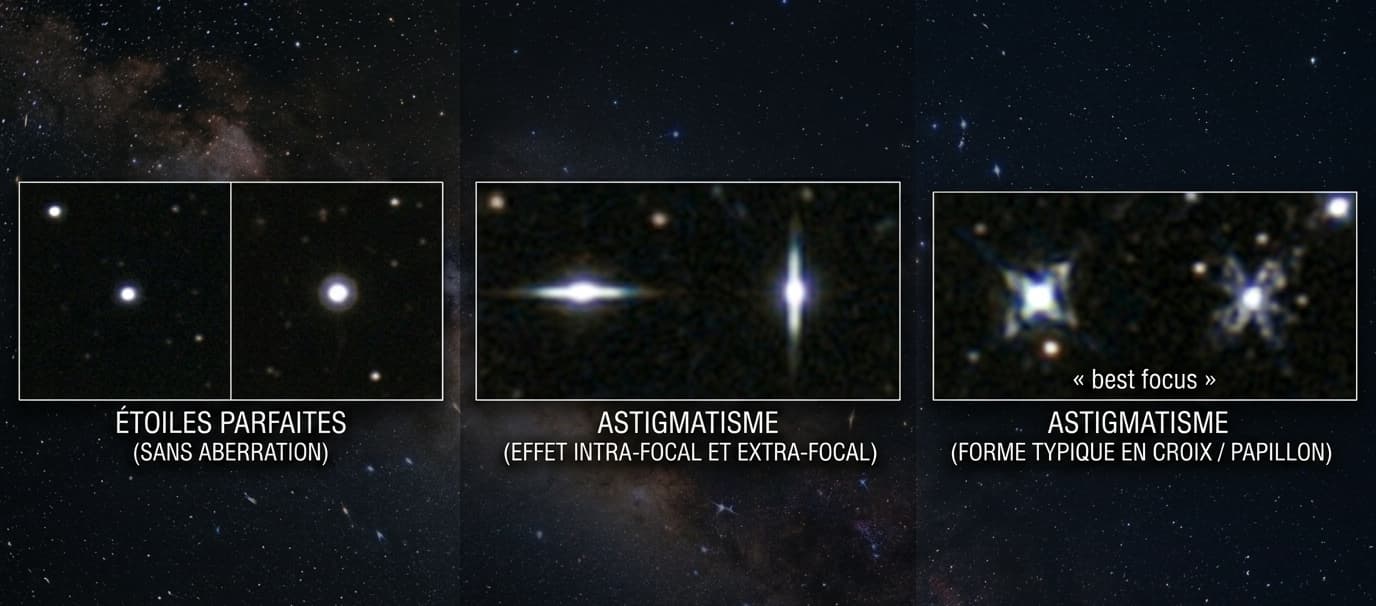
The only real point is a sensor tilt. The PSF panel is unambiguous: top row pinpoint (TL 1.12, TR 1.06), bottom row stretched diagonally (BL 1.21, BR 1.49 at PA35 deg), with a sharp center. This is the signature of a tilted focal plane, not field curvature (which would be symmetric across all 4 corners) nor coma (radial commas). On a sub it is cosmetically minor, but since it persists and accumulates during integration, it is worth fixing mechanically.
Note that the real nebulosity (confirmed by the DSS) spills slightly into the top-left and top-right: these are filaments of the remnant, not a background artifact, do not correct them as a gradient.
Priority actions
- Fix the sensor tilt: check the orthogonality and tightening of the optical train, then equalize the 4 corner FWHM with a tilt-plate
- Confirm the tilt pattern on 2-3 subs before intervening (diagnostic stability)
- Watch for saturation of 52 Cygni at gain 252 during stacking