Astrophotography diagnosis of IC 434: Sensor tilt
Raw300s14 sept. 2026
The Doc examined this image of IC 434 (raw, 300s). Estimated overall technical quality: 7/10. 1 defect found: Sensor tilt (severity 3/5).

Info
- Cible
- IC 434
- Date
- 14 sept. 2026, 03:21
- Lune
- Gibbeuse décroissante 89.7% (sous l'horizon)
- Site
- Bortle 2 · rural typique (VIIRS)
- Position
- 5h39m41s · -2°42'08"
Excellent conditions. Bortle 2 with a 89.7% waning gibbous Moon but below the horizon: no lunar contribution is possible on this sub, and the sky background confirms it (no measured moon gradient). On IC 434, an emission target, this is the ideal context and you can afford 300s subs without flooding the background. The background map shows a slight oriented structure, but the DSS confirms that the Orion B nebulosity genuinely fills the right half of the field: this is not a parasitic gradient. Under such a sky, the point is to stack more subs rather than lengthen them.
Setup
- Type d'image
- Brut
- Télescope
- EQMod Mount
- Caméra
- ZWO ASI585MM Pro
- Exposition
- 300s
- Phase de lune
- Premier croissant (6 %)
- FOV
- 3.36°
Coherent but clearly undersampled setup. At 190mm focal length with 2.9um pixels you sit at 3.148 arcsec/px over a 3.36 deg field, which frames IC 434 and NGC 2024 comfortably with room to spare, but a star only spans about 1.5 px FWHM: you are sampling-limited, not seeing-limited. That is a deliberate wide-field tradeoff, provided you dither properly to recover resolution at stacking. On the settings side, gain 160 on the ASI585MM and -21C are healthy, offset 15 produces no shadow clipping (0%). The background-to-black-point margin of 1.85 is low, but that is normal in narrowband under a Bortle 2 sky: do not lengthen the exposure for it, you are already at 300s.
The diagnosis in detail
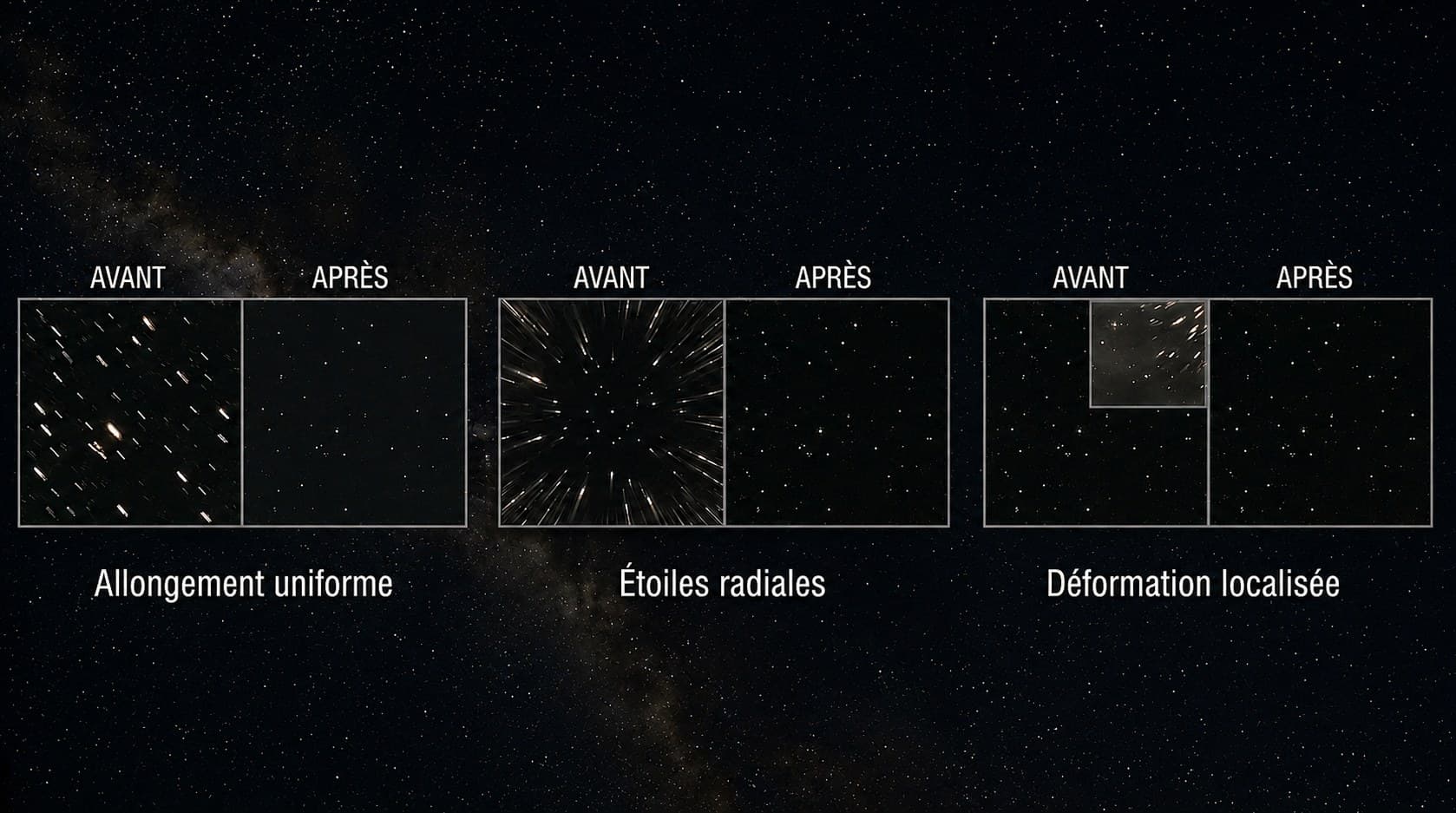
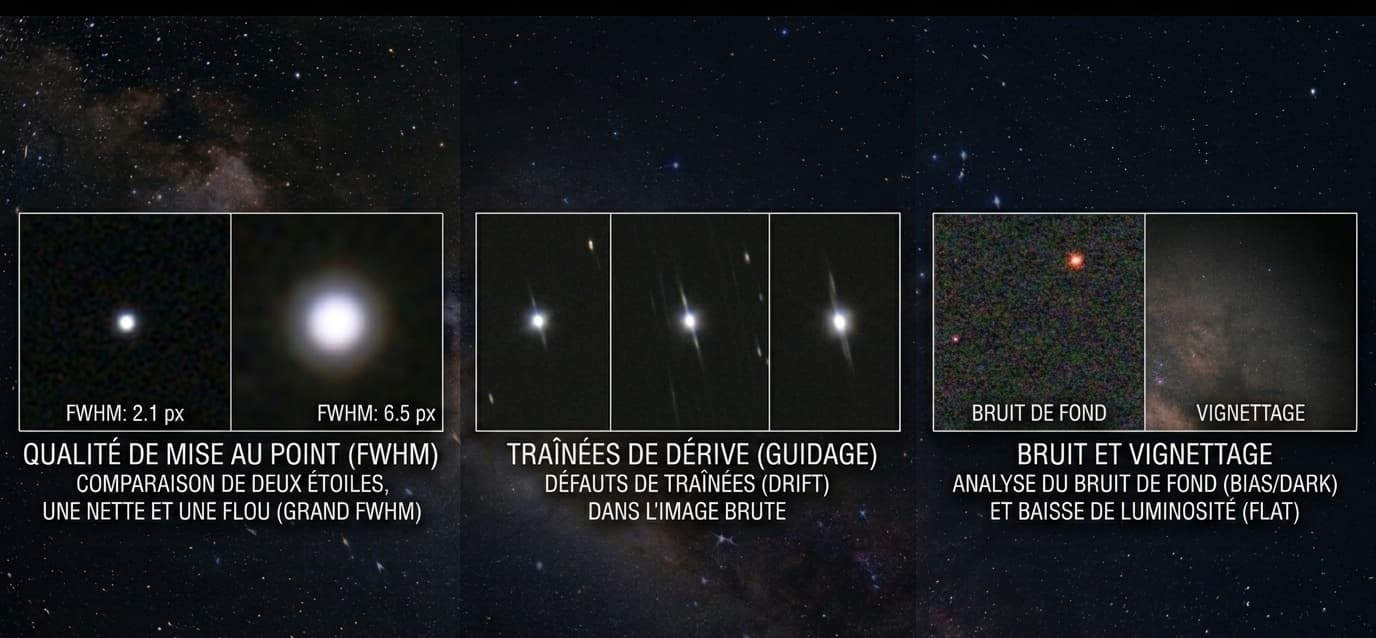
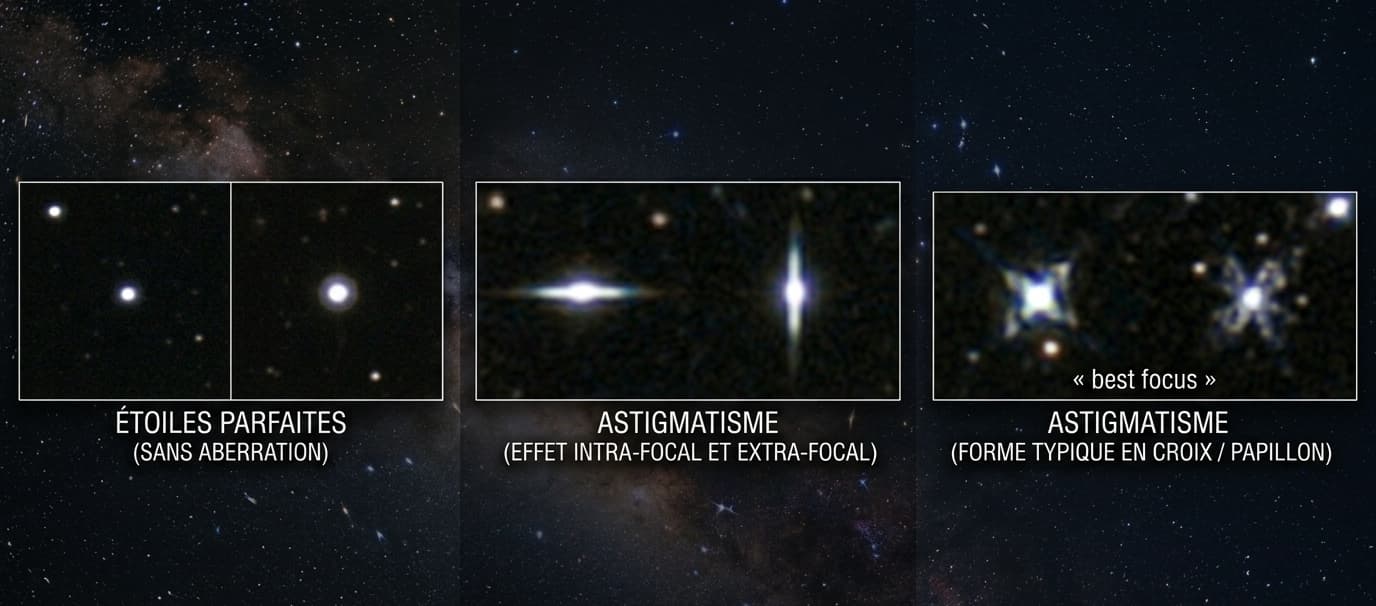
The diagnosis comes down to one point: field flatness. The Moffat measurements show a perfectly clean center (elong 1.12 against a 1.08 field floor, FWHM 1.54 px) and a strictly horizontal degradation gradient. Horizontal FWHM asymmetry reaches 0.189 against 0.018 vertical, with TR at 2.32 px on one side and TL at 1.75 px on the other. This single-axis signature, clean center and unbalanced opposite corners, rules out backfocus error (which would be symmetric across all four corners) and coma (radial and symmetric): this is a mechanical tilt of the focal plane.
Everything else is healthy. Tracking raises no concern over 300s: any drift would elongate stars in the center too, which is not the case. No satellite trail, no overwhelming hot pixels, no amp glow in the corners despite the sensor at -21C. Comparison with the DSS confirms that every visible nebulous structure (the IC 434 wall, the Flame, the dark clouds in the right half) is real.
In practice the image remains fully usable: at 3.148 arcsec/px, going from 1.75 to 2.3 px FWHM stays visually modest, and stacking will not worsen the defect since it is stable. But fixing it will give you a uniform field at no cost elsewhere.
Priority actions
- Fix the sensor tilt: tighten the imaging train evenly, move to threaded connections, then fine-tune with a tilt plate while monitoring left/right FWHM
- Re-check the field with the Aberration Inspector after each adjustment iteration, on a dense star field
- Stack many more 300s subs and dither between each one, the Bortle 2 sky and the 3.148 arcsec/px undersampling fully justify it