Astrophotography diagnosis of IC 4592: Light pollution gradient and sensor tilt
MasterL300s31 juil. 2024
The Doc examined this image of IC 4592 (master, L, 300s). Estimated overall technical quality: 7/10. 2 defects found: Light pollution gradient (severity 3/5), Sensor tilt (severity 2/5).
&w=1920&q=75)
Info
- Cible
- IC 4592
- Date
- 31 juil. 2024, 20:45
- Lune
- Gibbeuse croissante 86.6% (sous l'horizon)
- Site
- Bortle 1 · ciel pristine (VIIRS)
- Position
- 16h14m14s · -19°14'39"
Bortle 1 sky and a gibbous Moon at 86% but BELOW the horizon (azimuth opposite the target, 158°): near-ideal conditions, the Moon plays no role. The ~240° gradient is therefore neither lunar nor urban light pollution in the classic sense, more likely airglow or a background residual. On IC 4592 (a faint reflection nebula) under such a sky, SNR is the key issue: the measured background/black-point margin (2.61) stays low and the 97% dark clipping betrays a slightly short sub exposure to fully exploit this dark sky.
Setup
- Type d'image
- Master
- Télescope
- FRA400
- Caméra
- ZWO ASI2600MM Pro
- Filtre
- L
- Monture
- ZWO AM5
- Exposition
- 300s
FRA400 (400mm focal length) + ASI2600MM Pro: a wide field well suited to IC 4592, a large reflection nebula that fits comfortably in the frame with margin. The sampling of this combo is comfortable, consistent with the measured FWHMs of 2.2-2.7 px (stars properly resolved, neither over- nor under-sampled). The L filter is the right choice to gather the broadband luminance of this faint nebula under a Bortle 1 sky. The mild measured tilt warrants an optical train orthogonality check to even out the corners.
The diagnosis in detail
The PSF plate confirms a well-made master: the center is sharp (FWHM 2.38 px, elong 1.07, just above the field floor of 1.05) and PA dispersion (28°) stays moderate. The corner/center ratio of 1.25 and especially the horizontal FWHM asymmetry (0.181 vs 0.056 vertical) flag a mild sensor tilt: the bottom-left corner is the most degraded (FWHM 3.03, elong 1.12) while the right edges stay tight. This is not a critical defect but an optical train orthogonality adjustment would clear it.
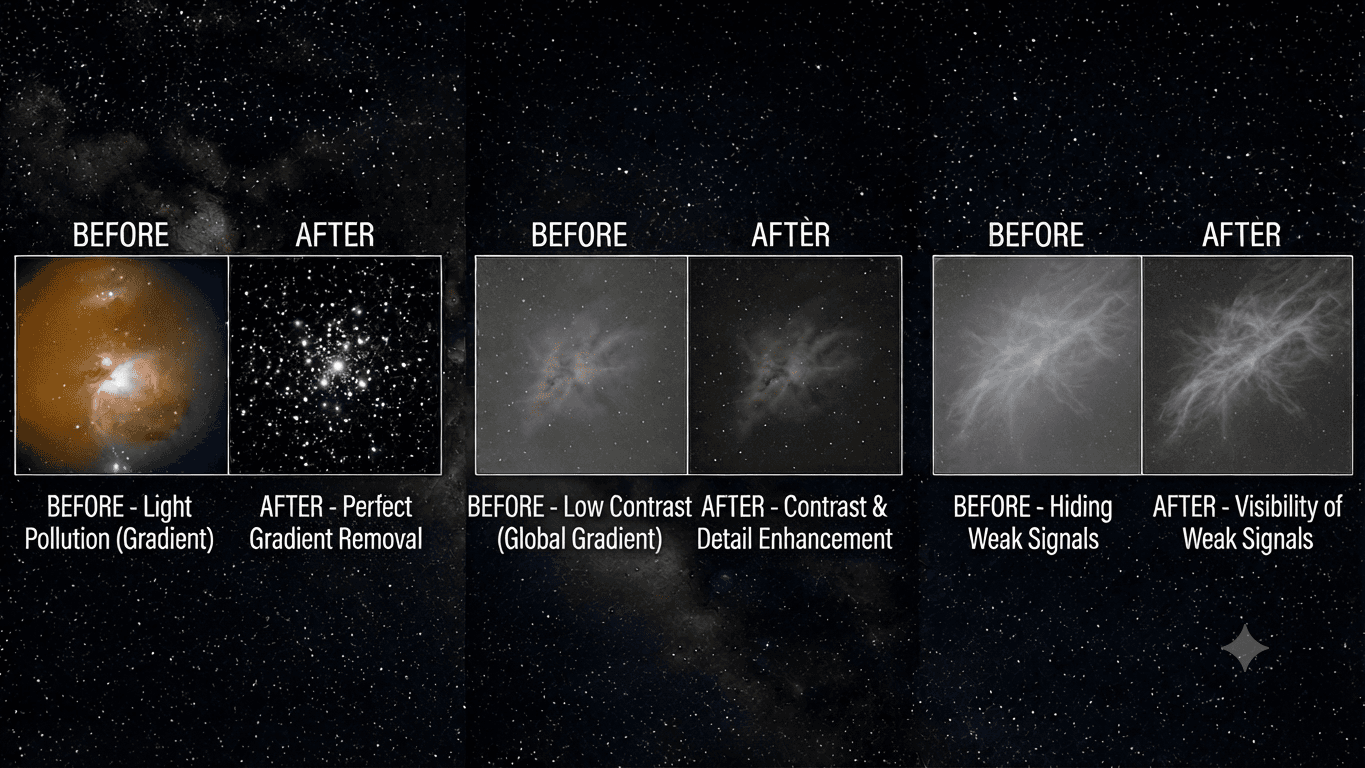
The second point is the measured background gradient (plane at 73%, oriented ~240°, R²=0.64, dominating the radial term by a factor of 3.5). Under Bortle 1 with the Moon set, this is neither urban nor lunar pollution: it is more likely low-horizon airglow or a slight illumination residual, perfectly correctable with gradient extraction in processing.
Finally, the histogram (dark clipping 97%, background/black-point margin 2.61) indicates a short sub exposure for this exceptional sky: increasing the sub duration and the number of subs would improve SNR on this faint reflection nebula.
Priority actions
- Extract the background gradient (GraXpert or DBE/ABE) before any stretch
- Check the optical train orthogonality to reduce the bottom-left corner tilt
- Lengthen the sub exposure and gather more subs to gain SNR on this faint nebula