Astrophotography diagnosis of NGC 4889: Tracking drift
Raw90s21 mai 2026
The Doc examined this image of NGC 4889 (raw, 90s). Estimated overall technical quality: 4/10. 1 defect found: Tracking drift (severity 3/5).
&w=1920&q=75)
Info
- Cible
- NGC 4889
- Date
- 21 mai 2026, 23:52
- Lune
- Gibbeuse décroissante 66.2% (2.9° d'alt., 56.1° de la cible)
- Site
- Bortle 1 · ciel pristine (VIIRS)
- Position
- 13h00m08s · +27°58'37"
The Bortle 1 site is ideal for a faint galaxy cluster like Coma: exactly the sky this kind of broadband target needs. The 66% gibbous Moon is only 2.9° above the horizon and 56° from the target, so its impact stays marginal that night with the cluster high up. The real limiting factor is not the sky but the exposure: a single 90s sub on faint-magnitude galaxies leaves the background barely lifted off the black point (e_margin 2.13), a sign that total integration must be greatly increased.
Setup
- Type d'image
- Brut
- Télescope
- NEWTON 200
- Caméra
- ZWO ASI2600MC Pro
- Monture
- EQ6r pro
- Exposition
- 90s
- Phase de lune
- Premier croissant (29 %)
- FOV
- 2.24°
The 200mm/600mm Newtonian with the ASI2600MC gives 1.293"/px and a 2.24° field: comfortable sampling under typical seeing and sensible framing, with the cluster well centered. Gain 100 (unity) and offset 100 are healthy, no hard dark clipping on the offset side, and a -15°C sensor temperature is fine. The weak point is exposure length: 90s broadband on faint galaxies is short (e_margin 2.13, Bowley skew ~0), so multiply the subs (aim for several cumulative hours) to lift the signal. The ~4px FWHM mostly reflects tracking drift, not the optics.
The diagnosis in detail
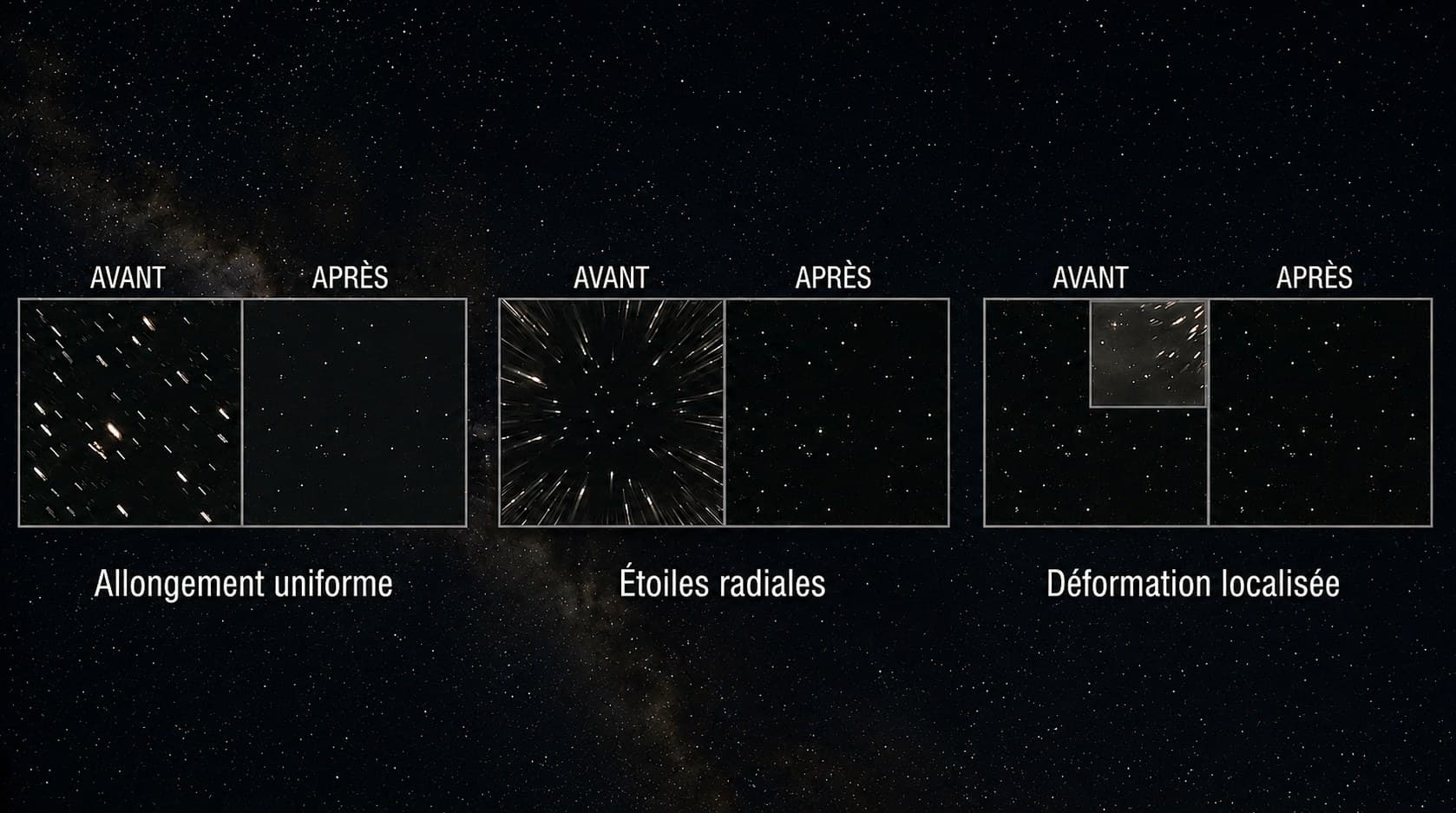
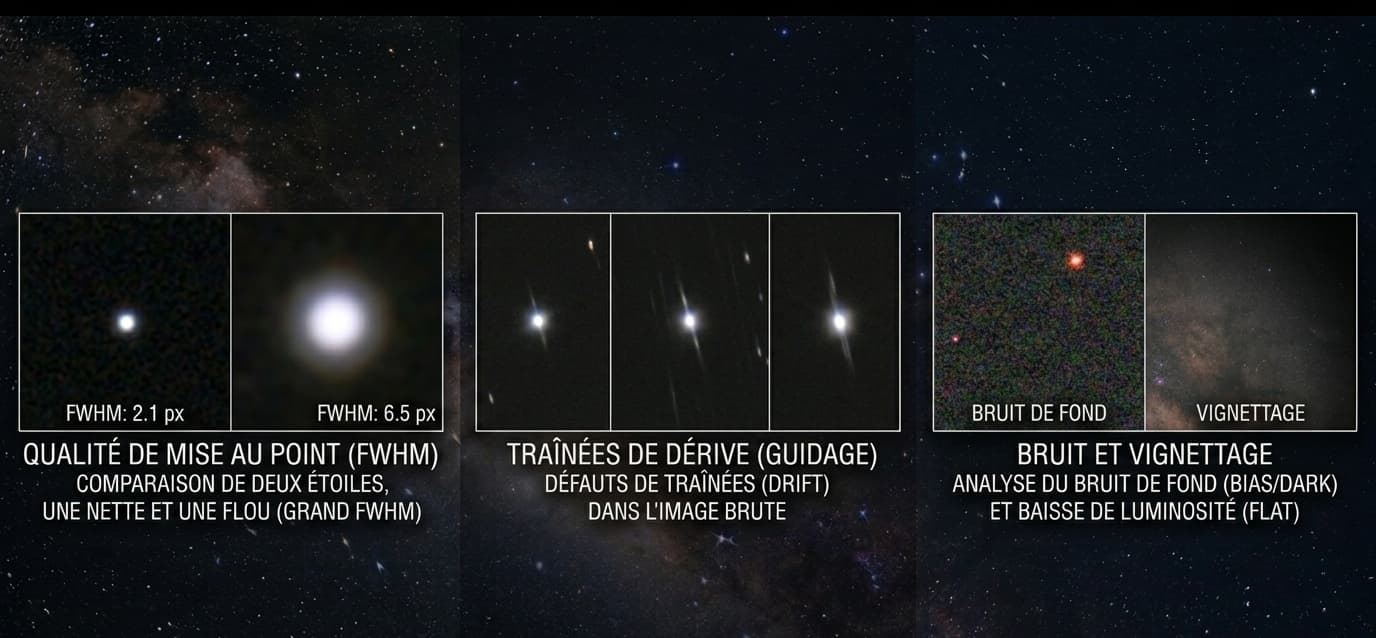
The star-shape diagnosis is unambiguous. The PSF panel shows oval stars oriented in nearly the same direction everywhere, from center to all four corners, with elongation measured at 1.65 at center against a field floor of 1.30 and a PA spread of only 4.3°. This signature, elongation present AT THE CENTER and consistent in direction, is that of tracking/guiding drift, not an optical aberration: the corner/center FWHM ratio is 1.097 and inter-corner asymmetry is negligible, so tilt, backfocus and coma are ruled out. Your Newtonian's optics perform well on this field.
The second point is not a defect but an acquisition fact: this sub is under-exposed for the target. The background stays glued to the black point (margin 2.13), which is expected on a single 90s broadband sub aimed at faint galaxies under a Bortle 1 sky. The gradient visible in the field corresponds to real structure (galactic gas/IFN confirmed by the DSS), so it should not be corrected as a gradient.
In practice, fix tracking first: that is what costs you the most in star sharpness. Once stars are round, the challenge becomes purely cumulative integration time to bring out the cluster's hundreds of galaxies.
Priority actions
- Fix the tracking drift: refine polar alignment and enable autoguiding (PHD2) before the next session
- Multiply the subs to reach several cumulative hours of integration on this faint target
- Do not process the background gradient as a gradient: it is real IFN/structure confirmed by the DSS