Astrophotography diagnosis of NGC 4889: Tracking drift and sensor tilt
Raw90s21 mai 2026
The Doc examined this image of NGC 4889 (raw, 90s). Estimated overall technical quality: 6/10. 2 defects found: Tracking drift (severity 3/5), Sensor tilt (severity 2/5).
&w=1920&q=75)
Info
- Cible
- NGC 4889
- Date
- 21 mai 2026, 23:50
- Lune
- Gibbeuse décroissante 66.2% (3.1° d'alt., 56.1° de la cible)
- Site
- Bortle 4 · transition rural/banlieue (saisi)
- Position
- 13h00m08s · +27°58'37"
Decent conditions for this target. The Bortle 4 sky suits a broadband RGB galaxy cluster: the background stays dark and even, with no instrumental gradient (the measured +44% background variation matches the extended field structure, not a defect). The 66% gibbous Moon sits only 3° above the horizon and 56° from the target: its impact here is very limited, especially with the target high in the sky. No significant lunar pollution expected. The window is good; the priority is not the sky but the tracking.
Setup
- Type d'image
- Brut
- Télescope
- NEWTON 200
- Caméra
- ZWO ASI2600MC Pro
- Exposition
- 90s
- Phase de lune
- Premier croissant (29 %)
- FOV
- 2.24°
Setup is consistent for NGC 4889. The 200/600 Newton (f/3) with the ASI2600MC yields a 2.24° field and 1.29"/px: the Coma Cluster fits comfortably in frame and the sampling is ideal under typical seeing (measured FWHM ~3.6 px, i.e. ~2.3"). Gain 100 (unity) and offset 100 are healthy, sensor temp -15°C is perfect. The 90s exposure at f/3 under Bortle 4 gives a background/black-point margin (e_margin) of 2.12, a bit tight: the background is slightly under-separated from the black point. On an f/3 this is not dramatic, but 120-180s would improve SNR if tracking allows.
The diagnosis in detail
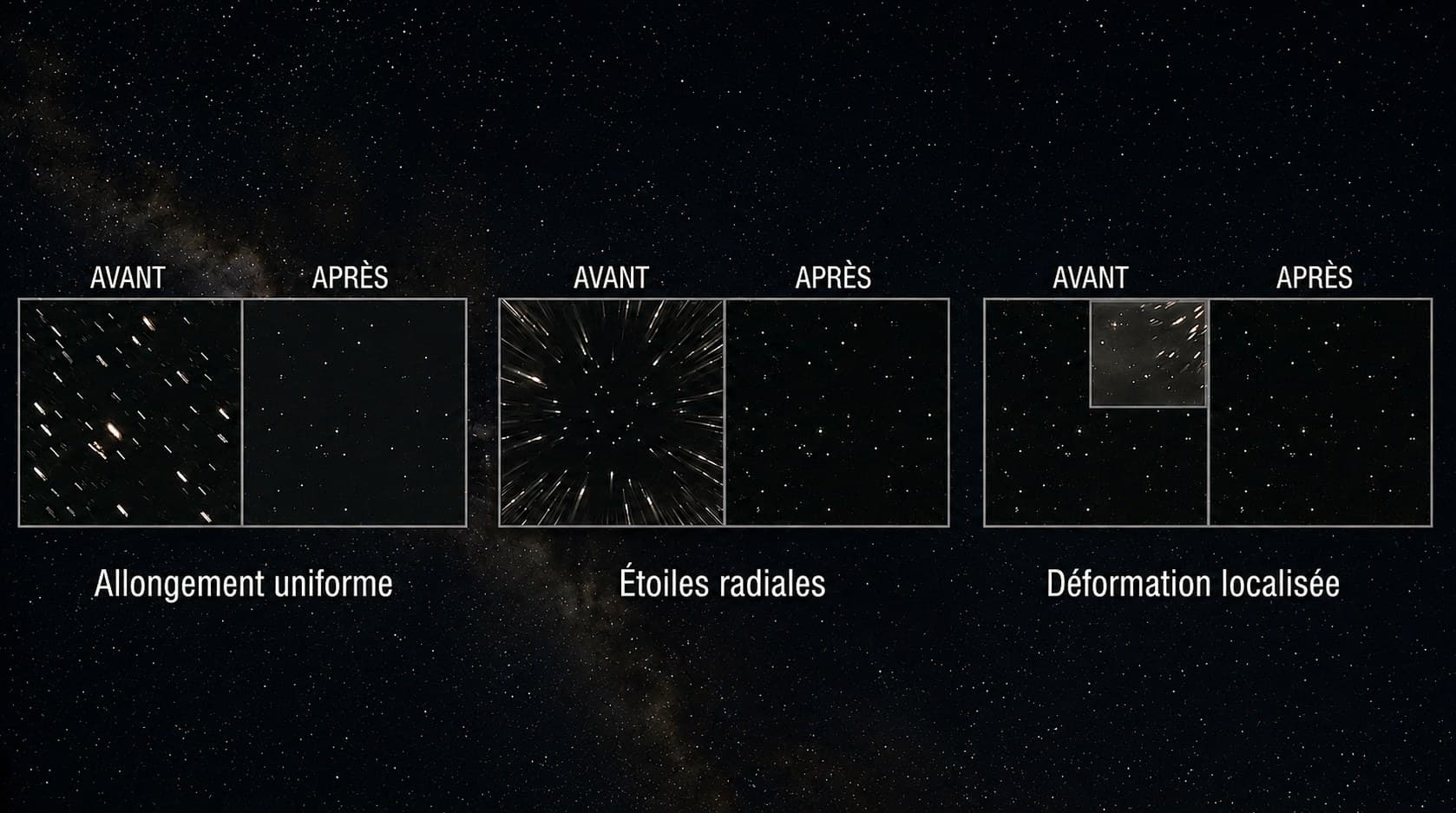
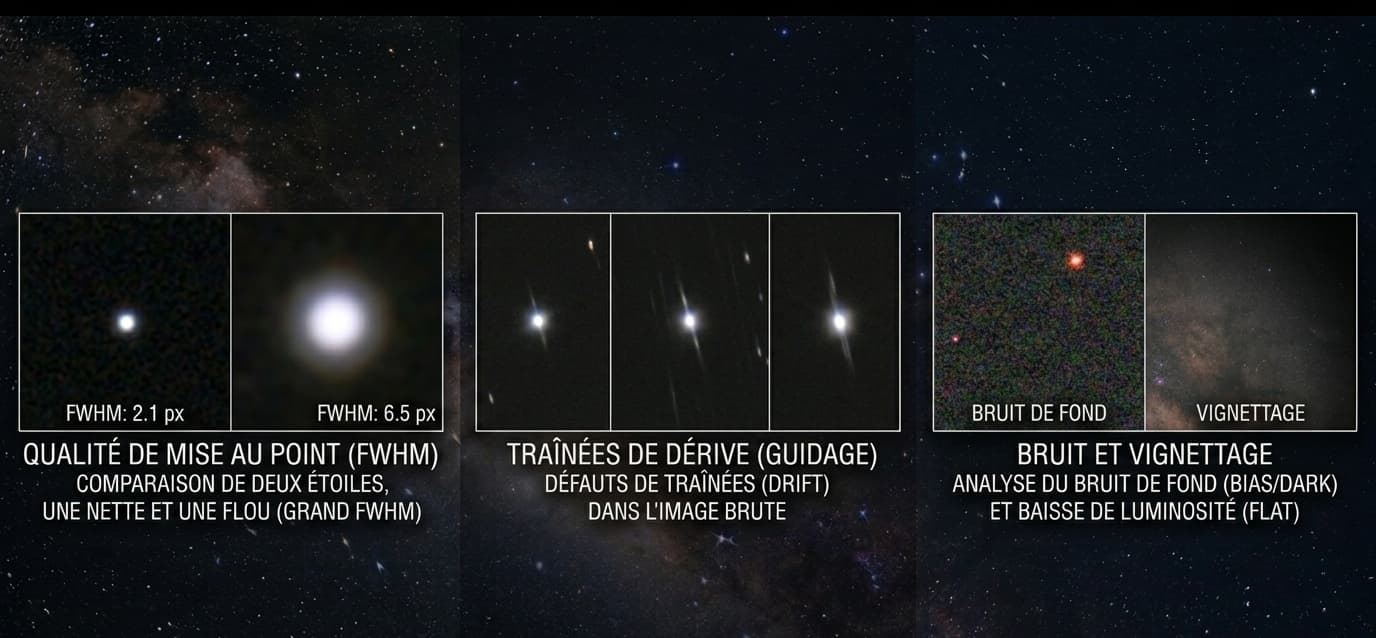
On this 90s sub, the PSF analysis is unambiguous: elongation is present across all nine zones, center included (central elong 1.43 vs a field floor of 1.37), and crucially the elongation direction is extremely consistent from zone to zone (PA dispersion of only 5.7°). This signature, measured all the way to field center, is not optical: an edge aberration (tilt, coma, backfocus) would leave the center round and affect only the corners. Here a tracking/guiding drift dominates, moderate and usable but worth correcting to gain stellar sharpness.
The tilt component flagged by the metrics (horizontal FWHM asymmetry 0.125, stronger elongation on the lower-left side) remains a second-order signal: the corner/center ratio reaches only 1.127, below the discriminating threshold, and the tracking drift contaminates the shape measurement anyway. So treat it as a watch-point, to recheck on a stacked AND guided master before any mechanical action on the optical train.
The rest is solid: clean dark sky background (Bortle 4), no instrumental gradient, ideal sampling, healthy sensor settings. The only acquisition caveat is a slightly short exposure (e_margin 2.12) that deserves to be lengthened if the mount allows once guiding is in place.
Priority actions
- Set up or fine-tune autoguiding (PHD2) to eliminate the tracking drift, the #1 cause of star elongation
- Check/refine polar alignment before the next session
- Extend the sub exposure toward 120-180s once tracking is reliable to better separate the background (current e_margin 2.12)
- Re-measure tilt on a stacked, guided master before any mechanical adjustment of the optical train