Astrophotography diagnosis of IC 5070_biss3_HA: Tracking drift
Raw300s26 juin 2026
The Doc examined this image of IC 5070_biss3_HA (raw, 300s). Estimated overall technical quality: 6/10. 1 defect found: Tracking drift (severity 3/5).
&w=1920&q=75)
Info
- Cible
- IC 5070_biss3_HA
- Date
- 26 juin 2026, 23:57
- Lune
- Croissant décroissant 8.3% (7.8° d'alt., 97.6° de la cible)
- Site
- Bortle 2 · rural typique (VIIRS)
- Position
- 20h51m12s · +43°59'43"
Excellent conditions for an emission target. The Bortle 2 sky guarantees a very dark background and great contrast on IC 5070's Hα. The Moon is a non-factor: waning crescent at 8.3% illumination, only 7.8° above the horizon and 97.6° from the target, so its background contribution is negligible, all the more since an Hα filter rejects it almost entirely. No lunar gradient expected or measured. Nothing to change condition-wise: the night is ideal for stacking narrowband signal.
Setup
- Type d'image
- Brut
- Télescope
- EQMod Mount
- Caméra
- ZWO ASI585MM Pro
- Exposition
- 300s
- Phase de lune
- Gibbeuse croissante (90 %)
- FOV
- 1.70°
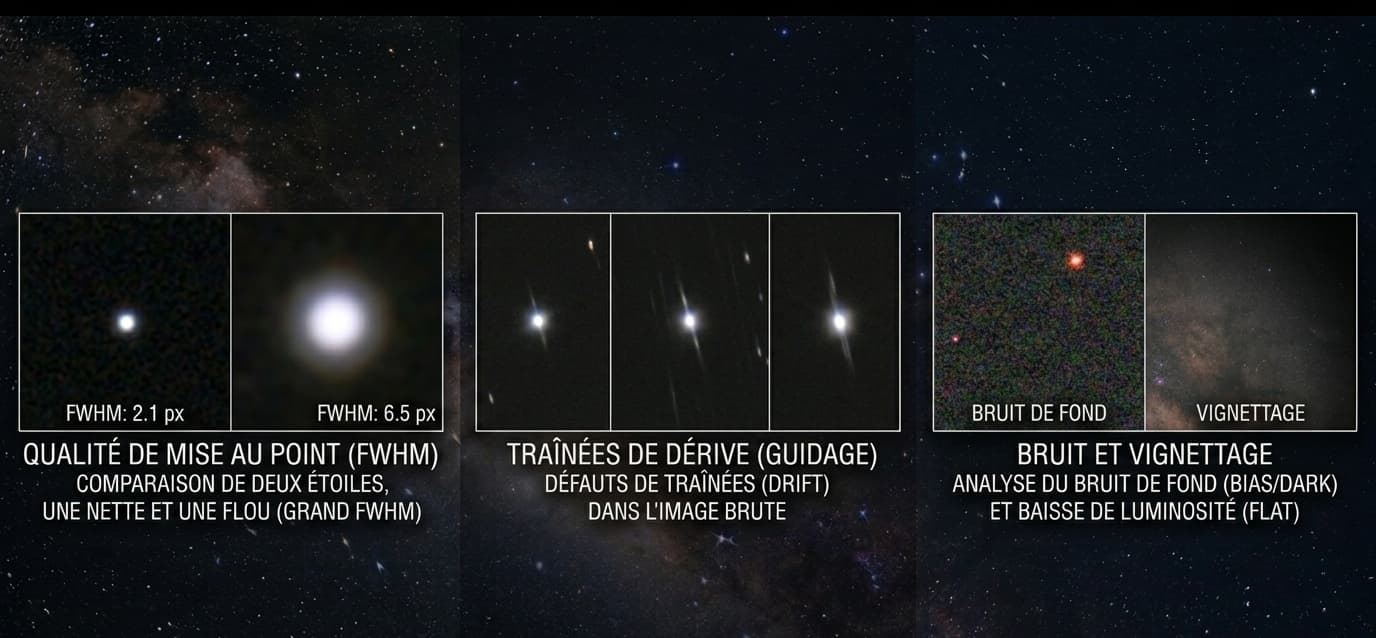
Setup consistent with the target. The ASI585MM Pro cooled to -11.5°C (healthy, no thermal drift) in Hα over a 1.70° field frames a portion of IC 5070 (the Pelican's head) well, even if the full object spills out, which is a deliberate framing choice. The measured FWHM around 2.7px indicates correct sampling under current seeing. Gain 252 is high but reasonable in narrowband to limit read noise, offset 15 with no dark clipping (0%), 300s exposure suitable. The low background/black-point margin (e_margin 1.69) is NORMAL in Hα at 300s and should not be over-read as underexposure.
The diagnosis in detail
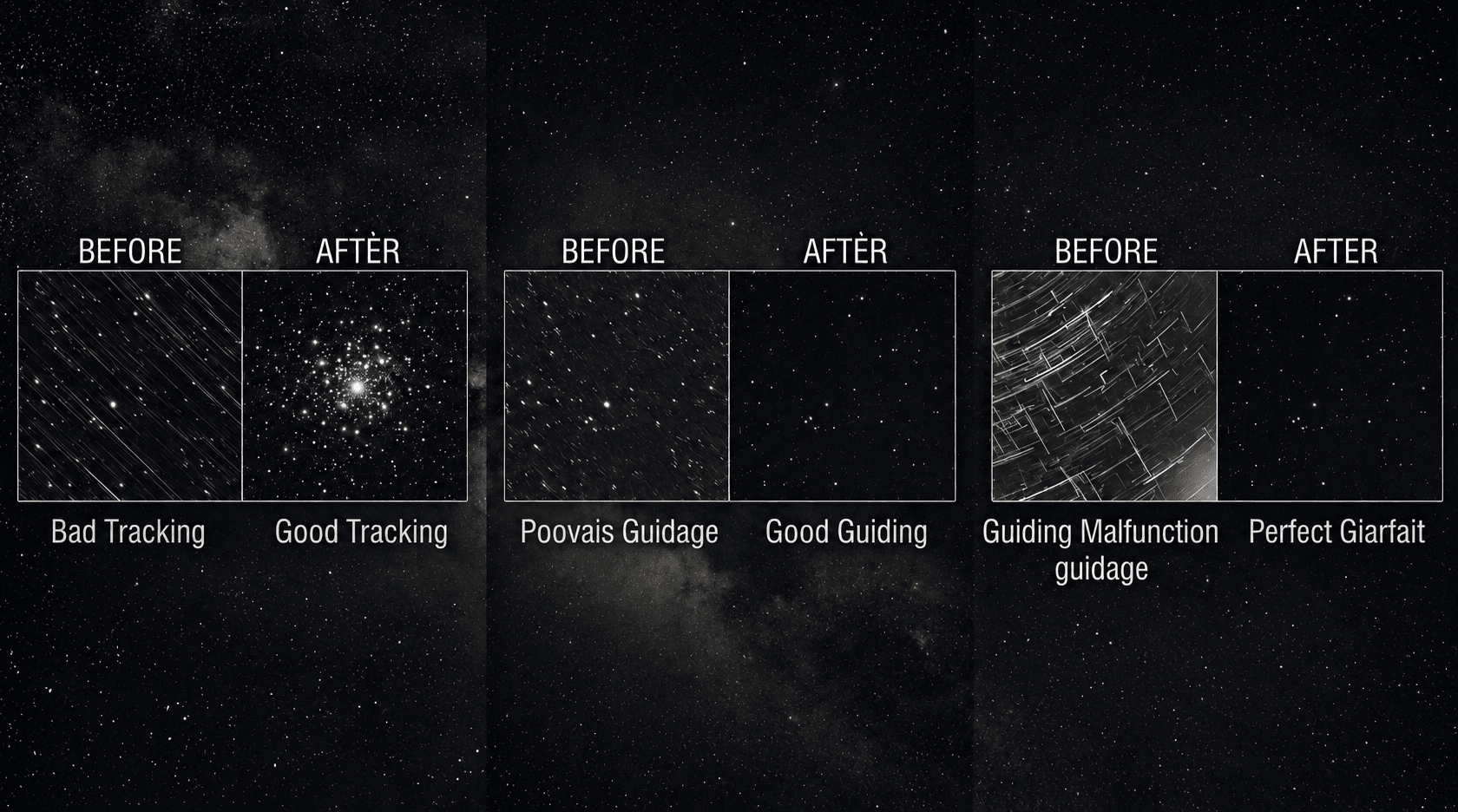
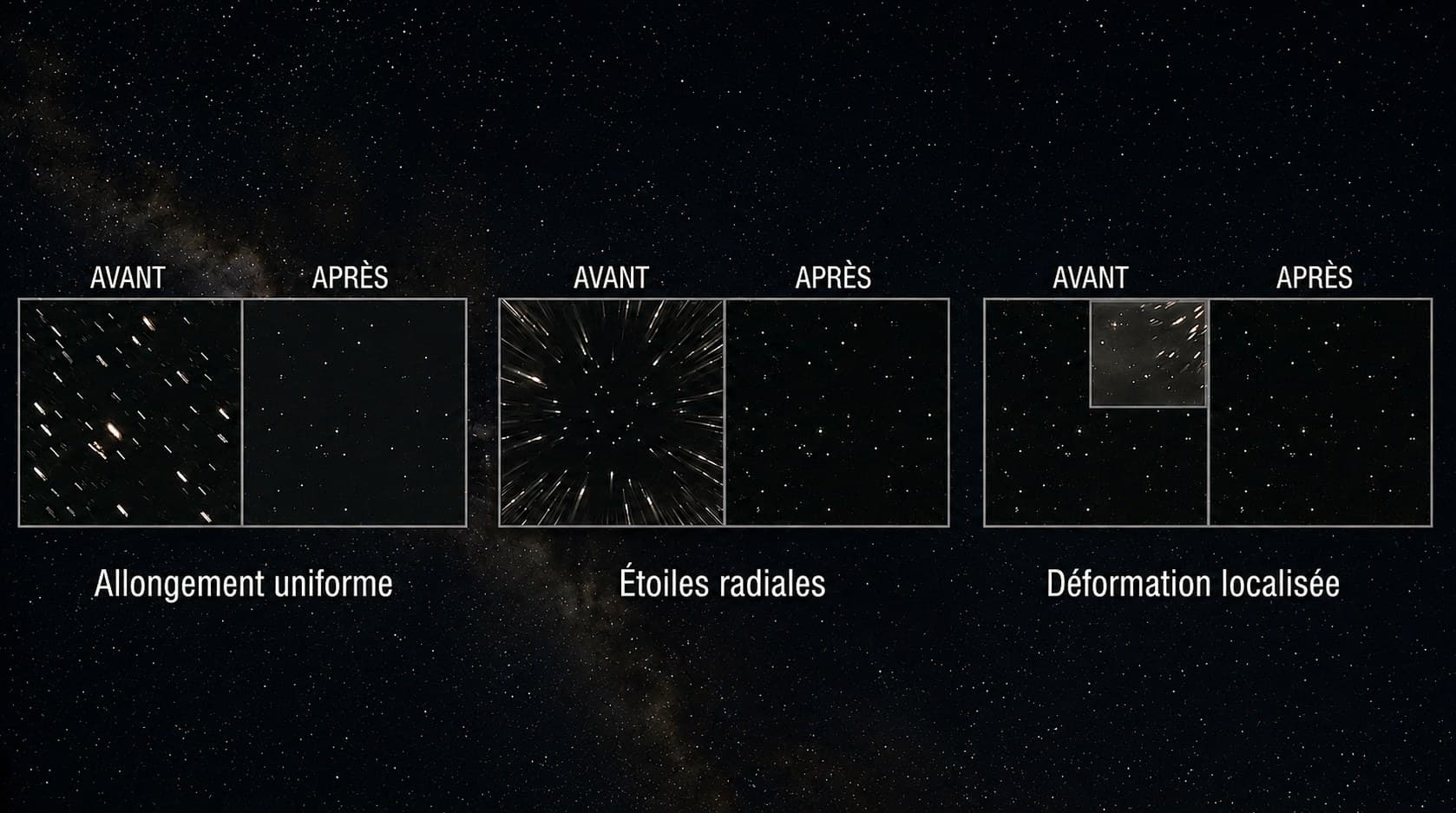
The image is a good Hα sub whose only significant defect is mechanical. The Moffat metrics are remarkably homogeneous from zone to zone (FWHM 2.5 to 2.7px, elong 1.18 to 1.40), with a corner/center ratio of 1.07 and near-zero FWHM asymmetry: this rules out tilt, backfocus, coma or astigmatism, which would degrade the edges while sparing the center. Here the center itself is elongated (1.32) and all major axes point in the same direction (PA ~85°, 6.5° dispersion). That signature, global iso-oriented elongation, is a tracking drift during the exposure, not optics.
The defect stays moderate: stars are not turned into streaks, just slightly ovalized, and the frame remains perfectly stackable. On the background side, the measured variation (+18%) matches IC 5070's nebulosity, confirmed by the DSS reference, not a vignetting or gradient: nothing to fix there. Calibration, color and processing are not assessable at this stage (mono pre-calibration sub).
In practice, improving guiding/polar alignment will tighten the stars and is the only lever that will take this set from good to excellent.
Priority actions
- Fix the tracking drift: check polar alignment and balance, then refine guiding (RA/DEC RMS) to remove the uniform star elongation
- Keep these acquisition settings (gain/offset/exposure/temperature), which are healthy for Hα under Bortle 2
- Stack several hours of exposures to fully exploit the excellent sky and bring out IC 5070's signal