Astrophotography diagnosis of IC 5070_biss3_HA: Tracking drift
Raw300s26 juin 2026
The Doc examined this image of IC 5070_biss3_HA (raw, 300s). Estimated overall technical quality: 6/10. 1 defect found: Tracking drift (severity 3/5).
&w=1920&q=75)
Info
- Cible
- IC 5070_biss3_HA
- Date
- 26 juin 2026, 23:45
- Lune
- Croissant décroissant 8.3% (8.8° d'alt., 97.7° de la cible)
- Site
- Bortle 2 · rural typique (VIIRS)
- Position
- 20h51m12s · +43°59'43"
Excellent sky conditions: Bortle 2 and a Moon at only 8.3% illumination, 97.7° from the target and 8.8° above the horizon, so no lunar impact. In Hα at 300s the background stays naturally low (e_margin 1.82), which is normal for this narrowband under a dark sky and does not indicate underexposure. For an emission nebula like the Pelican, this context is ideal: you can stack long subs with no light-pollution gradient or moonlight veil to fight.
Setup
- Type d'image
- Brut
- Télescope
- EQMod Mount
- Caméra
- ZWO ASI585MM Pro
- Exposition
- 300s
- Phase de lune
- Gibbeuse croissante (90 %)
- FOV
- 1.70°
Setup well matched to the target: 375mm focal length gives a 1.70° field that frames the eastern part of IC 5070 nicely, and the 1.595"/px sampling is comfortable for typical seeing. The Hα filter on a mono sensor is perfectly suited to this emission nebula, especially to exploit the Bortle 2 sky. On settings: gain 252 is high for the ASI585 but acceptable in narrowband (low flux), offset 15 with no dark clipping (0%), sensor temp -11.5°C is healthy. The 300s exposure is justified, provided the guiding (today's limiting factor) is made reliable.
The diagnosis in detail
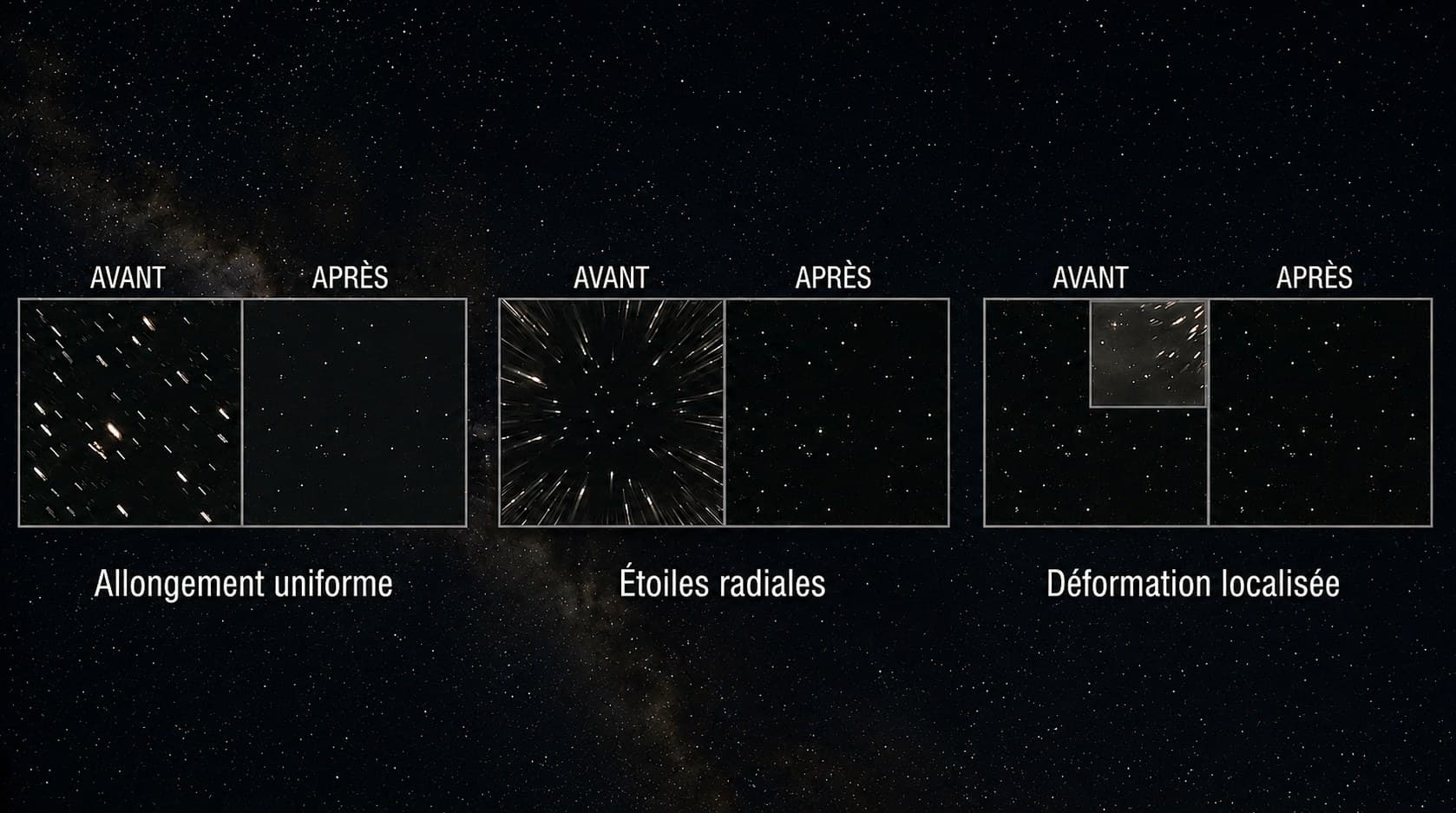
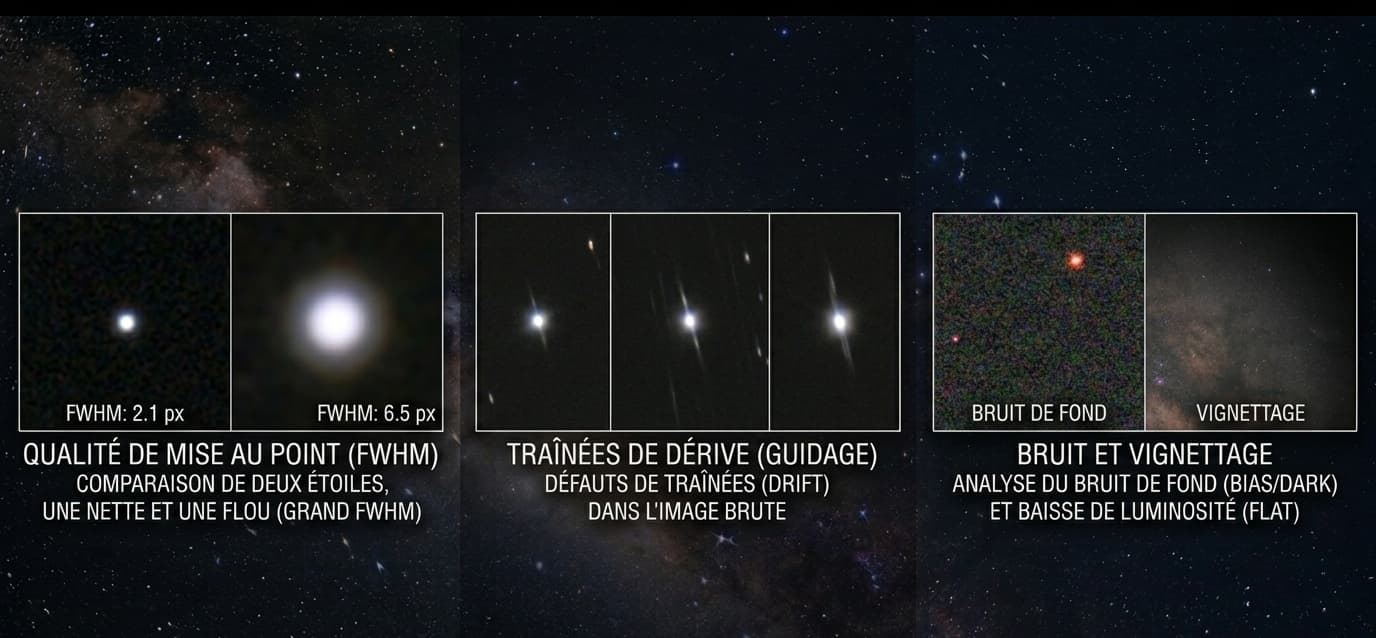
The verdict is simple: a good acquisition undermined by tracking. The PSF panel is unambiguous, the star elongation (elong 1.50 at center, field floor 1.27) is present everywhere, including at the central reticle, with only 4.3° of PA dispersion. An optical aberration (tilt, backfocus, coma) would spare the center and create a radial or diagonal asymmetry: that is not the case here. The 1.13 corner/center FWHM ratio and near-zero asymmetry confirm healthy optics. The cause is therefore mechanical: a mount drifting over the 300s, insufficient guiding or imperfect polar alignment.
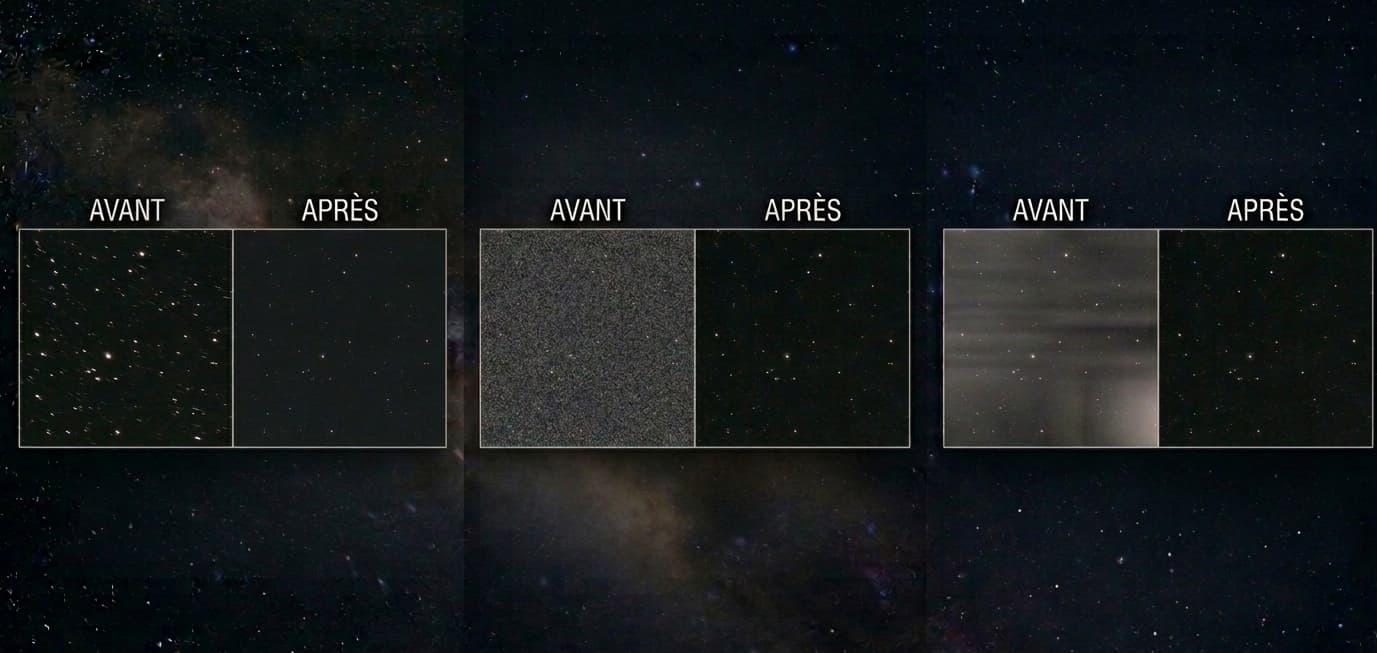
The rest is very clean. The sky background is homogeneous and the visible gradient corresponds to the real nebulosity of the Pelican (confirmed by the DSS), not a pollution gradient, consistent with Bortle 2 and the absence of the Moon. The Hα signal is well captured despite the single sub. No invasive hot pixels, no satellite trail, no calibration defect at this stage (uncalibrated raw).
In short, the image is one step from excellent: fix the guiding and you will get pinpoint stars over an already exemplary background.
Priority actions
- Make autoguiding reliable (PHD2) aiming for RMS < 0.7" to get round stars over 300s
- Redo a precise polar alignment before the session
- If guiding cannot hold 300s, lower the sub exposure to 180s and compensate with sub count