Astrophotography diagnosis of NGC 6888: Tracking drift
Raw300s21 juin 2026
The Doc examined this image of NGC 6888 (raw, 300s). Estimated overall technical quality: 7/10. 1 defect found: Tracking drift (severity 2/5).
&w=1920&q=75)
Info
- Cible
- NGC 6888
- Date
- 21 juin 2026, 00:10
- Lune
- Gibbeuse décroissante 59.7% (sous l'horizon)
- Site
- Bortle 2 · rural typique (VIIRS)
- Position
- 20h10m35s · +38°14'21"
Excellent conditions: Bortle 2 and the Moon below the horizon (waning gibbous at 59.7% but at 121.5 degrees and not risen) rule out any lunar pollution. For an emission target like NGC 6888 in Ha this is ideal: the background is very dark and SNR is maximal even on a single sub. No sky-side constraint here, the only limiting factor is the mechanical tracking, not the light environment. You can stack confidently and aim for deep integrations without fearing gradients.
Setup
- Type d'image
- Brut
- Télescope
- EQMod Mount
- Caméra
- ZWO ASI585MM Pro
- Exposition
- 300s
- Phase de lune
- Premier croissant (34 %)
- FOV
- 1.70°
Setup consistent with the target. At 375mm and 1.595 arcsec/px on the ASI585MM, the 1.70 degree field keeps NGC 6888 well centered with room for the surrounding nebulosity, a good compromise. Sampling at ~1.6 arcsec/px is comfortable under typical seeing, without oversampling. On settings, gain 220 is high for this sensor but reasonable in Ha where sensitivity is favored; cooling at -14.5C is healthy. The background/black-point margin e_margin 2.14 is low but NORMAL in narrowband at 300s (the narrow filter passes little background flux), it is not an underexposure to fix.
The diagnosis in detail
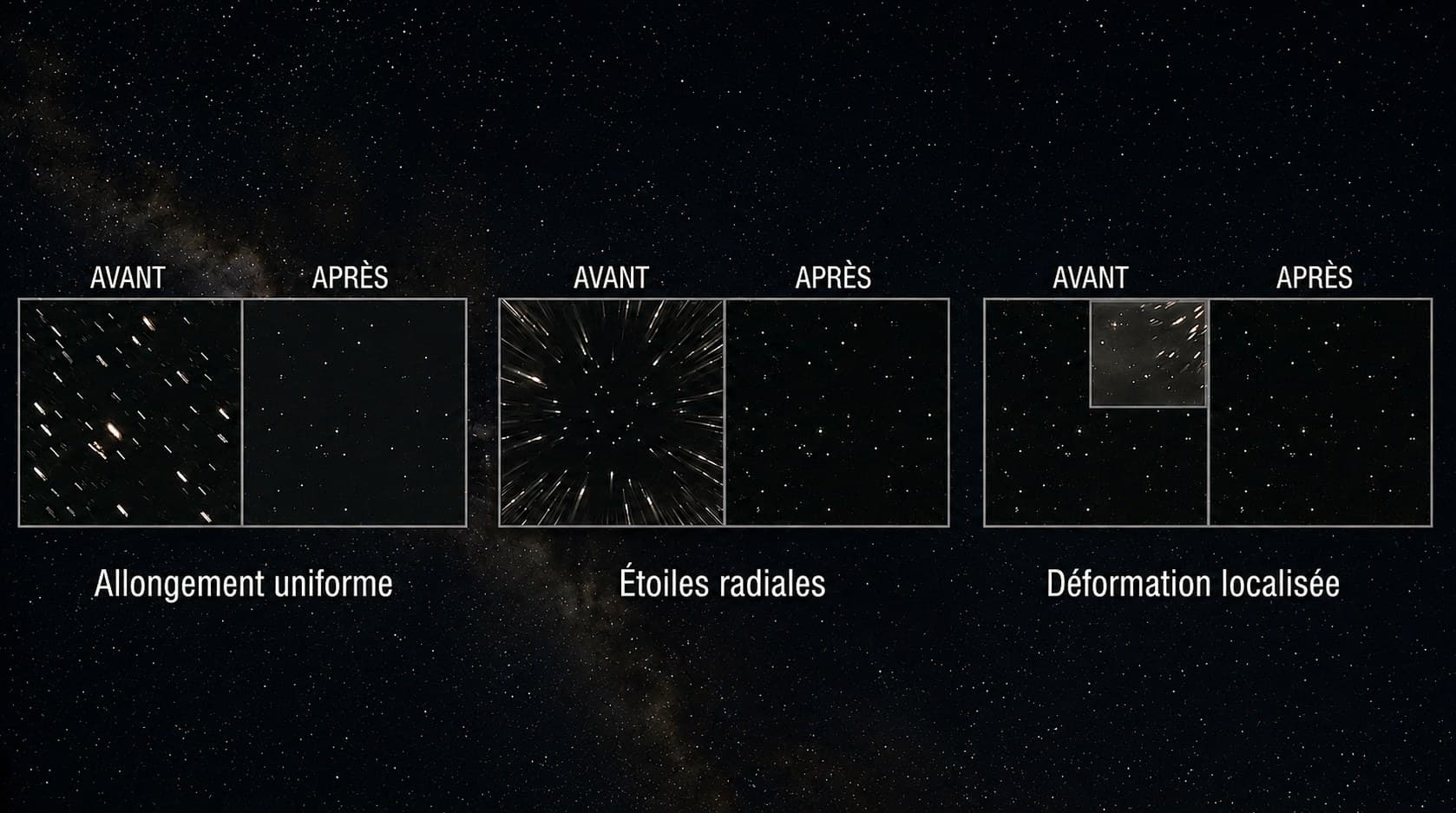
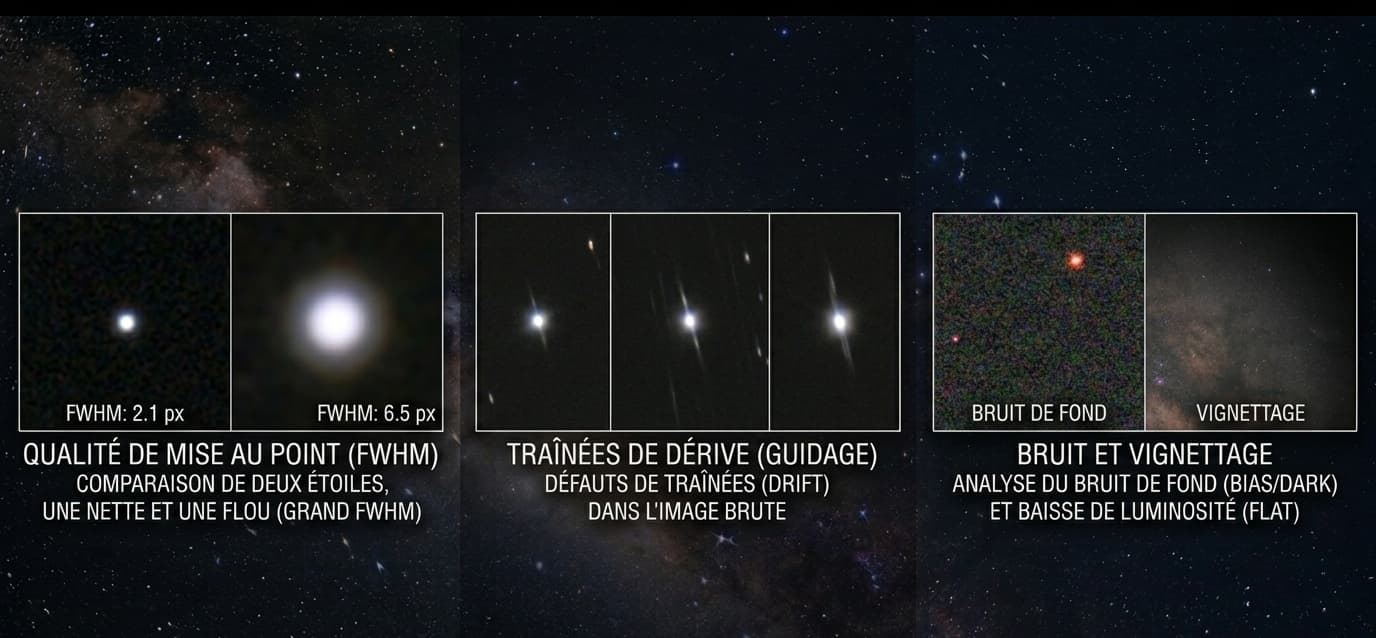
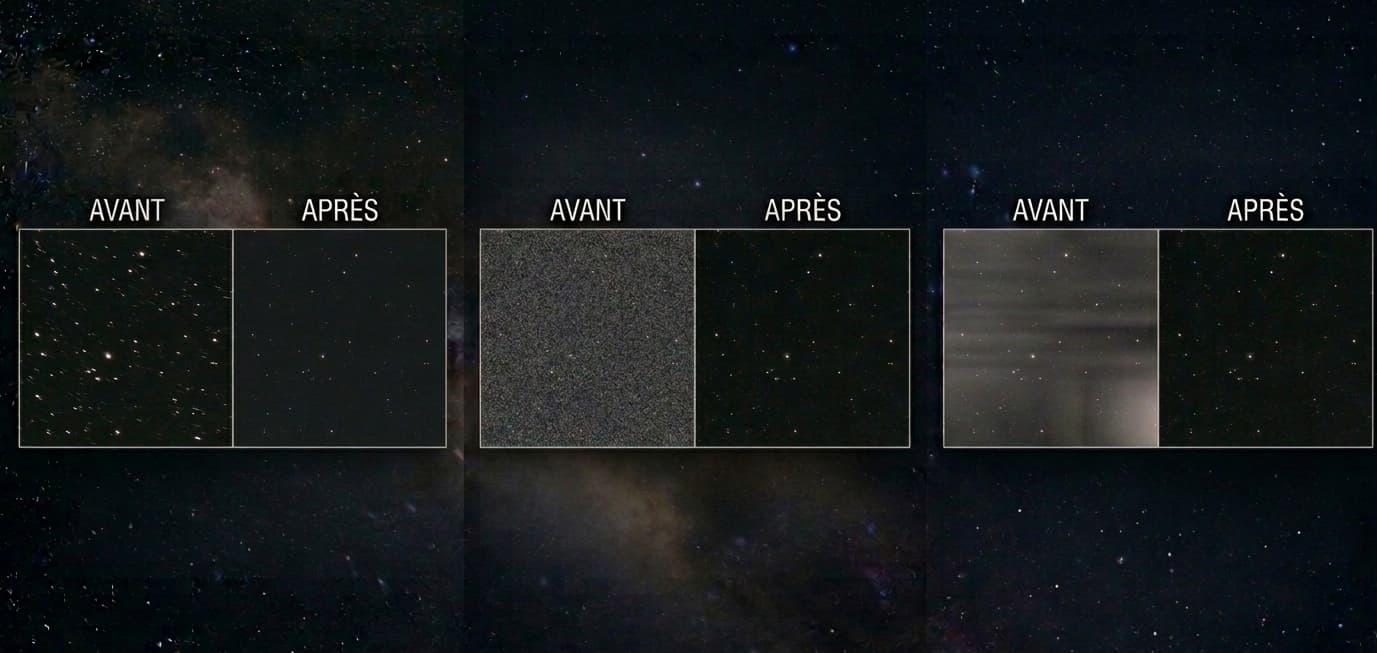
Overall a clean image, the diagnosis centers on a single point. The PSF panel shows generally tight stars (center FWHM 2.6 px, ~4.2 arcsec) but slightly stretched: the 1.19 elongation at center, just above the monochrome floor, combined with low PA dispersion (14 degrees), indicates a uniform directional component typical of tracking drift rather than an optical aberration. Corners rise to 1.5-1.74 (mainly TL/L/BL), adding a small edge contribution, but since the center is not round, tracking dominates the verdict.
The sky background is healthy: the illumination map is flat (radial profile 0%, plane gradient only 1%), so no vignetting or gradient to report, which is logical under Bortle 2 with the Moon absent. The diffuse clouds in the top-left corner appear in the DSS reference: this is real galactic gas, to be kept, not an artifact.
In summary, on a 300s sub this is a very good starting point. The single priority is to tighten tracking to improve star roundness; everything else (framing, optical calibration, sky) needs no action.
Priority actions
- Improve tracking: refine polar alignment and tune autoguiding to aim for perfectly round stars (center elong < 1.15)
- Keep the diffuse nebulosity in the top-left corner during processing: it is real IFN, not a gradient to remove