Astrophotography diagnosis of ic'"': Light pollution gradient, noise / underexposure and 3 others
Processed
The Doc examined this image of ic'"' (processed). Estimated overall technical quality: 6/10. 5 defects found: Light pollution gradient (severity 4/5), Noise / underexposure (severity 3/5), Sensor tilt (severity 2/5), Clipped stars (severity 2/5), Background chroma noise (severity 2/5).

Info
- Cible
- ic'"'
- Position
- 5h41m00s · -2°27'00"
Waxing gibbous Moon at 80%: that is the dominant factor of this session. On a complex like IC 434 / NGC 2024 imaged in broadband, such lunar illumination injects substantial background luminance, drops the contrast of the dark parts of the Horsehead and directly feeds the measured 224% gradient. The result is still respectable given that constraint, but you pay for it in background SNR. For this target, two options: switch to dual-band or Ha (IC 434 is an emission nebula, it handles moonlight very well), or shift the session toward last quarter or new Moon for a clean RGB. Orion being well placed for much of the winter night, shifting is easy to arrange.
Setup
- Type d'image
- Traitée
- Phase de lune
- Gibbeuse croissante (80 %)
- FOV
- 30.0'
The 0.50 degree wide field is very tight for this complex. You catch the Horsehead, NGC 2023 and part of the Flame, but IC 434 and NGC 2024 are cropped at the edges, which leaves little clean sky to place gradient removal samples. A 1.5 to 2 degree field would be more comfortable for this region and would make gradient removal far more reliable. On sampling, a 6.8 px FWHM at center is high: either the image is oversampled relative to the seeing, or focus was not optimal. A 2x2 binning or a shorter focal length would give back SNR per pixel without losing real detail.
The diagnosis in detail
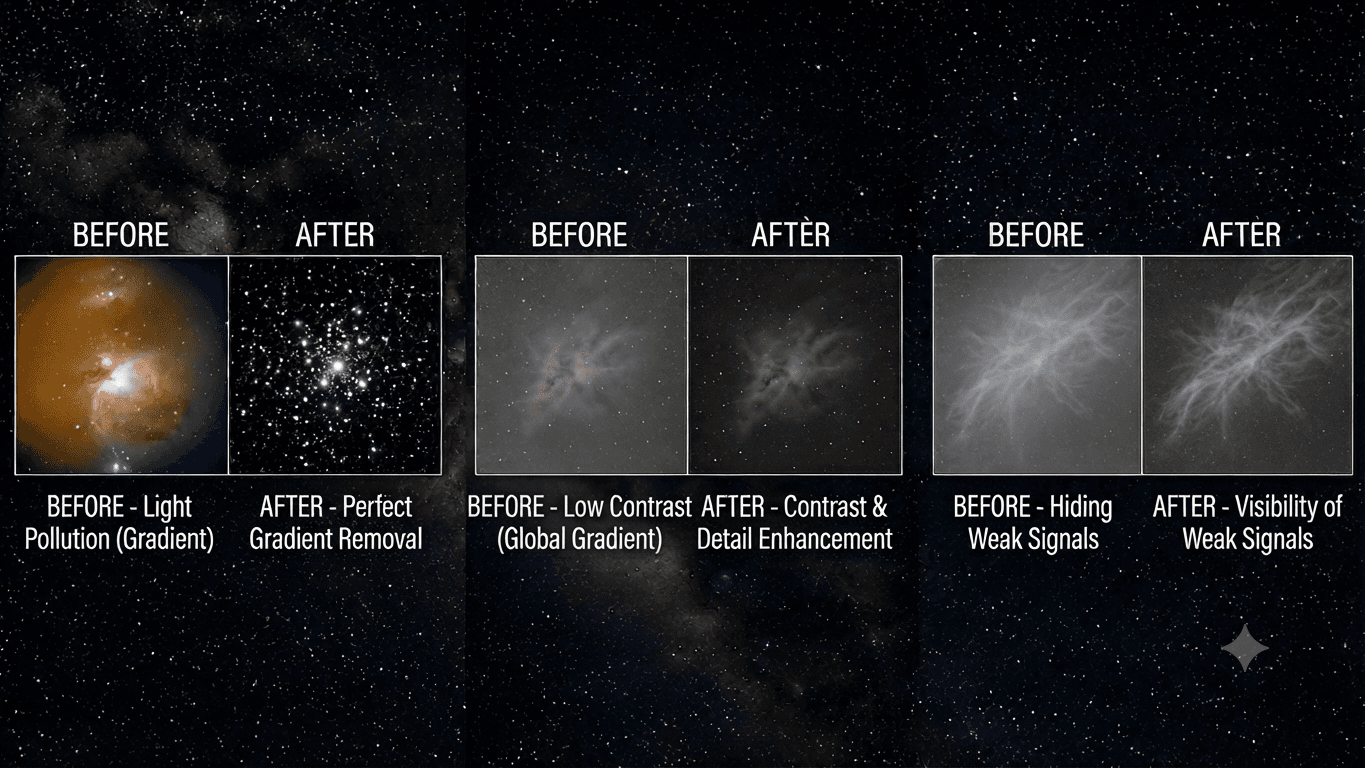
Two independent causes explain most of what limits this image. The first is the sky background: the gradient measured at 224% amplitude oriented 220 degrees clearly dominates the radial component (ratio 2.5), so it is external in origin, 80% gibbous Moon plus light pollution, and not a flat issue. Combined with a very low background/black point margin (e_margin 1.02), it forced a stretch that crushes the low lights and brings out the grain and colored mottling of the background. Correcting the gradient upstream, on the linear image, would mechanically free up contrast on the faint extensions.
The second is optical. The field center is the sharpest zone (FWHM 6.75 px) but FWHM rises in a single-axis way toward the bottom, 8.65 px at B and 8.82 px at BR, with a vertical asymmetry of 0.086 against 0.038 horizontally. That is the pattern of a slightly tilted focal plane rather than field curvature, which would be symmetric. The effect stays moderate here, but it adds to an already high FWHM at center.
Finally, processing: the cores of the bright stars, Alnitak first of all, are clipped to neutral white with no color gradient, and background chroma noise remains visible for lack of integration. Nothing fatal, but these three points together explain the slightly flat rendering of IC 434.
Priority actions
- Redo the gradient removal on the linear image with GraXpert or DBE, samples outside the nebulosity, before any stretch
- Greatly increase total integration to lift the background off the black point and bring the grain down
- Measure and correct the optical train tilt on the vertical axis of the field with an adjustment screw adapter
- Add short exposures to rebuild the cores of Alnitak and the other bright stars in HDR
- Favor a moonless window, or a dual-band filter, for the next session on this complex