Astrophotography diagnosis of IC1396: Tracking drift and background chroma noise
ProcessedAntlia Narrowband 3nm40 X 300
The Doc examined this image of IC1396 (processed, Antlia Narrowband 3nm, 40 X 300). Estimated overall technical quality: 8/10. 2 defects found: Tracking drift (severity 2/5), Background chroma noise (severity 2/5).
&w=1920&q=75)
Info
- Cible
- IC1396
- Position
- 21h38m60s · +57°30'00"
The session ran under a 99% waxing gibbous Moon, essentially full, normally the worst possible context. This is exactly where 3nm narrowband saves the night: on an emission region like IC1396, an Antlia 3nm filter rejects most scattered moonlight, and the resulting background here stays clean and dark, with no measurable lunar gradient. Shooting this target that night was a sound choice rather than a compromise. One caveat: under a full Moon the OIII channel remains the most penalized (wider effective sky band and intrinsically weaker signal), which partly explains the residual background noise. If you can, save clear moonless nights for OIII and SII subs.
Setup
- Type d'image
- Traitée
- Télescope
- ASKAR FRA 400
- Caméra
- ZWO ASI 2600 MM
- Filtre
- Antlia Narrowband 3nm
- Monture
- Zwo AM5
- Exposition
- 40 X 300
- Phase de lune
- Gibbeuse décroissante (99 %)
- FOV
- 2.80°
Target and instrument match is excellent. IC1396 spans nearly 2.5 to 3 degrees, and your 2.80 degree wide field contains it fully while leaving surrounding nebulous context: framing is snug without being cramped. The FRA 400 (400mm focal length) with the ASI2600MM gives comfortable sampling, consistent with the measured FWHM around 4 px, with no wasteful oversampling. The AM5 plus 300s combo is reasonable, but that is where the headroom lies: the residual central elongation shows tracking is at its limit over that duration. Either refine guiding, or drop to 180-240s with more frames, since per-sub SNR stays comfortable at 3nm.
The diagnosis in detail
This is a technically solid image whose two limits come from the same place: the signal to noise of the weak channels and mechanical stability, not the optics. On the PSF side the measurements are unambiguous: a corner/center FWHM ratio of 1.038 and no diagonal asymmetry (0.04 horizontal, 0.016 vertical) show the FRA 400 works perfectly flat across the whole APS-C surface. No tilt, no backfocus error, no coma. This is a well tuned optical train.
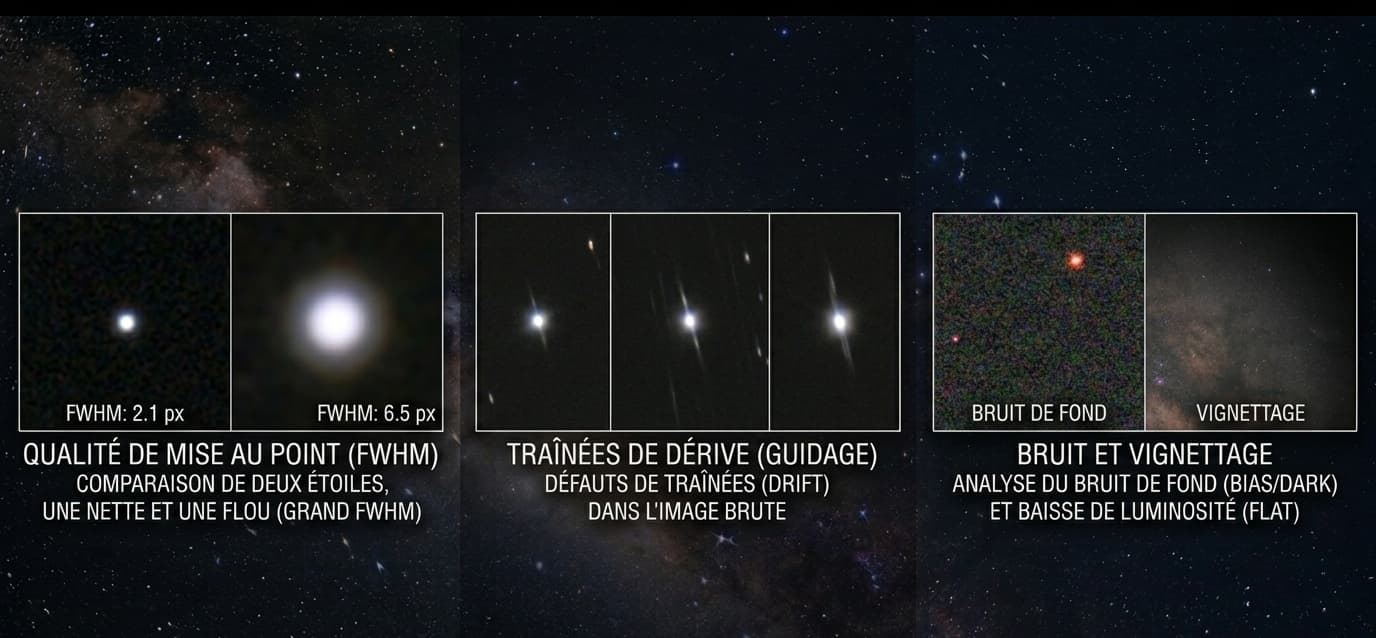
However, the strongest elongation is measured at the field center (1.13 against a 1.03 floor), which structurally rules out an optical cause: a field aberration spares the axis. That signature, combined with a PA spread of only 21.5 degrees, points to tracking drift accumulated over the 300s subs. The amplitude stays low and the image is perfectly usable, but this is the factor capping star sharpness.
Finally, the background reveals color mottling in the dark areas, a classic consequence of an SHO palette where OIII and SII are stretched harder than Ha to balance the hues. More time on those two channels, rather than heavier denoising, is the real answer.
Priority actions
- Refine AM5 polar alignment and guiding to bring central elongation down to the field floor (1.03)
- Add integration time on the OIII and SII channels to reduce background chroma noise
- Consider shortening subs to 180-240s if guiding cannot be stabilized over 300s
- Apply masked chroma noise reduction on the background in the next processing pass