Astrophotography diagnosis of IC5070_HA: Tracking drift
Raw200s25 mai 2026
The Doc examined this image of IC5070_HA (raw, 200s). Estimated overall technical quality: 5/10. 1 defect found: Tracking drift (severity 3/5).
&w=1920&q=75)
Info
- Cible
- IC5070_HA
- Date
- 25 mai 2026, 00:02
- Position
- 20h52m00s · +44°23'60"
Moon at first quarter (60% illumination) on the capture night: for an emission target imaged in narrowband Ha, this is perfectly workable since the filter rejects most of the Moon's scattered light. The background stays dark and clean, with no marked moon gradient in the image. You can keep using these gibbous nights in narrowband with no real penalty; save moonless nights for broadband RGB and star layers.
Setup
- Type d'image
- Brut
- Caméra
- ASI Camera (1)
- Exposition
- 200s
- Phase de lune
- Premier quartier (60 %)
- FOV
- 1.50°
Sampling of 1.41 arcsec/px with 2.9um pixels: comfortable and well matched to typical seeing, neither over- nor under-sampled. The 1.5deg field only captures a portion of IC5070, a legitimate framing to target a detail of the Pelican's wisps. 200s exposure at -18C with moderate gain: healthy on the sensor side. The background-to-blackpoint margin is low (e_margin 1.83) but that is NORMAL in narrowband Ha, do not push exposure for it. The real limit is not optical but mechanical: without guiding, 200s is too long for your mount.
The diagnosis in detail
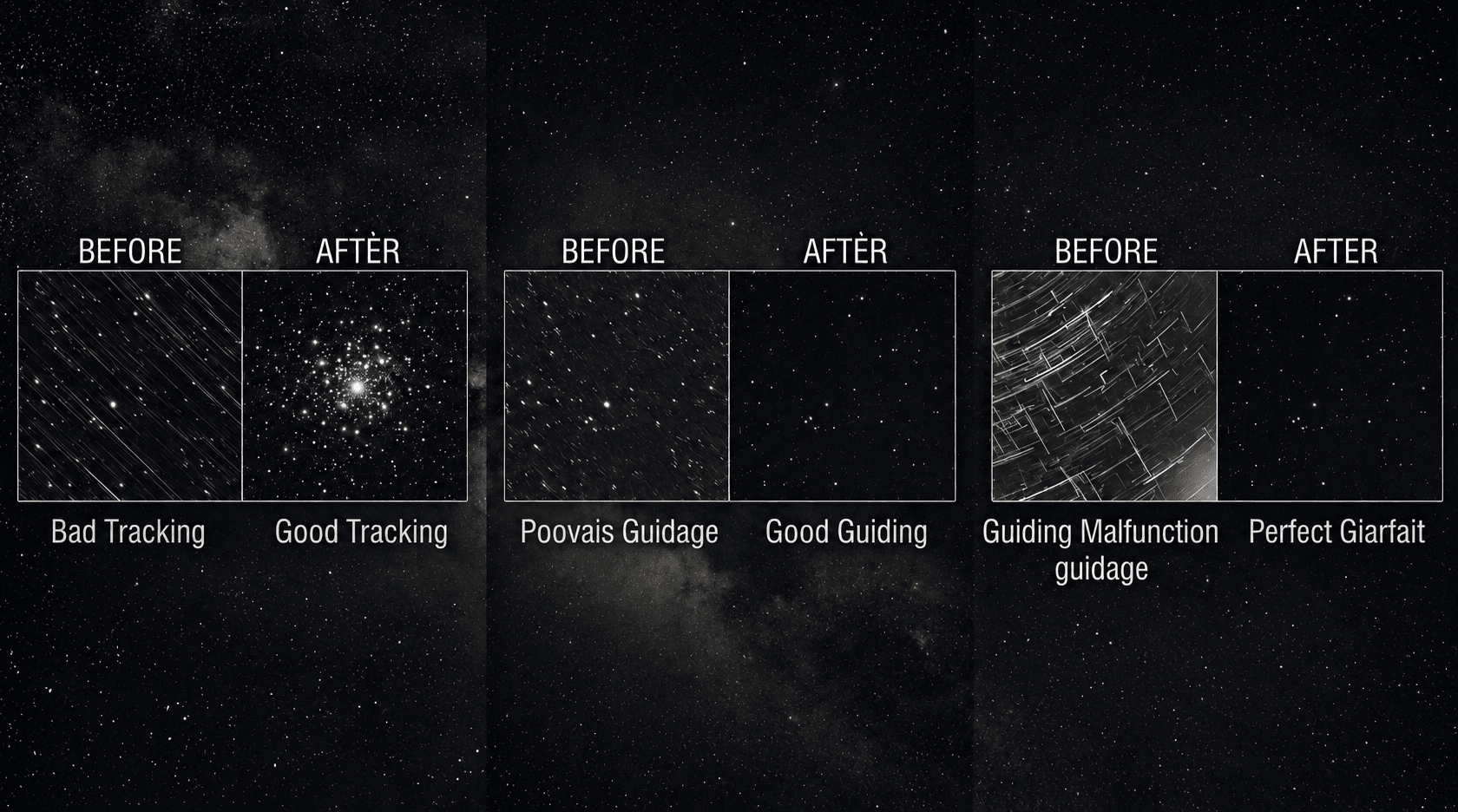
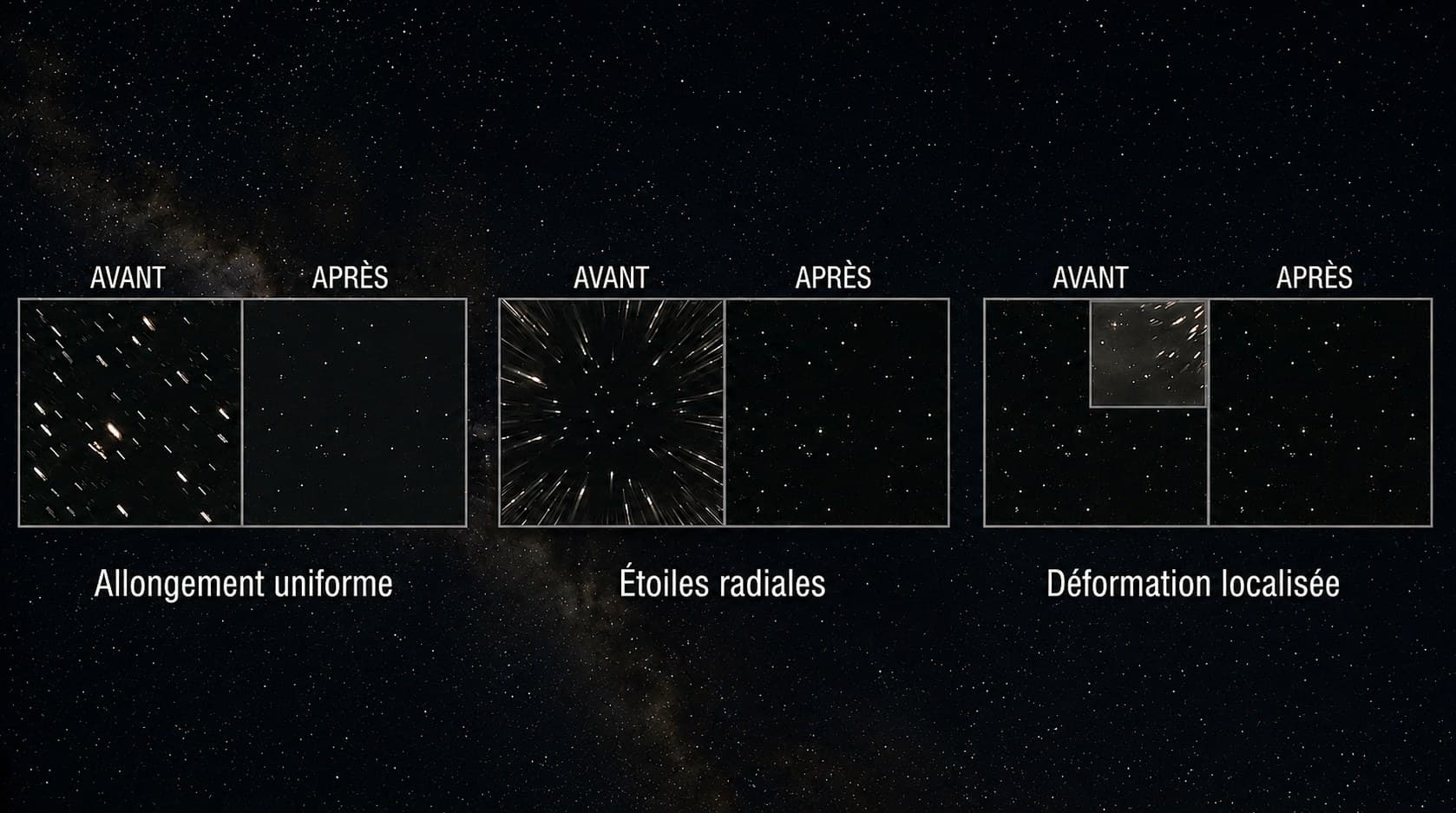
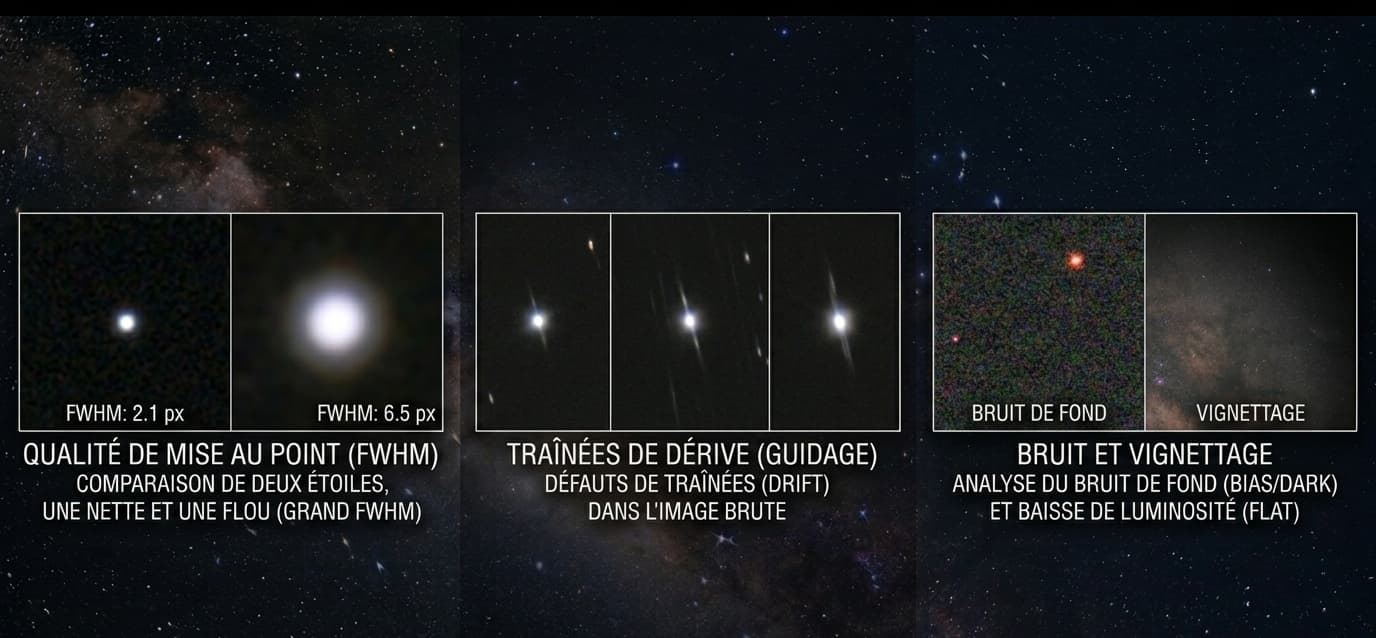
The diagnosis is unambiguous on the mount side. The preview and the PSF panel agree: stars are stretched uniformly across the whole field, center included, with measured elongation between 2.3 and 4.8 depending on zone. An optical aberration (tilt, backfocus, coma) would preferentially degrade the edges while sparing the center, which is not the case here; the uniform, oriented elongation points to a tracking drift during the 200s exposure. The broadly consistent direction favors a drift (polar alignment or lack of guiding) over a guiding oscillation, but a series would let you settle it against pe-unguided.
The rest is encouraging. The Ha signal is well captured: the Pelican structures match the DSS reference faithfully, the background is clean with no moon gradient despite the first quarter, which validates the narrowband choice. The radial edge darkening (+24%, rotational symmetry) is plain optical vignetting, expected on an uncalibrated sub, to be neutralized with flats. The low exposure margin is typical of a narrowband channel and does not reflect underexposure.
In short: a usable base once tracking is fixed. As long as stars stay as dashes, stacking will lock in this defect and the stars will remain ugly even with a good nebula.
Priority actions
- Sort out tracking first: enable autoguiding and refine polar alignment to get round stars
- If guiding stays unavailable, shorten the sub exposure to 60-120s
- Acquire flats to correct the edge vignetting
- Check mount balance and mechanical tensions