Astrophotography diagnosis of IC5070_HA: Tracking drift
Raw200s25 mai 2026
The Doc examined this image of IC5070_HA (raw, 200s). Estimated overall technical quality: 5/10. 1 defect found: Tracking drift (severity 3/5).
&w=1920&q=75)
Info
- Cible
- IC5070_HA
- Date
- 25 mai 2026, 00:52
- Position
- 20h52m00s · +44°23'60"
First-quarter Moon at 61% on acquisition night: in broadband that would be a problem, but on an emission target shot in Hα the impact is largely filtered out, and the background stays clean with no measurable moon gradient here. Conditions are therefore acceptable for this kind of capture. You can use these moonlit nights for narrowband emission targets like the Pelican, keeping broadband RGB and galaxies for moonless nights.
Setup
- Type d'image
- Brut
- Caméra
- ASI Camera (1)
- Exposition
- 200s
- Phase de lune
- Premier quartier (61 %)
- FOV
- 1.50°
Sampling of 1.41″/px for a 1.50° field is comfortable and well matched to typical seeing, neither over- nor under-sampled, and IC5070 fits easily in the frame. The cooled monochrome sensor at -18°C is healthy (no thermal concern expected). The 200 s Hα exposure gives a background only slightly off the black point (e_margin 1.8), which is normal in narrowband and should not be penalized. The real limiting factor is not the optical setup but the tracking chain: holding 200 s cleanly requires reliable guiding.
The diagnosis in detail
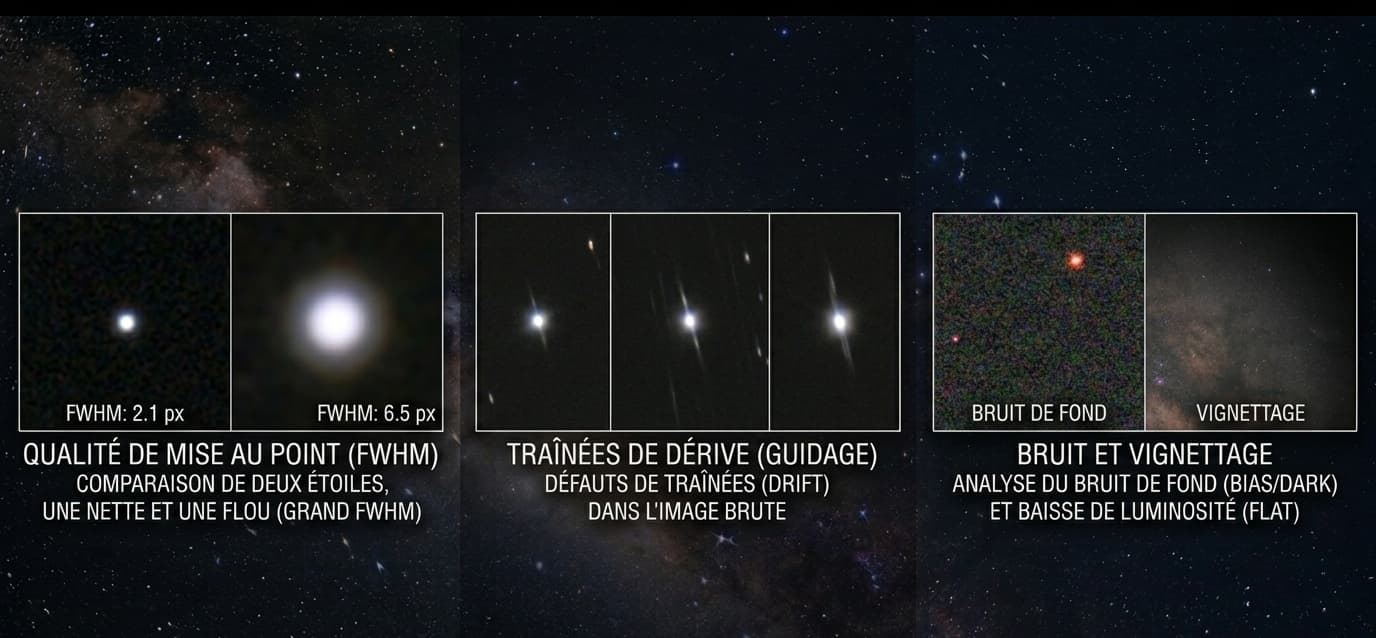
Validation frame of an Hα sub on the Pelican Nebula (IC5070). The nebular signal is real: the dark lanes and bright ridges of the Pelican's head are faithfully found in the DSS reference, so nothing to mistake for a background artifact. The background map shows darker edges (+23%, radial symmetry) typical of optical vignetting not yet corrected by flats, which is expected on a raw sub and not a defect at this stage.
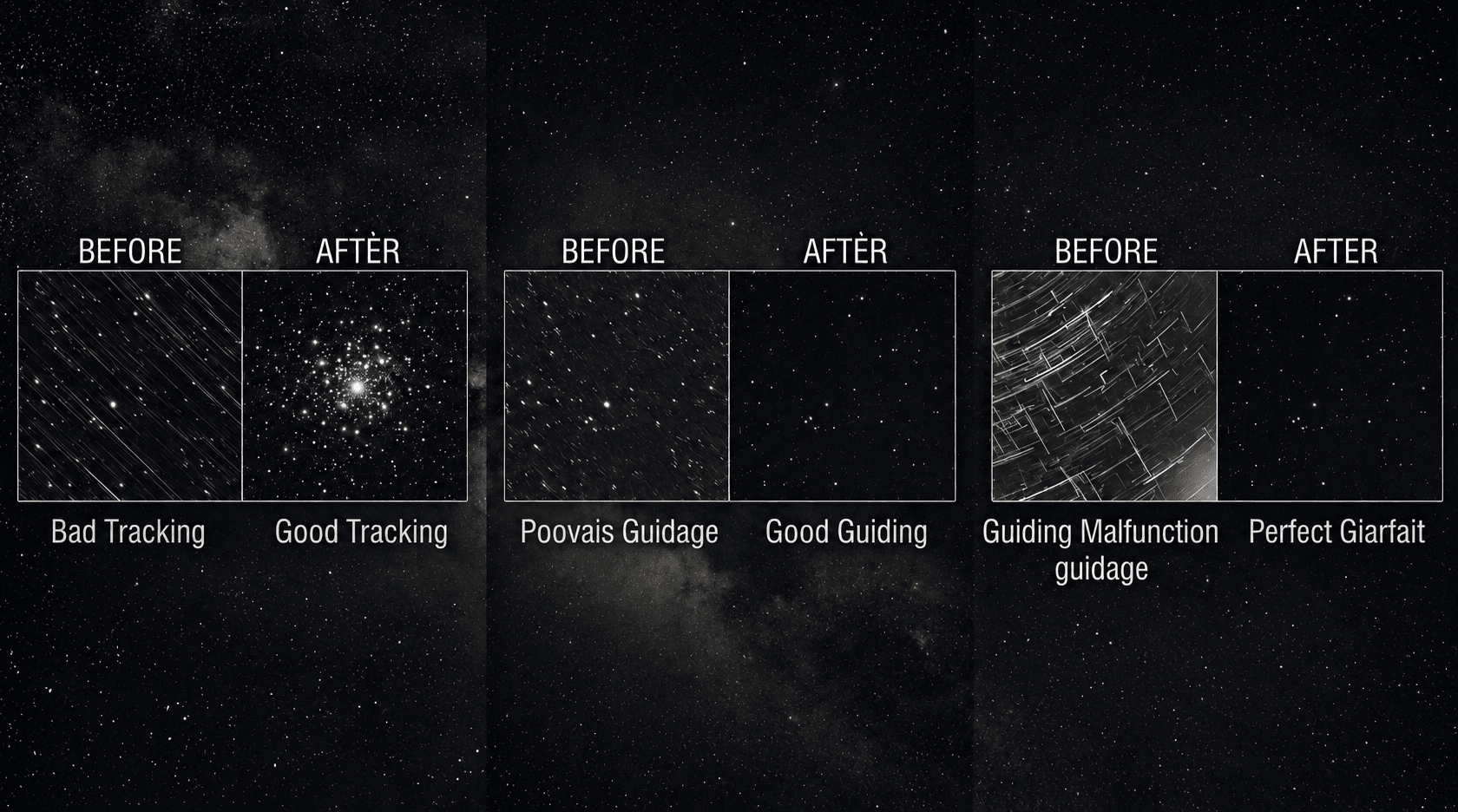
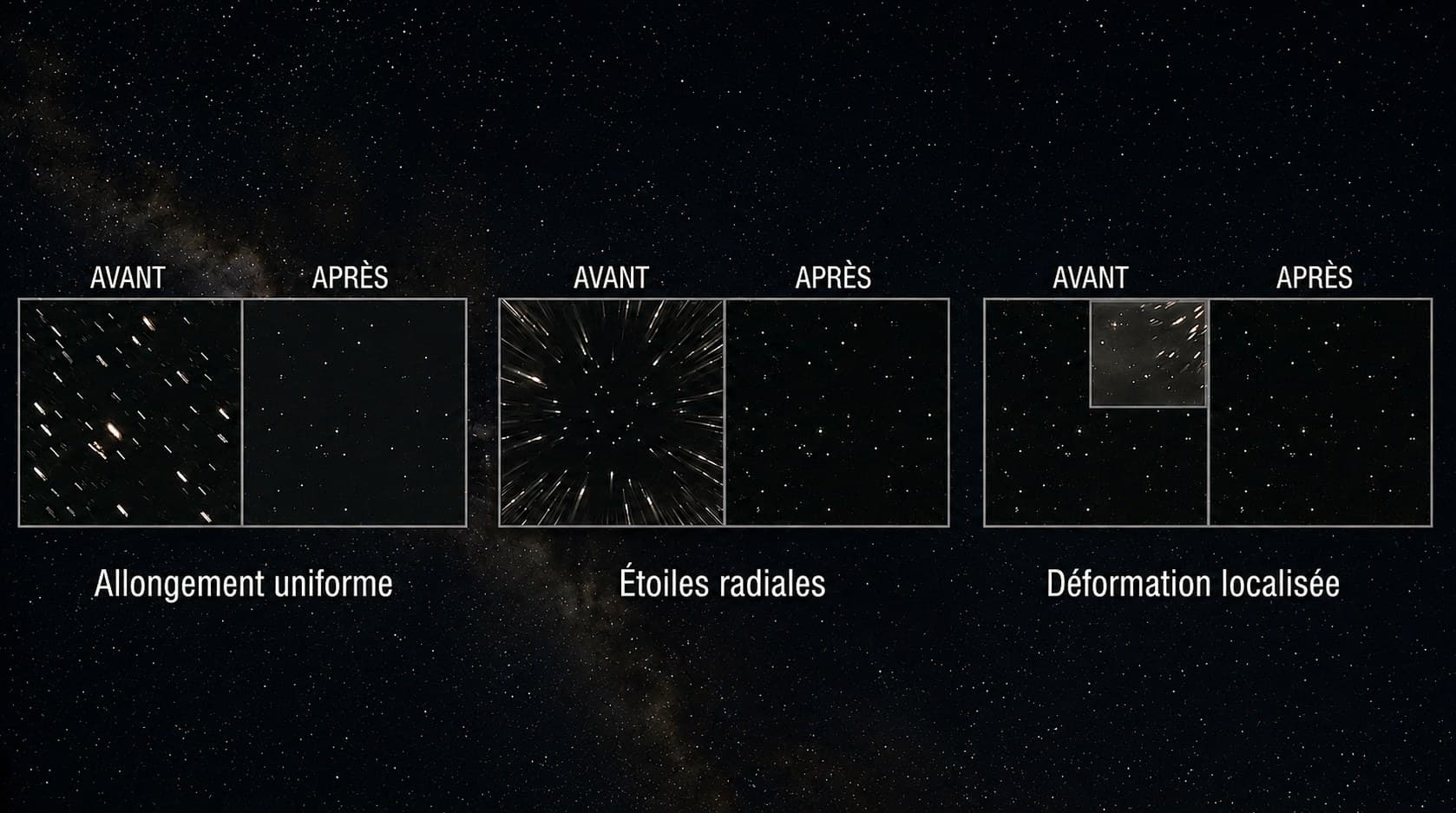
The only true issue is tracking. Stars, including the brightest ones, form small vertical dashes oriented in the same direction and of comparable length across the entire field. This directional uniformity, with no rotation center and no preferential corner degradation, points to tracking drift during the 200 s rather than an optical aberration. The Moffat metrics show high elongations but rely on unstable fits (minor axis 0.3 px), hence the indeterminate pre-verdict; I therefore rely on the consistent visual appearance.
In practice, optics and sampling are good, the target is well framed, and future calibration (flats) will smooth the vignetting. The priority is to get round stars: rigorous polar alignment and autoguiding, or shorter exposures if shooting unguided.
Priority actions
- Fix tracking: improve polar alignment and enable/tune autoguiding to hold 200 s with round stars
- If unguided, shorten the sub length and stack more subs
- Take flats to correct the vignetting visible at the field edges