Astrophotography diagnosis of M 31_100926: Tracking drift
Raw300s09 sept. 2026
The Doc examined this image of M 31_100926 (raw, 300s). Estimated overall technical quality: 7/10. 1 defect found: Tracking drift (severity 2/5).
&w=1920&q=75)
Info
- Cible
- M 31_100926
- Date
- 09 sept. 2026, 20:56
- Lune
- Gibbeuse croissante 98% (sous l'horizon)
- Site
- Bortle 2 · rural typique (VIIRS)
- Position
- 0h44m45s · +40°39'08"
Excellent conditions: Bortle 2 and the Moon below the horizon, 117 degrees from the target, so no lunar contribution is possible on this sub. It shows in the background measurement: flat radial profile, zero gradient amplitude, zero azimuthal anisotropy. On a broadband galaxy like M31 this is exactly the context you want, the faint outer halo signal is not drowned by a parasitic sky background. With a sky this dark you can afford long exposures without saturating the background, and prioritize accumulating hours rather than filtering. No reason to postpone the session.
Setup
- Type d'image
- Brut
- Télescope
- EQMod Mount
- Caméra
- ZWO ASI585MM Pro
- Exposition
- 300s
- Phase de lune
- Dernier croissant (4 %)
- FOV
- 3.36°
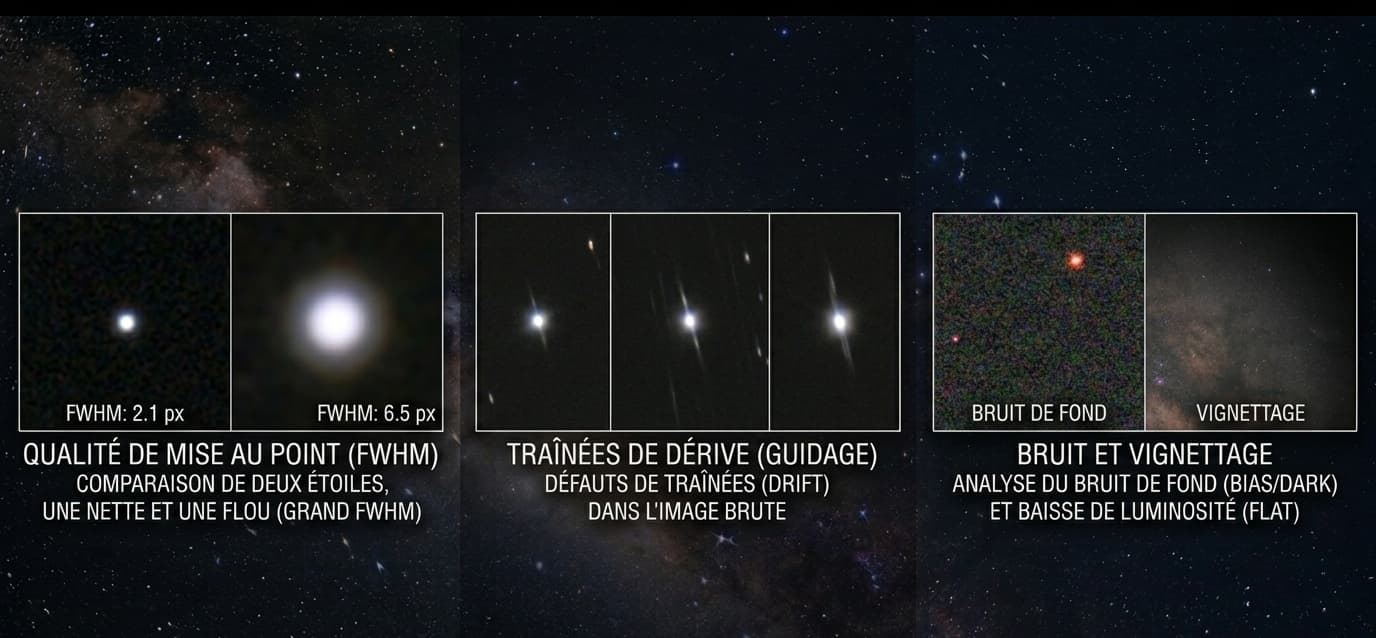
The setup fits the target: 190mm of focal length gives a 3.36 degree field, M31 and its companions fit comfortably with room for the outer halo, and the framing is good. However, sampling at 3.15 arcsec/px is clearly undersampled, confirmed by the measured FWHM of only 1.4 to 1.6 px: stars span barely a pixel and a half, you lose resolution and shape measurement becomes fragile. That is not a problem on an extended target like M31, but it means any tracking imprecision shows up immediately. On settings, gain 160 and -21.5C are healthy; offset 15 produces no dark clipping. The background-to-black-point margin e_margin=2.02 stays low: in broadband under Bortle 2 that simply reflects a very dark sky, not a problematic underexposure.
The diagnosis in detail
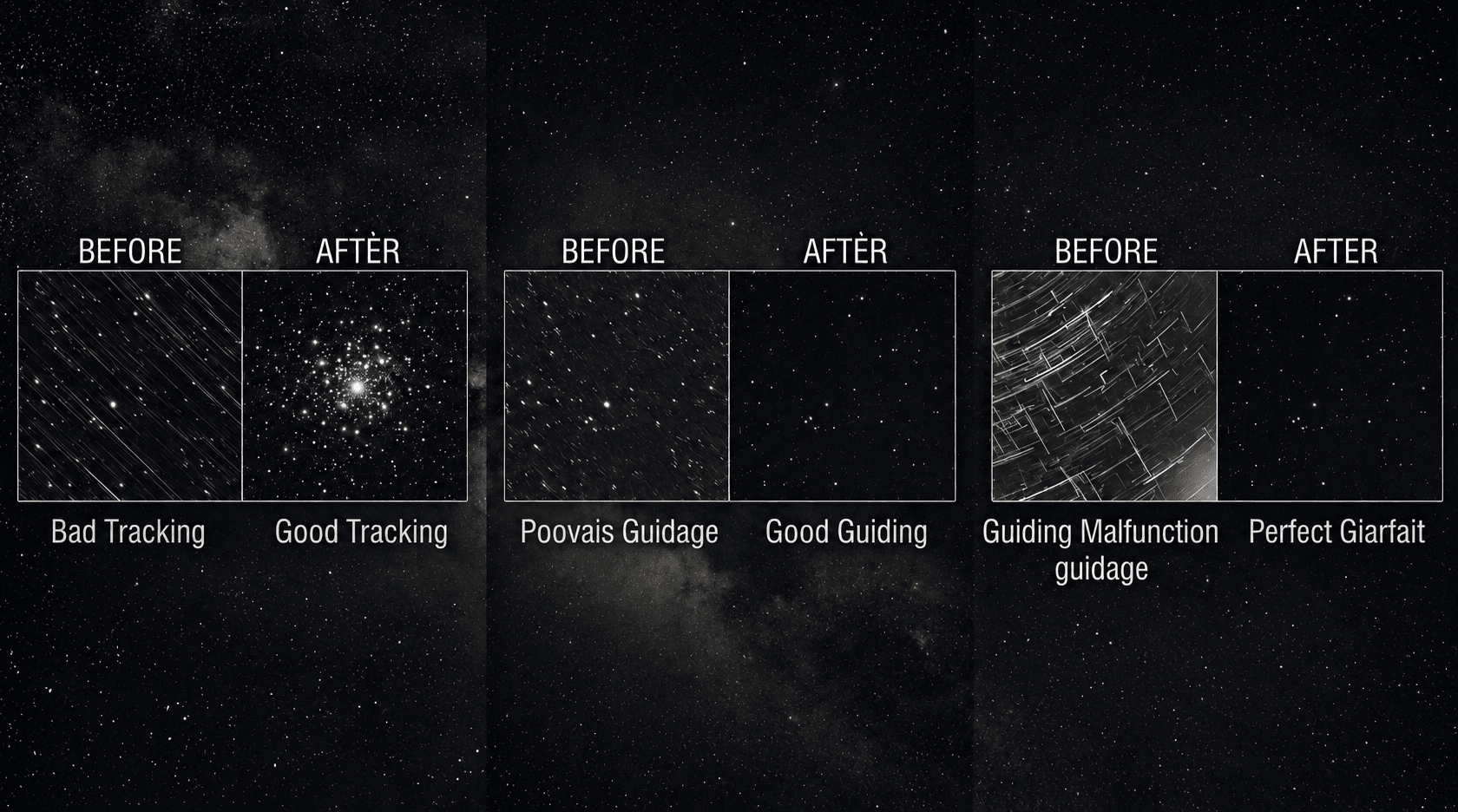
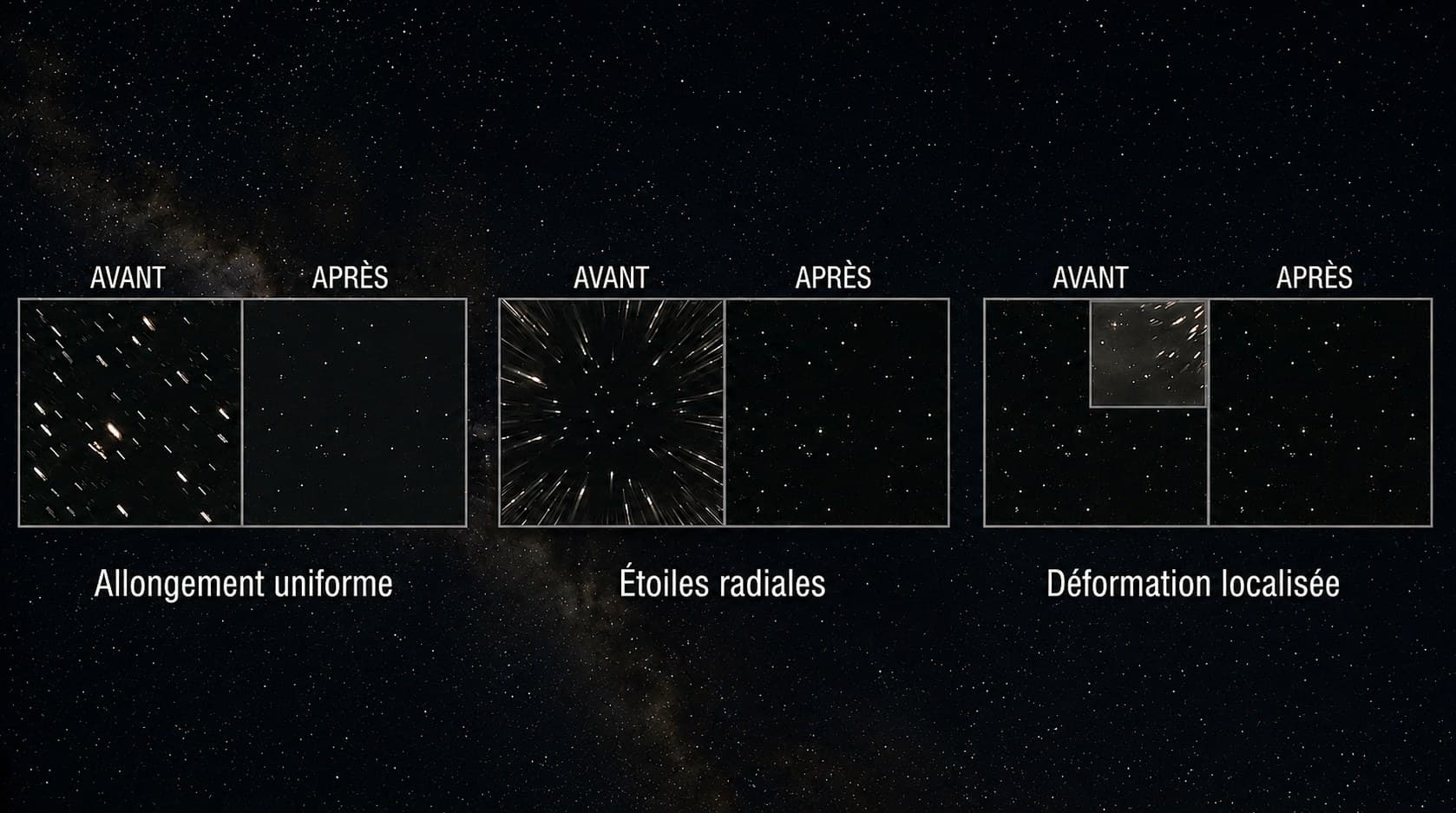
The diagnosis comes down to one point: the star deformation is not optical, it is mechanical. The proof is the corner/center FWHM ratio of 1 and the near-zero horizontal and vertical asymmetry (0.018 and 0.042). Tilt, incorrect backfocus or coma would degrade the edges while sparing the center. Here it is the opposite: the center is the most elongated zone (1.37) while the corners are the cleanest (TR 1.14, BR 1.15). A deformation present at the center can only come from image motion on the sensor during integration.
The direction confirms it: PA clustered around 80 to 87 degrees at the center and the top and bottom edges, overall scatter of 10.7 degrees, which describes a coherent translation rather than an oscillation. This is slow drift, not periodic error nor a guiding rebound. Over 300s at 3.15 arcsec/px, an elongation of 1.37 corresponds to roughly 1.5 to 2 arcsec of motion over the exposure, so a small but real drift, typically imperfect polar alignment or no guiding at all.
The rest is good: the background is flat in the strict sense (radial and plane amplitude at 0%), and the low R-squared of the models reflects the absence of structure to fit, not a measurement failure. The nebulosity visible around the bulge matches the M31 arms in the DSS, no background artifact. The two satellite trails will vanish under sigma rejection.
Priority actions
- Redo polar alignment with the NINA or SharpCap polar alignment routine before the next session
- Set up or tune PHD2 autoguiding, targeting total RMS below 1 arcsecond
- Enable dithering between exposures, useful both against satellite trails and walking noise
- Collect enough subs (10 minimum) so sigma rejection cleanly removes the trails