Astrophotography diagnosis of M 31_100926: Tracking drift
Raw300s09 sept. 2026
The Doc examined this image of M 31_100926 (raw, 300s). Estimated overall technical quality: 7/10. 1 defect found: Tracking drift (severity 2/5).
&w=1920&q=75)
Info
- Cible
- M 31_100926
- Date
- 09 sept. 2026, 20:51
- Lune
- Gibbeuse croissante 97.9% (sous l'horizon)
- Site
- Bortle 2 · rural typique (VIIRS)
- Position
- 0h44m45s · +40°39'08"
Excellent conditions. Bortle 2 on a broadband galaxy is the ideal scenario: very low sky background, gradient measured at only 2% amplitude, no need for a light pollution filter. The Moon, despite 97.9% illumination, was below the horizon at capture time and 117.5 deg from the target: no lunar contribution is possible on this sub. In that context nothing limits the signal on the sky side, and the low background-to-black-point margin (e_margin 1.8) reflects the darkness of the site rather than underexposure: under a sky this dark, stretching the exposure further would gain little against the added drift risk.
Setup
- Type d'image
- Brut
- Télescope
- EQMod Mount
- Caméra
- ZWO ASI585MM Pro
- Exposition
- 300s
- Phase de lune
- Dernier croissant (4 %)
- FOV
- 3.36°
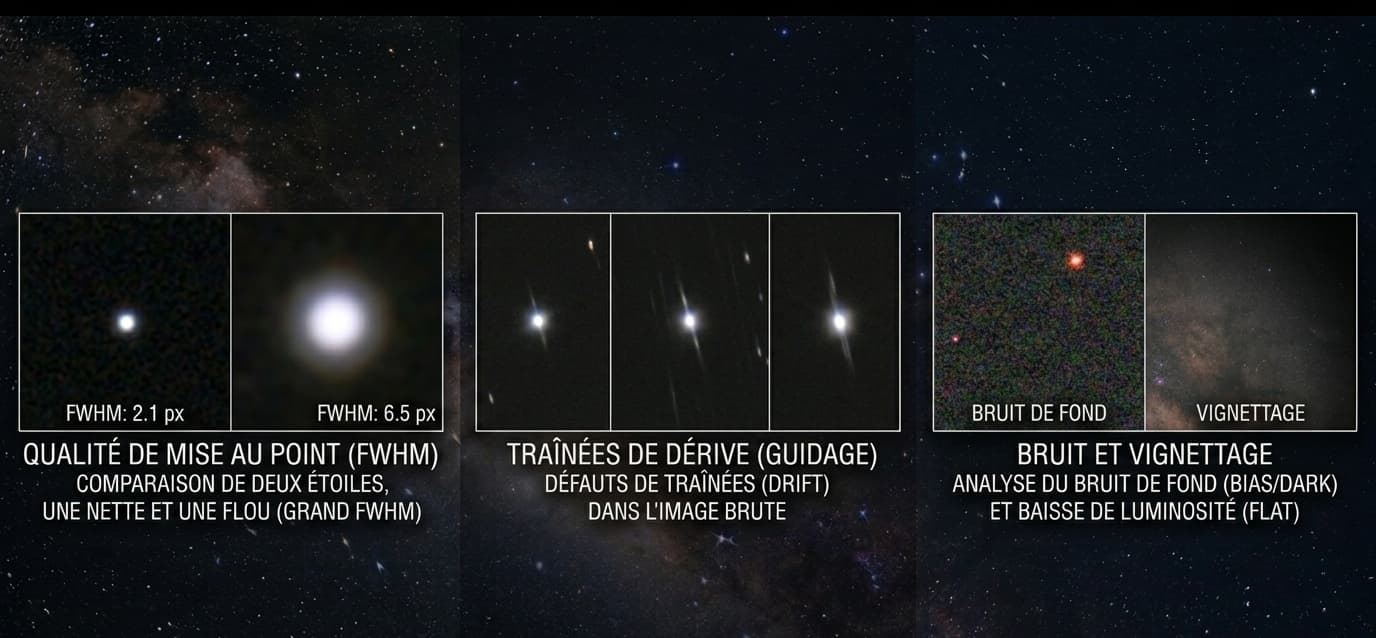
The setup matches the target, with one reservation on sampling. At 190mm focal length and a 3.36 deg field, M31 fits comfortably in frame along with M110 and M32, the right format for this galaxy. On the other hand 3.15 arcsec/px is clearly undersampled: stars measure 1.4 to 1.7px FWHM, so under 2 pixels, resolution is lost and the PSF fit becomes fragile. That is not a defect as such on a wide field, but it caps the final sharpness. On settings, gain 160 on the ASI585MM, offset 15 with no dark clipping (0%) and sensor at -21.5 deg C: all healthy, no saturated pixels, the 300s exposure burns nothing out.
The diagnosis in detail
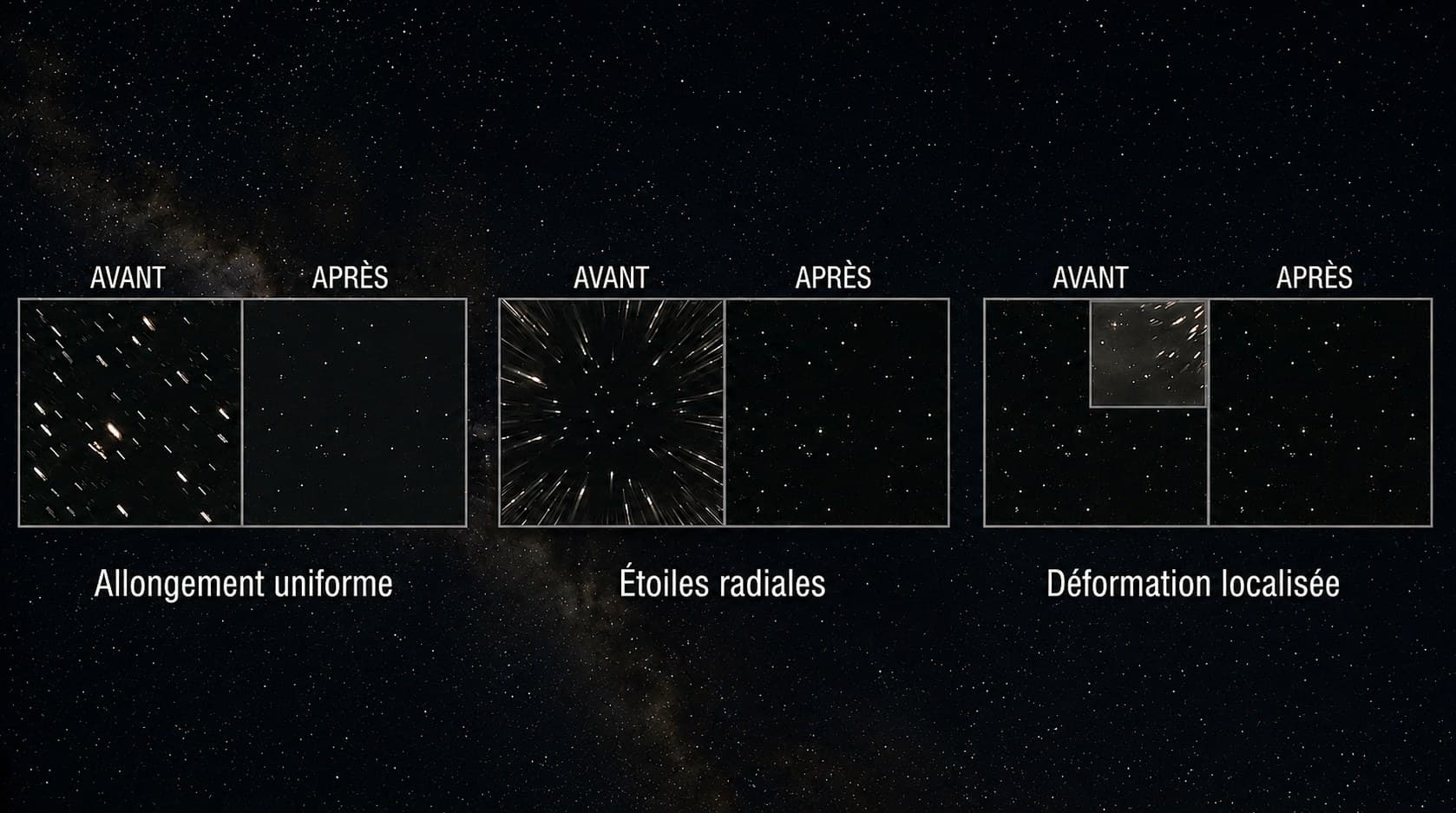
The diagnosis comes down to a single but well measured point: the stars are not round, and they are not round at field centre either. That is the key discriminant. A central elongation of 1.28 against a field floor of 1.11, with a corner/centre FWHM ratio of 0.945 (the corners are actually slightly tighter than the centre), mechanically rules out any field aberration: neither tilt, backfocus nor coma can produce this, since those defects spare the centre by construction.
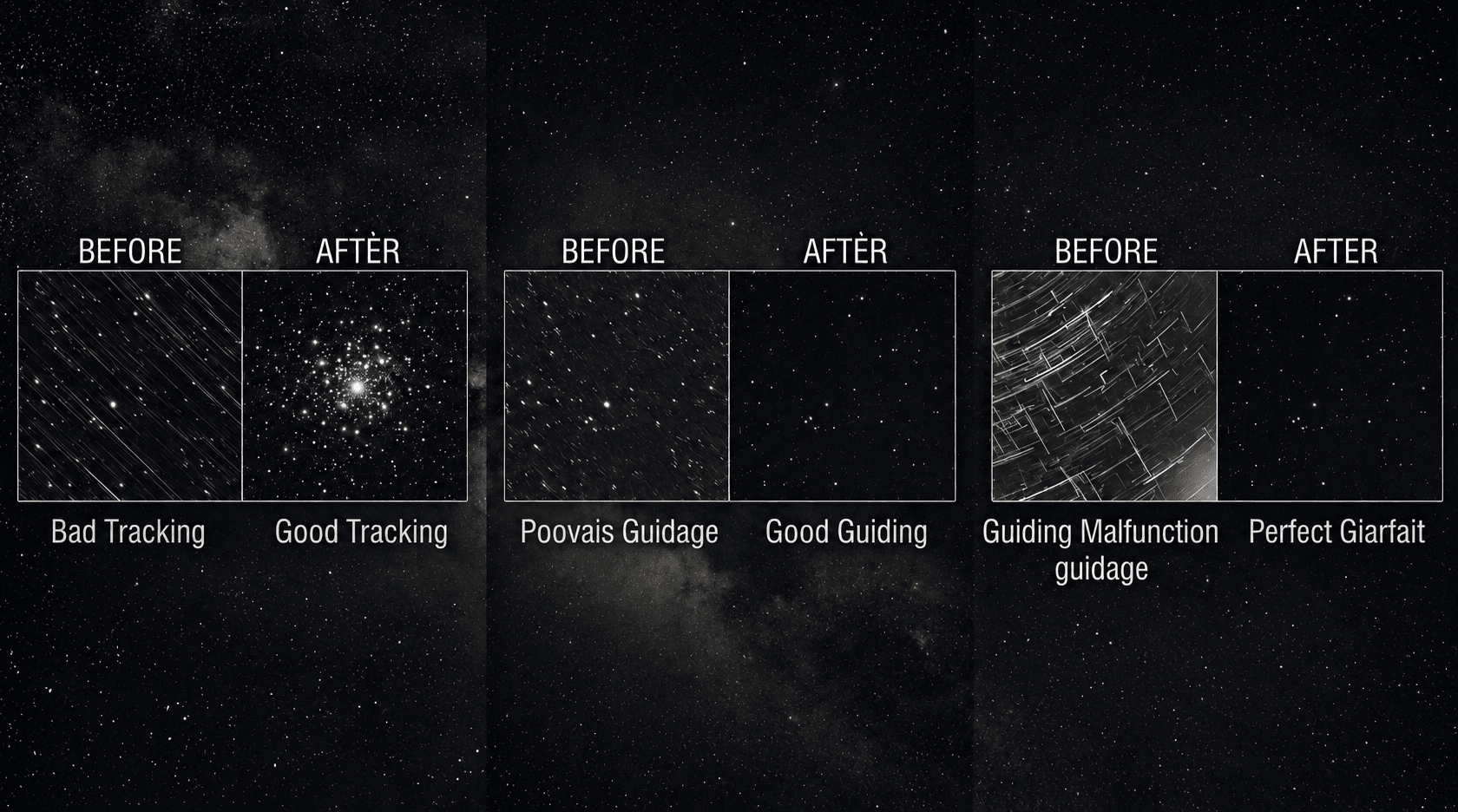
The direction confirms the mechanical lead. Position angles are tightly grouped, 7.1 deg of scatter, around a roughly horizontal axis. Elongation uniform in direction and amplitude over 300s is the signature of a slow drift: rough polar alignment or insufficient guiding. The PSF panel shows neither S-shaped curvature (periodic error) nor bean shapes (guiding oscillation), which points to a clean drift rather than an oscillation.
Worth keeping in perspective though: at 3.15 arcsec/px we are talking about roughly 0.3 to 0.4 pixel of elongation in absolute terms. It is real and measurable, but its visual impact on the final image will stay modest. The rest of the sub is of very good quality, clean background, M31's outer halo already perceptible in a single exposure, which speaks to the quality of the site.
Priority actions
- Redo a careful polar alignment with the NINA or SharpCap polar align routine before the next session
- Confirm autoguiding is running and log the PHD2 RMS across a full 300s exposure
- Test a 180s exposure for comparison to see whether central elongation drops below 1.15