Astrophotography diagnosis of M 42: Tracking drift, backfocus error and 1 other
Raw180s20 sept. 2026
The Doc examined this image of M 42 (raw, 180s). Estimated overall technical quality: 7/10. 3 defects found: Tracking drift (severity 2/5), Backfocus error (severity 2/5), Clipped stars (severity 2/5).

Info
- Cible
- M 42
- Date
- 20 sept. 2026, 02:02
- Lune
- Croissant décroissant 39.1% (sous l'horizon)
- Site
- Bortle 5 · banlieue résidentielle (VIIRS)
- Position
- 5h35m31s · -4°31'04"
Favourable conditions: the Moon is a 39% waning crescent and, more importantly, below the horizon, so there is no lunar contribution to the sky background, which the absence of any measured gradient confirms. Bortle 5 remains compatible with M42, a very bright emission nebula that handles this light pollution level easily in broadband RGB. The measured background to black point margin (e_margin 1.92) is low for broadband, meaning the background sits close to the black point: on such a bright target this is not penalising, but you can raise the offset slightly or lengthen exposure for the faint areas of the field. Cooling at -11.5C is healthy.
Setup
- Type d'image
- Brut
- Télescope
- iOptron CEM40/GEM45/HAE43 210101+
- Caméra
- ZWO ASI533MC Pro
- Exposition
- 180s
- Phase de lune
- Premier quartier (60 %)
- FOV
- 1.01°
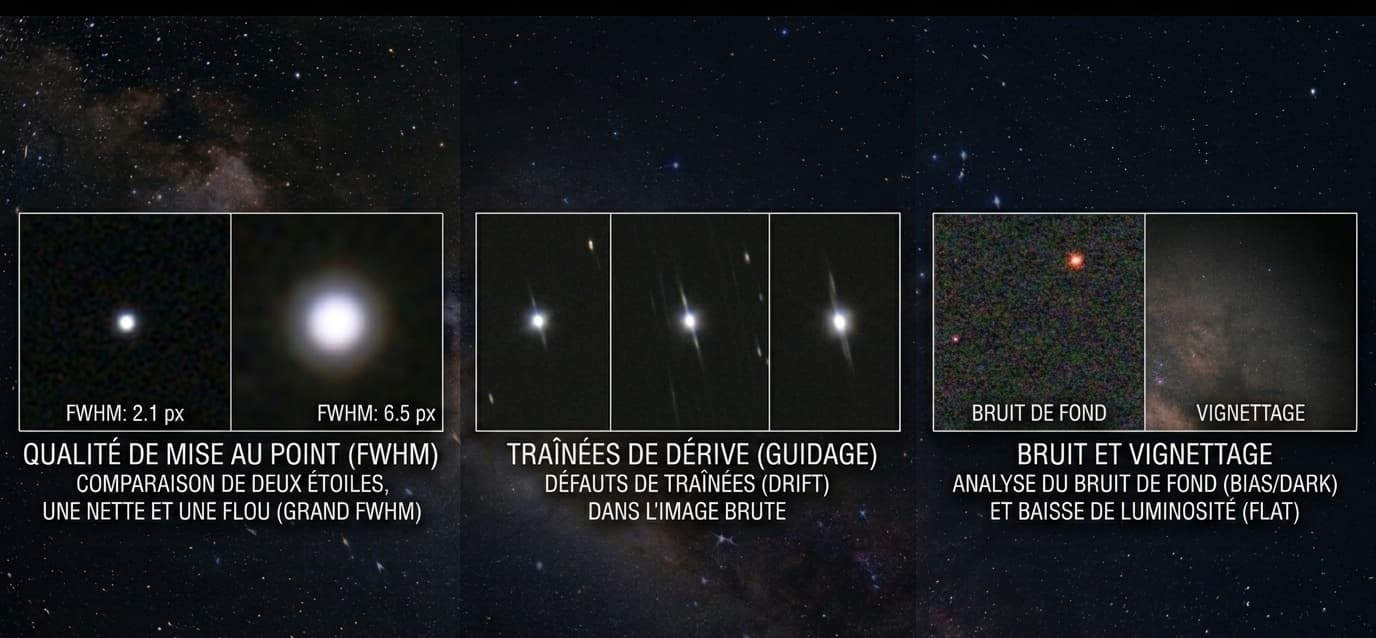
The setup matches the target well. At 518 mm focal length with a square 3008x3008 sensor, the 1.01 degree field holds M42 and M43 comfortably with room for the outer loops: framing is good, the object sits slightly high but is fully contained. Sampling at 1.497 arcsec/px is in the comfortable range for typical seeing, and the measured centre FWHM (4.33 px, roughly 6.5 arcsec) points to average seeing or imperfect focus rather than a sampling problem. Gain 101 (unity on the ASI533MC) and offset 70 are healthy settings; dark clipping at 0.01% confirms the offset is sufficient. On such a high dynamic range target, a dual exposure set (180s plus short subs) is the real improvement to bring.
The diagnosis in detail
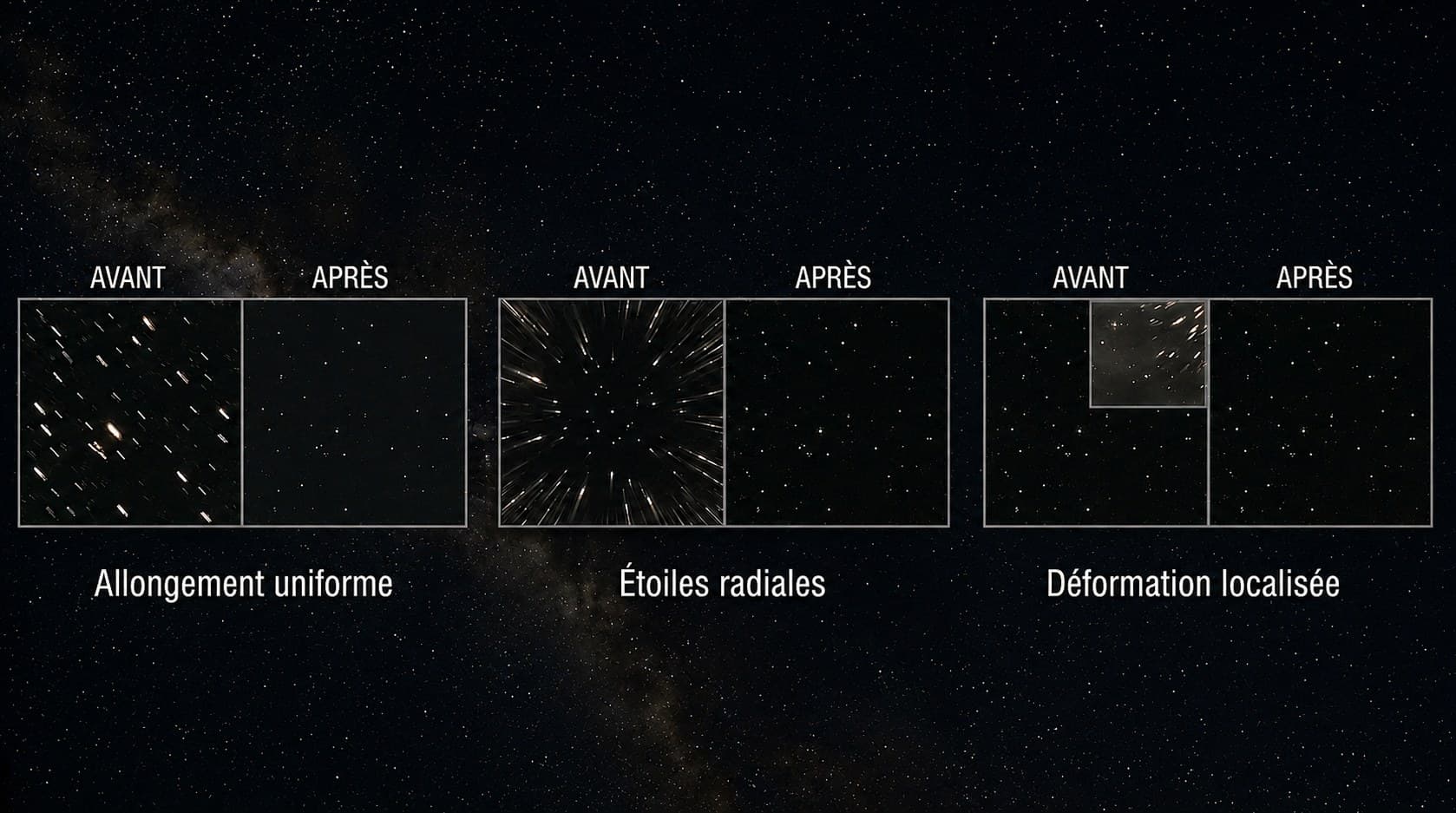
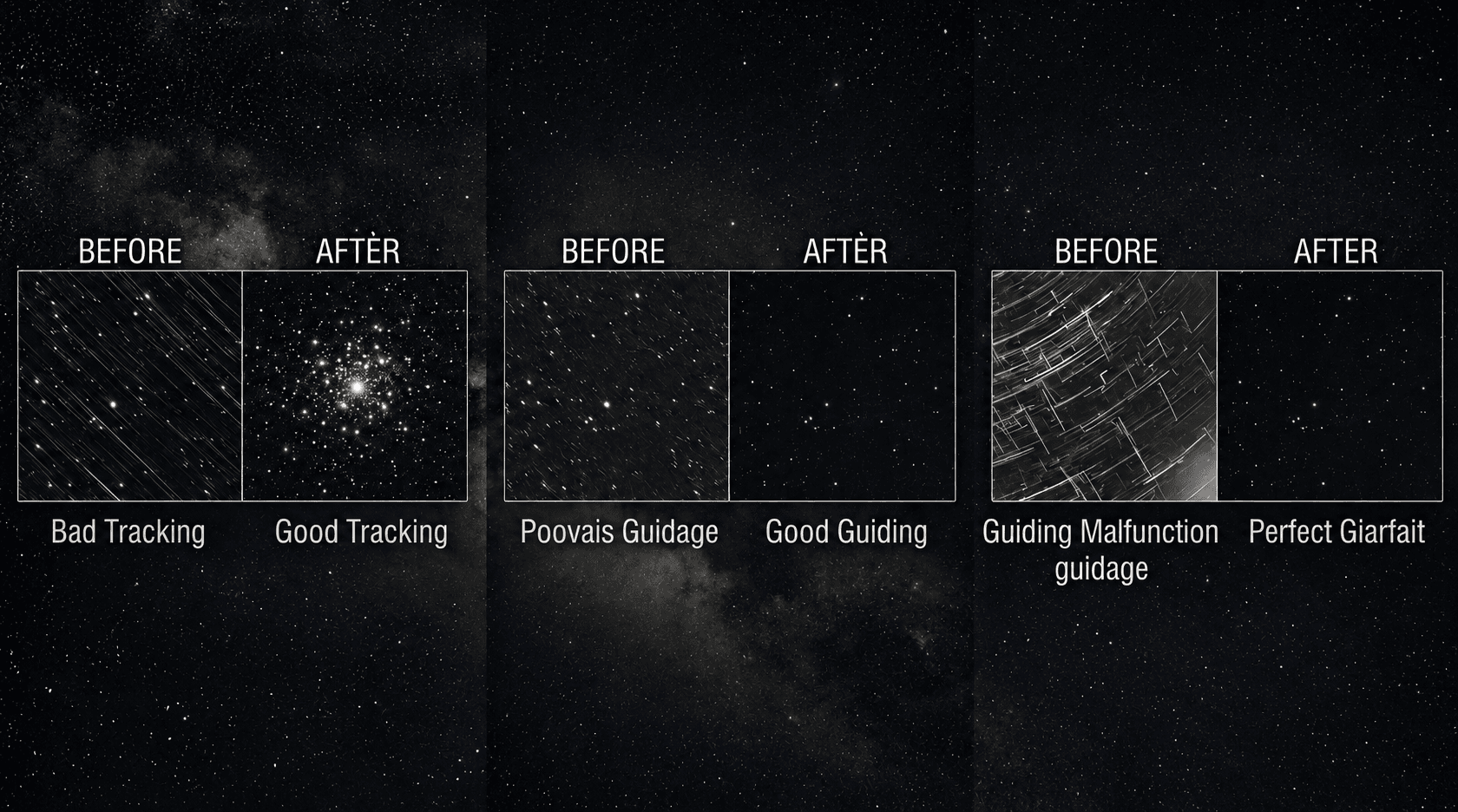
This is a good sub, usable as is. The Moffat measurements tell a two-part story. First a global component: elongation reaches 1.15 at centre while the field floor is 1.11, with a remarkably stable position angle across zones (only 6.7 degrees of spread). A deformation present at centre cannot come from field optics, it comes from tracking: a gentle drift, consistent in direction over the whole 180s.
Then a field component: FWHM starts at 4.33 px at centre and rises to 5.25 px top left and 4.65 px bottom right, with the strongest elongations precisely in those two corners (1.27 and 1.26). The rise is broadly symmetric and corner stars stay oval with no radial tail, the signature of residual field curvature or a backfocus slightly out of tolerance rather than coma or tilt. The gap stays modest (corner/centre ratio 1.15), so this is a setting to refine, not a blocking defect.
Everything else is healthy: the sky background shows no instrumental gradient, the measured variation corresponds to the nebula's own extensions, and cooling and offset are correct. The one real trade-off to address is M42's dynamic range, whose core and several bright stars are clipped at 180s.
Priority actions
- Add a short exposure set (5s to 30s) on M42 to recover the Trapezium in HDR
- Refine polar alignment and check guiding RMS to remove the residual centre elongation
- Adjust backfocus in 0.5 mm steps and revalidate corner FWHM on a fresh aberration panel
- Redo a careful focus run (V-curve autofocus) to bring centre FWHM below 4 px