Astrophotography diagnosis of M 42: Sensor tilt
RawAucun60s11 janv. 2026
The Doc examined this image of M 42 (raw, Aucun, 60s). Estimated overall technical quality: 6/10. 1 defect found: Sensor tilt (severity 2/5).
&w=1920&q=75)
Info
- Cible
- M 42
- Date
- 11 janv. 2026, 20:02
- Lune
- Gibbeuse croissante 61.5% (sous l'horizon)
- Site
- Bortle 3 · rural peu pollué (VIIRS)
- Position
- 5h35m17s · -5°23'28"
Excellent conditions for M42: Bortle 3 sky and a 61% gibbous Moon but BELOW the horizon, so no lunar light pollution contribution. The measured sky background is healthy (radial symmetry, azimuthal anisotropy 0.02), no real parasitic gradient. On a target as bright as the Orion Nebula, these conditions allow building an excellent signal-to-noise ratio. The declared 2.0" seeing is consistent with the measured central FWHM (~4px). Nothing to fault on the sky side: use this window to stack as many subs as possible.
Setup
- Type d'image
- Brut
- Télescope
- TS-Optics 61 EDPH
- Caméra
- ATR585C
- Filtre
- Aucun
- Monture
- TeSeek HM-17PE
- Exposition
- 60s
- Phase de lune
- 61.5%
- Seeing
- 2.0"
- FOV
- 2.34°
The TS 61 EDPH + ATR585C combo yields a 2.34 degree field that comfortably frames M42 and the surrounding nebular complex (M43, NGC 1977 visible on the left). Sampling falls in a reasonable range for this small sensor. Gain 100 (unity) and -10C cooling are healthy. The offset at 0 deserves attention: with 59% dark clipping, verify the left tail of the histogram is not truncated, a slightly higher offset would protect the shadows. The 60s exposure without a filter on M42 is short: the core saturates quickly while the extensions stay faint, plan HDR exposures (short + long) to handle this target's high dynamic range.
The diagnosis in detail
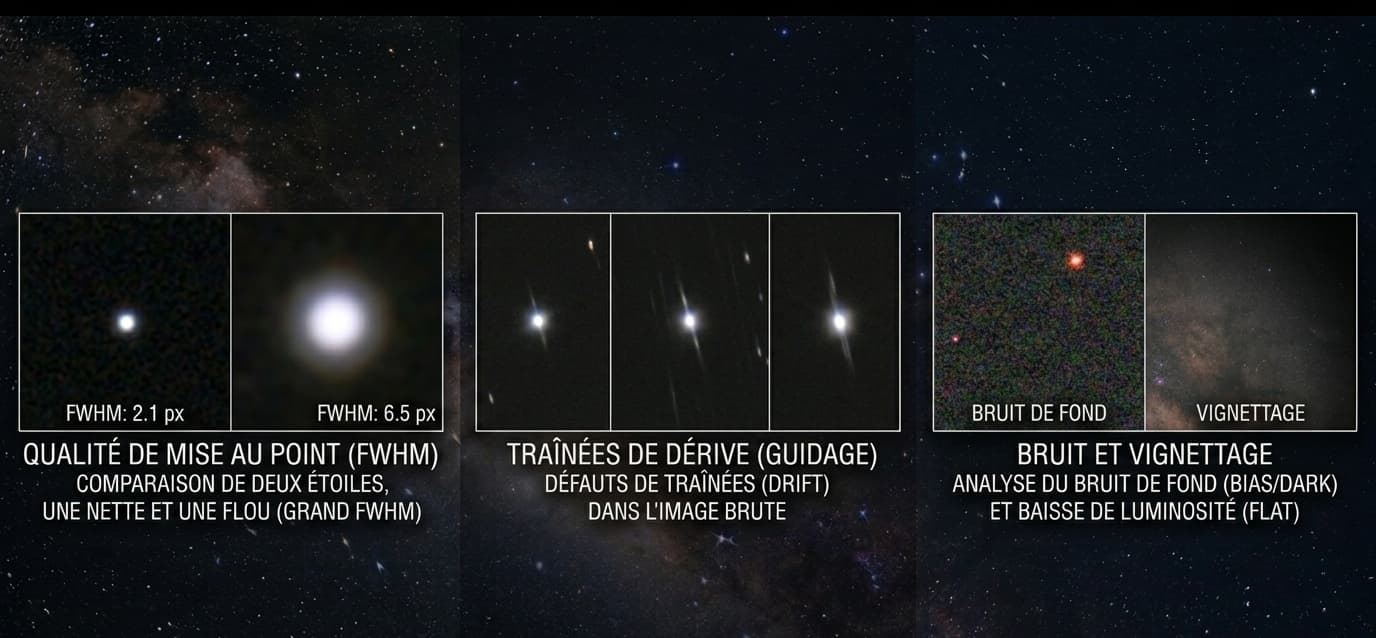
This 60s sub is overall healthy. The PSF panel confirms solid tracking and focus: center elong 1.08 (field floor 1.03), PA spread of only 6.9 degrees and round stars across the frame, so no tracking drift, guiding oscillation or periodic error. The 2.0" seeing produces central FWHM of about 4px, reasonable.
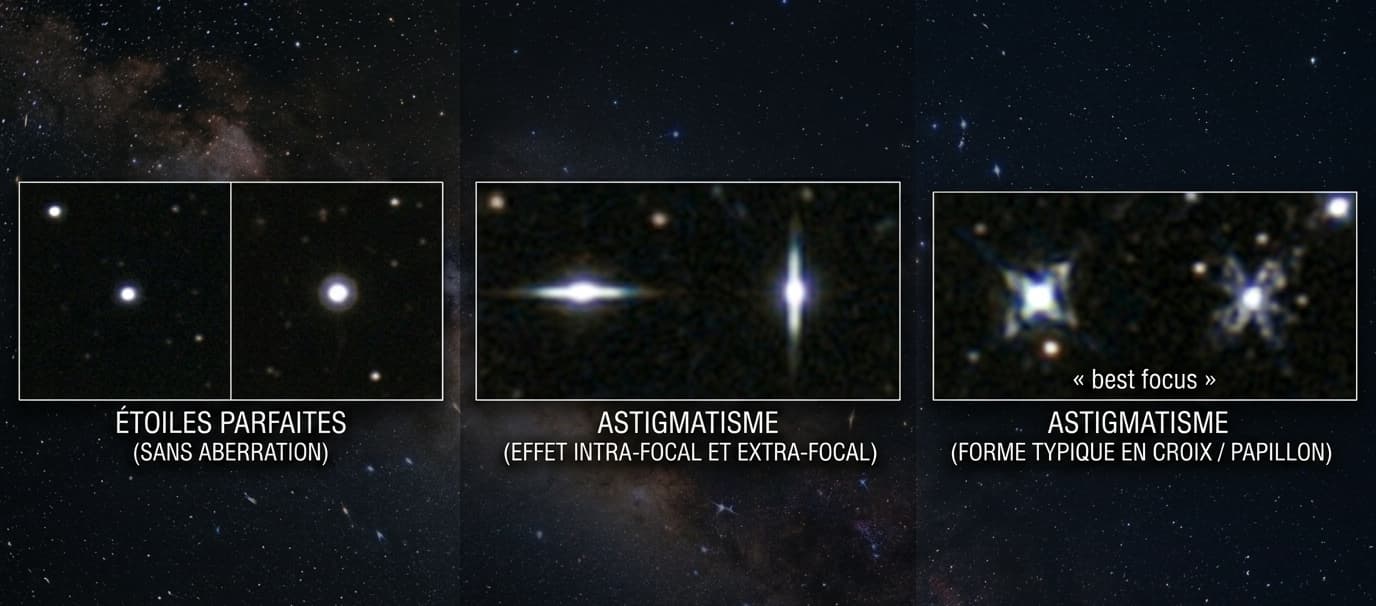
The only optical point is the horizontal FWHM asymmetry (0.30): the right edge (TR 5.1, R 5.0, BR 5.5px) is noticeably softer than the left (TL/L ~3.9px), while vertical stays homogeneous (0.04). This uni-axial signature with a sharp center reveals a slight focal plane tilt, not coma or backfocus (which would be symmetric across all four corners). It is minor and degrades only a fraction of the field.
The real issue is exposure: 59% dark clipping and a background-to-black-point margin of 2.36 indicate underexposure. Without a filter under a Bortle 3 sky this is expected for 60s, but stacking many subs will be essential to lift the faint nebulosity out of the noise. The Trapezium core saturates, classic on M42, to be recovered with a short-exposure layer.
Priority actions
- Stack a large number of subs (several hours) to offset each sub's underexposure and bring out M42's faint extensions
- Add a series of short exposures (5-15s) to recover the saturated Trapezium core (HDR compositing)
- Check and evenly retighten the optical train to correct the slight right-side tilt
- Slightly raise the offset to avoid any shadow clipping (current dark clipping at 59%)