Astrophotography diagnosis of NGC 6960_1-2: Tracking drift, sensor tilt and 1 other
Raw300s03 juil. 2026
The Doc examined this image of NGC 6960_1-2 (raw, 300s). Estimated overall technical quality: 4/10. 3 defects found: Tracking drift (severity 3/5), Sensor tilt (severity 3/5), Satellite trail (severity 2/5).
&w=1920&q=75)
Info
- Cible
- NGC 6960_1-2
- Date
- 03 juil. 2026, 23:49
- Lune
- Croissant croissant 14.4% (14.9° d'alt., 47.8° de la cible)
- Site
- Bortle 2 · rural typique (VIIRS)
- Position
- 20h50m05s · +31°12'49"
Bortle 2 sky: rare, excellent conditions, very favorable background SNR for a faint emission remnant like the Veil. The provided Moon data is ambiguous (header 83% but context 14.4% at 14.9° altitude and 47.8° from the target); either way its impact is marginal here, the background is clean with no visible lunar gradient. No sky-side correction needed: the limiting factor tonight is not the sky but the tracking mechanics. You can exploit this sky with long exposures without fear of light pollution, provided you make the guiding reliable.
Setup
- Type d'image
- Brut
- Télescope
- EQMod Mount
- Caméra
- ZWO ASI585MM Pro
- Exposition
- 300s
- Phase de lune
- Gibbeuse décroissante (83 %)
- FOV
- 1.70°
Coherent setup for the target: 375 mm focal length and a 3840x2160 sensor give a 1.70° field, suited to the large Veil complex (you can mosaic for the whole thing). Sampling at 1.595"/px: comfortable and well matched to current seeing, neither over- nor under-sampled. Gain 220 on the ASI585MM is high but sensible for mono narrowband/low flux; offset 15 with no dark clipping (0%) is sufficient, and -19°C keeps dark current under control. The background/black-point margin e_margin=2.16 is low but NORMAL on a narrowband/low-signal sub, do not penalize it. The weak link is purely mechanical: tracking and sensor orthogonality.
The diagnosis in detail
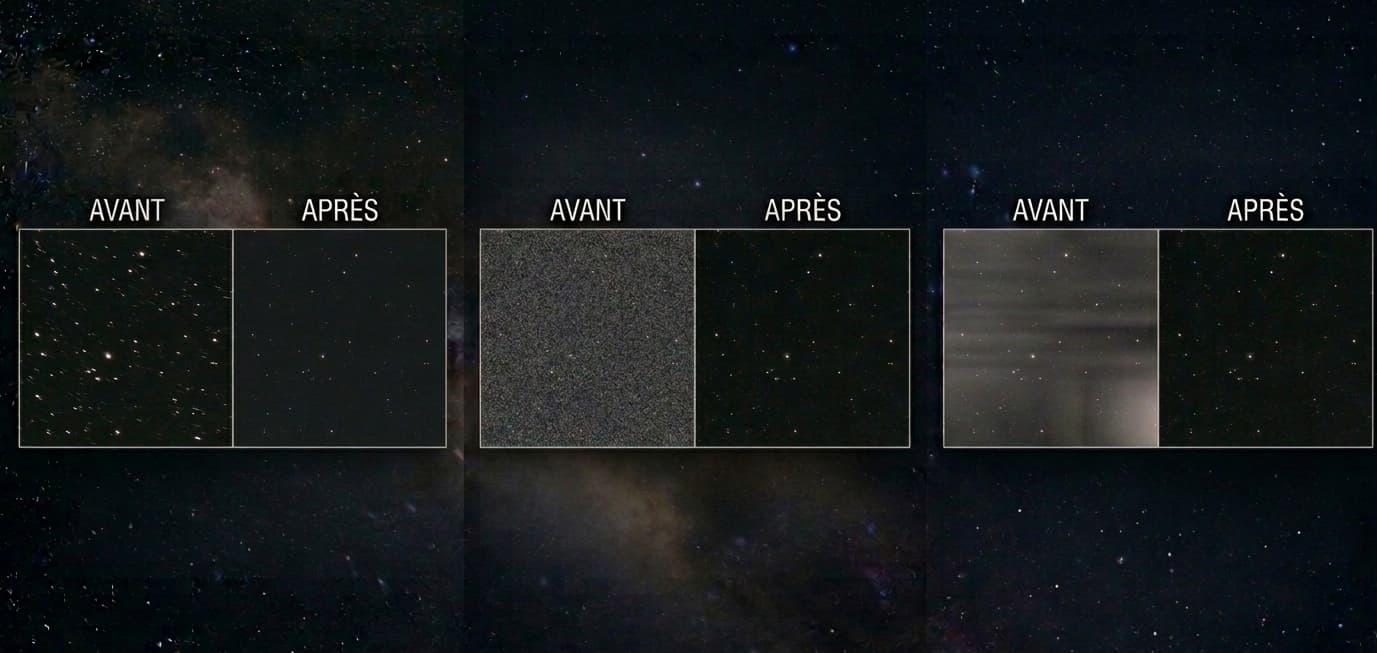
The image is a clean sub on the sky side: the background is neutral, gradient-free, and the orange wisps match the real filaments of remnant NGC 6960 (cross-checked with the DSS), so nothing to correct there. The two continuous straight trails are satellites: they affect only one sub and will be removed by statistical rejection during stacking, provided you have enough frames and dithered.
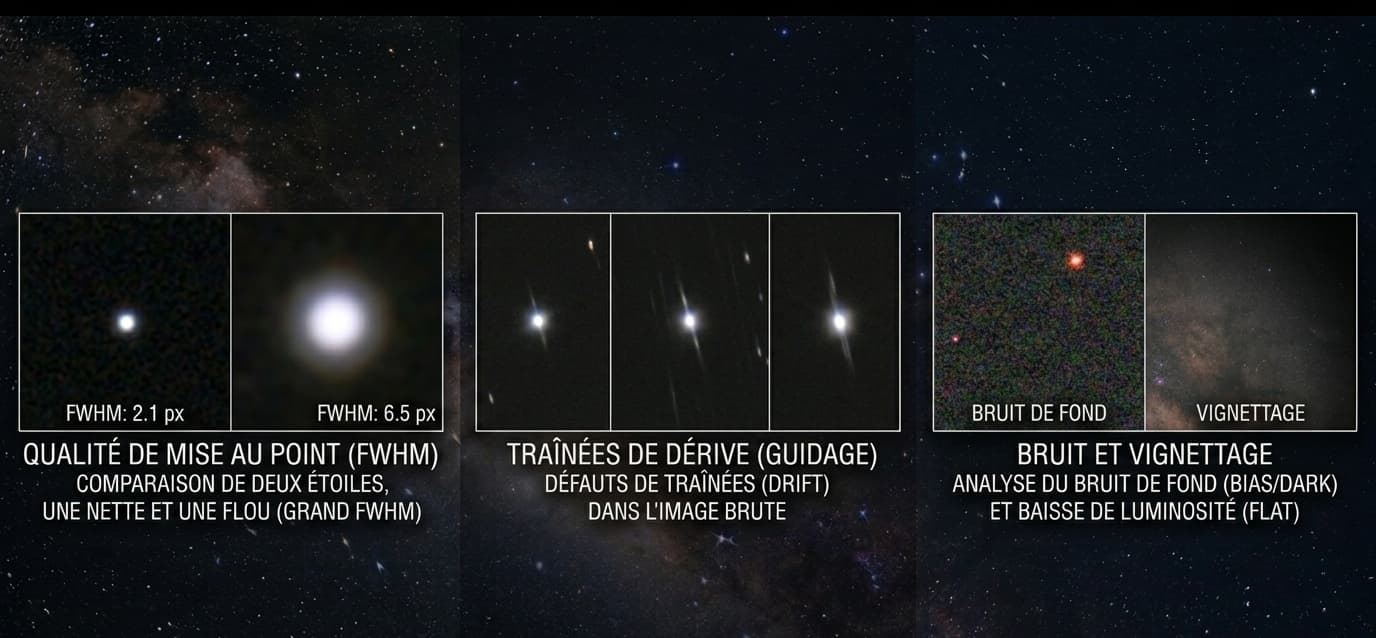
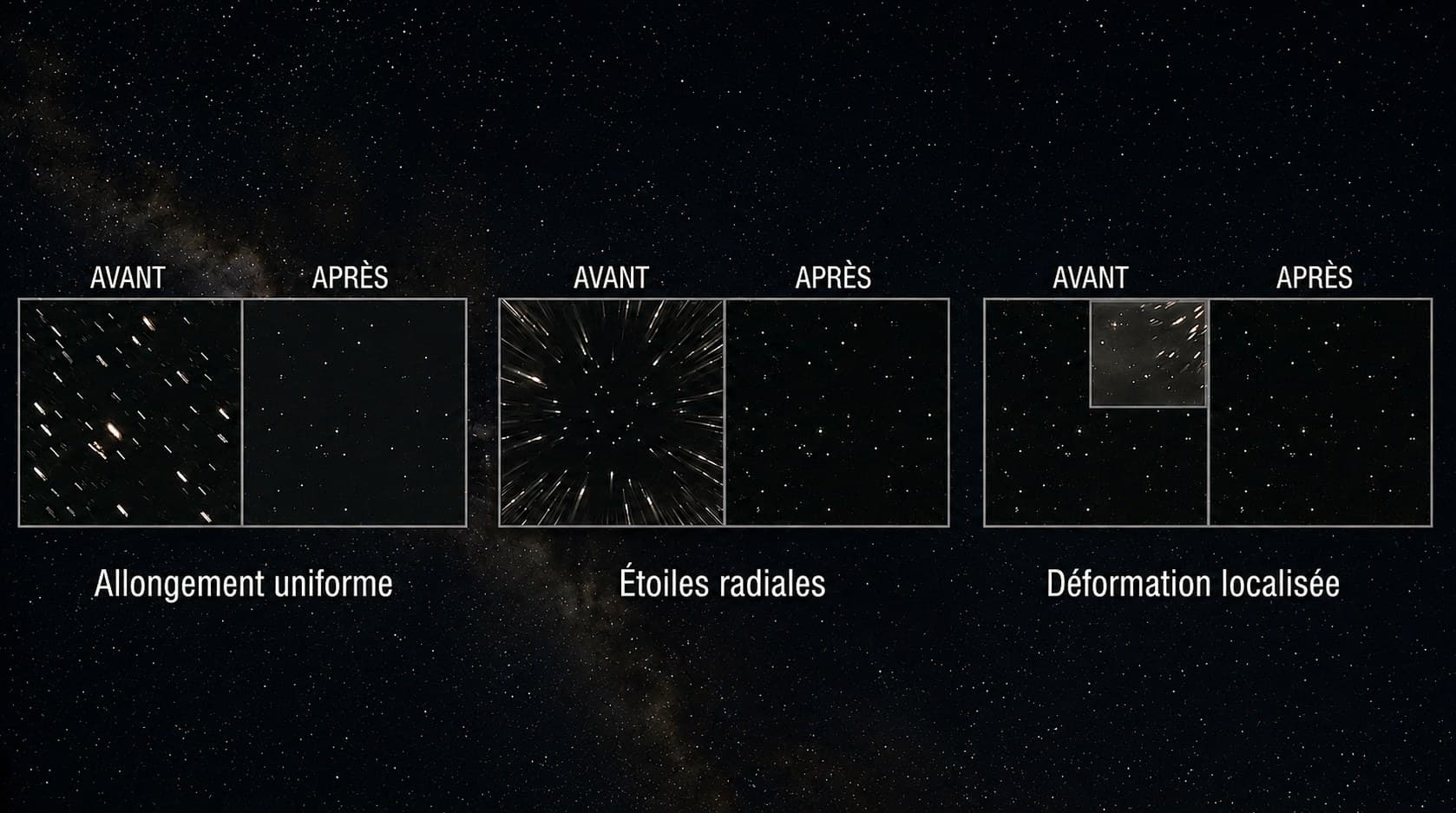
The real subject is the PSF. Elongation reaches the center (elong 1.94) with a consistent orientation across the whole field (PA spread 18.6°): this is the signature of tracking/guiding drift, not a purely optical edge defect. On top of that sits a measured sensor tilt, revealed by the asymmetry between opposite corners (top-left FWHM 7.5/elong 3.01 versus bottom-right 3.6/1.50, vertical asymmetry 0.386, corner/center ratio 1.63).
In order: first make the tracking reliable (autoguiding, polar alignment), because it degrades every star including at the center; then adjust the tilt to homogenize the corners. Once these two points are handled, this setup under Bortle 2 has everything it needs to deliver excellent Veil images.
Priority actions
- Make tracking reliable: enable/optimize autoguiding (PHD2, RMS < 1 px) and refine polar alignment before any new session
- Adjust sensor tilt to equalize FWHM across all 4 corners, then re-check with an aberration measurement
- Stack with dithering and sigma rejection to automatically remove the satellite trails
- If tracking cannot hold 300s, shorten the sub exposure and compensate with more subs