Astrophotography diagnosis of NGC 6960_1-1: Sensor tilt
Raw300s03 juil. 2026
The Doc examined this image of NGC 6960_1-1 (raw, 300s). Estimated overall technical quality: 6/10. 1 defect found: Sensor tilt (severity 3/5).
&w=1920&q=75)
Info
- Cible
- NGC 6960_1-1
- Date
- 03 juil. 2026, 23:12
- Lune
- Croissant croissant 14.3% (10.1° d'alt., 46.5° de la cible)
- Site
- Bortle 2 · rural typique (VIIRS)
- Position
- 20h52m14s · +29°57'55"
Excellent conditions: Bortle 2 sky and a Moon at only 14% illumination, just 10 above the horizon and 46 from the target, so lunar pollution is negligible. The background is very dark (background/black-point margin e_margin 2.16, normal for a nebula sub), with no significant stray gradient. For an emission target like the Veil, these conditions are ideal to chase faint Ha/OIII filaments; you can stack many subs without fear of a light-pollution gradient. Nothing to reschedule, the window is good.
Setup
- Type d'image
- Brut
- Télescope
- EQMod Mount
- Caméra
- ZWO ASI585MM Pro
- Exposition
- 300s
- Phase de lune
- Gibbeuse décroissante (83 %)
- FOV
- 1.70°
Setup consistent with the target. At 375mm focal length, the 1.595"/px sampling is comfortable and well matched to typical seeing (neither over- nor under-sampled). The 1.70 field only covers a portion of the Veil (hence the panel tiling, here NGC 6960_1-1): a logical mosaic approach. Gain 220 on the ASI585MM and a 300s exposure suit narrowband/faint signal, offset 15 with no dark clipping (0%) and -18C cooling are healthy. The only caveat is mechanical: the measured tilt shows the sensor/filter-holder plate needs adjustment before launching the full run.
The diagnosis in detail
This is a clean, promising sub. The sky background is excellent (Bortle 2, harmless Moon), the background calibration shows only a 5% amplitude plane at low R², not significant, and above all the visible nebulosity matches the real Veil filaments seen in the DSS: neither a gradient nor an artifact, nothing to fix there.
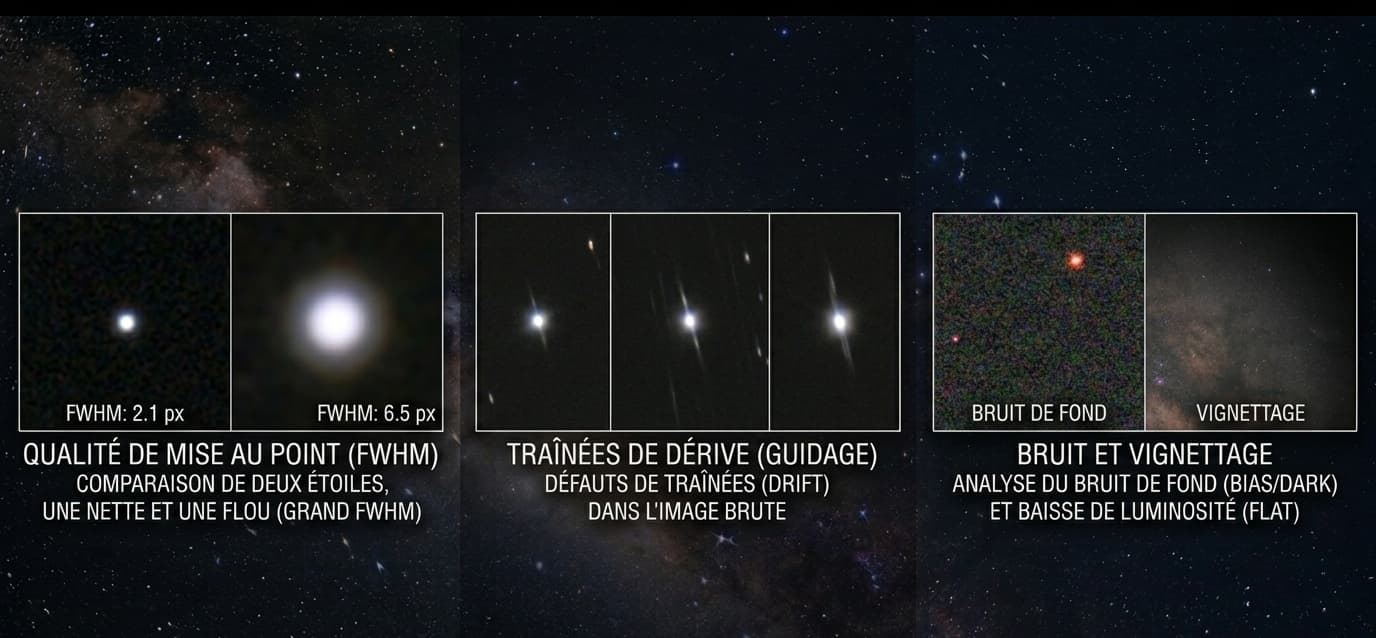
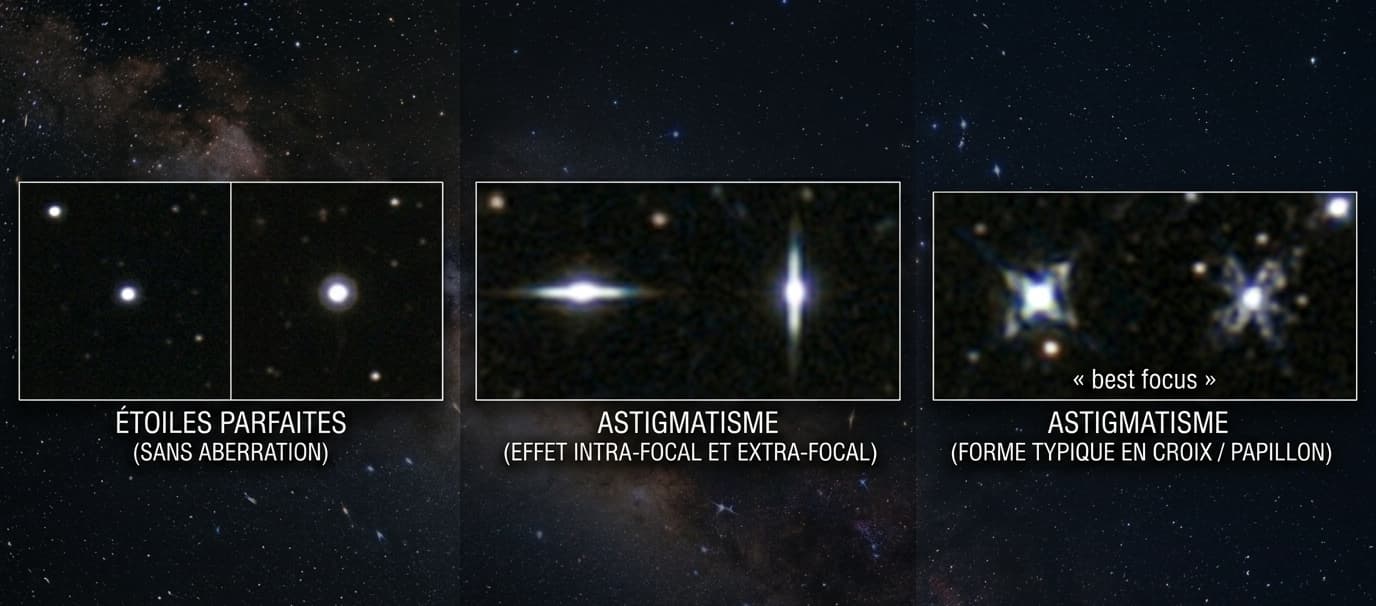
The dominant defect is a sensor tilt, clearly measured and confirmed on the PSF plate. FWHM and elongation degrade along a single axis: the top edge is heavily stretched (TL 7.1/elong 1.92, TR 6.7/elong 1.94) versus a tight bottom edge (B 3.8/elong 1.19), with a healthy center (4.0/elong 1.26) and a corner/center ratio of 1.44. This top/bottom asymmetry, rather than a symmetric radial degradation, rules out field curvature or pure backfocus: it is indeed a tilted focal plane.
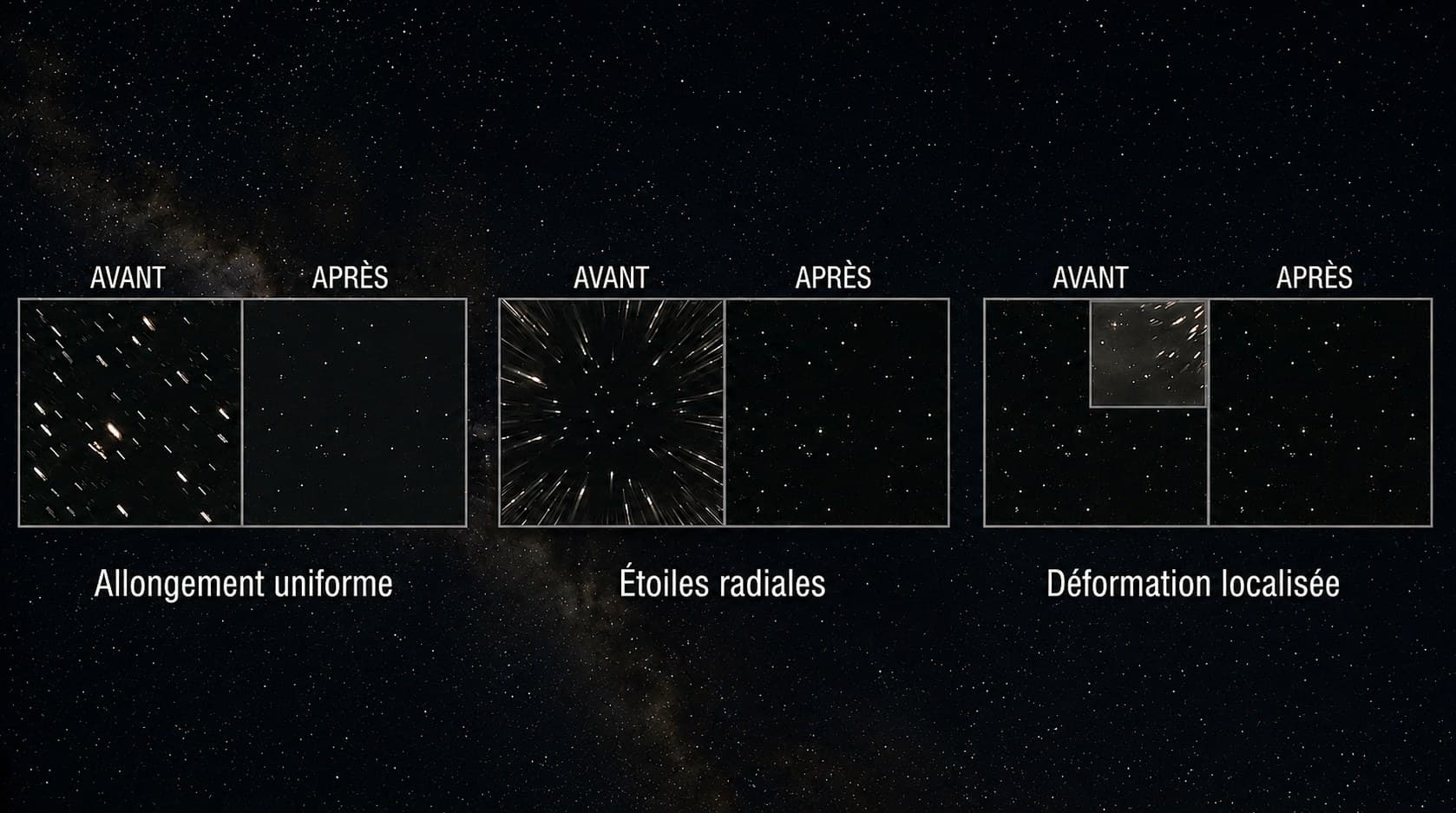
Tracking is not to blame (round center, no uniform directional streaking, moderate PA spread) and focus is fine. The priority is therefore purely mechanical: adjust the tilt plate and re-check before accumulating the mosaic, otherwise asymmetric stars will carry through the whole final integration.
Priority actions
- Adjust the imaging-train tilt plate to equalize FWHM between the top and bottom edges, then re-check with a test sub before stacking
- Verify tightness and eliminate play in the camera/filter-holder/corrector connections
- Once the field is even, accumulate subs taking advantage of the Bortle 2 sky to bring out the faint Veil filaments