Astrophotography diagnosis of NGC 6960: Tracking drift and sensor tilt
Raw300s27 juin 2026
The Doc examined this image of NGC 6960 (raw, 300s). Estimated overall technical quality: 6/10. 2 defects found: Tracking drift (severity 3/5), Sensor tilt (severity 2/5).
&w=1920&q=75)
Info
- Cible
- NGC 6960
- Date
- 27 juin 2026, 23:18
- Lune
- Croissant décroissant 3.9% (12° d'alt., 82.1° de la cible)
- Site
- Bortle 2 · rural typique (VIIRS)
- Position
- 20h48m02s · +30°12'27"
Excellent conditions: Bortle 2 gives a very dark background and strong contrast on this emission nebula, confirmed by Hα signal already readable in a single sub. The Moon is a non-factor here: 3.9% crescent, only 12° above the horizon and 82° from the target, its contribution is negligible. The background map shows only a very gentle 6% gradient consistent with a dark site, no marked pollution. No reason to skip the session: use it to pile up integration.
Setup
- Type d'image
- Brut
- Télescope
- EQMod Mount
- Caméra
- ZWO ASI585MM Pro
- Exposition
- 300s
- Phase de lune
- Gibbeuse croissante (96 %)
- FOV
- 1.70°
Setup consistent with the target. At 375mm and 1.595"/px the sampling is comfortable for typical seeing (center FWHM 2.9px, ~4.6"), and the 1.70° field nicely frames the western Veil around 52 Cygni. The ASI585MM at -13°C, gain 220 over 300s in Hα is sensible: the low sky/black-point margin (e_margin=2.02) is NORMAL in narrowband, do not penalize it. Offset 15 with no dark clipping (0%) is sufficient. The item to work on is not the setup but the mechanics: guided tracking and sensor orthogonality adjustment.
The diagnosis in detail
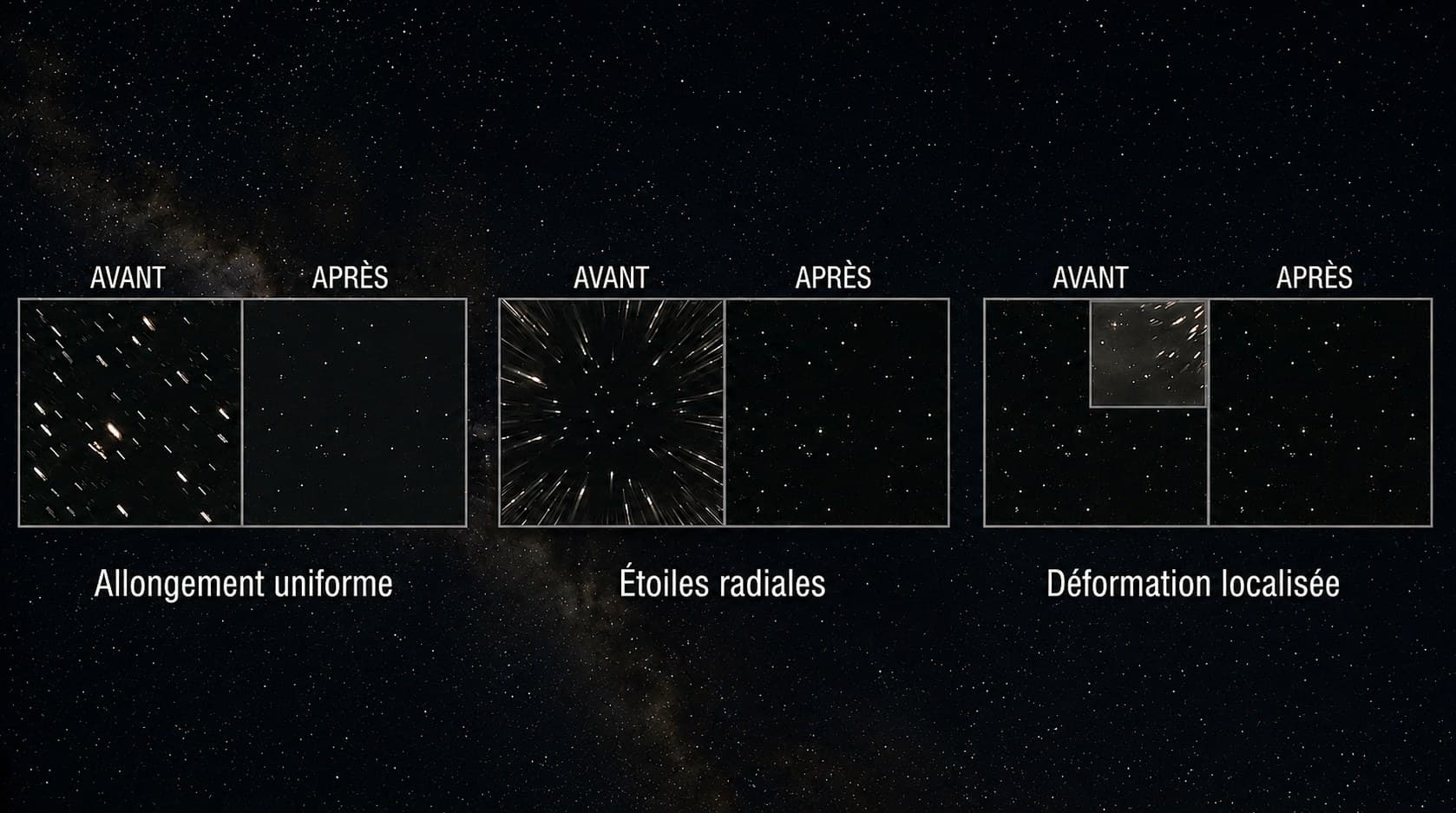
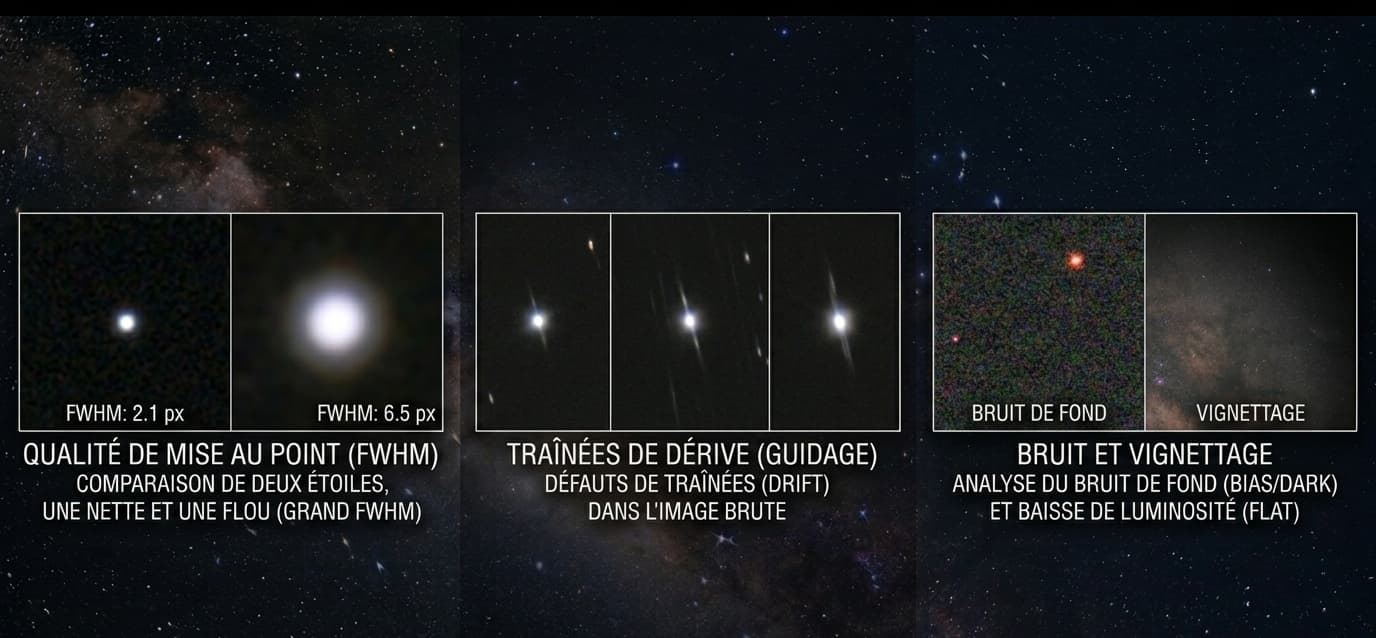
On this sub the Moffat metrics tell a two-part story. First, tracking drift: elongation does not spare the center (center elong=1.33 versus a 1.20 field floor) and its direction stays coherent across zones (PA scatter only 18°). Pure optical aberration would leave the center round; here the field core is already stretched, which points to the mount or guiding over the 300s.
Second, sensor tilt is superimposed. The signature is clear: the top-left corner is the most degraded (FWHM 5.0px, elong 1.93), while the opposite bottom-right stays the best in the field (FWHM 2.9px, elong 1.20). Vertical FWHM asymmetry (0.248) and a 1.43 corner/center ratio confirm a slightly tilted sensor, one edge defocused relative to the other. It is minor and correctable with a tilt plate.
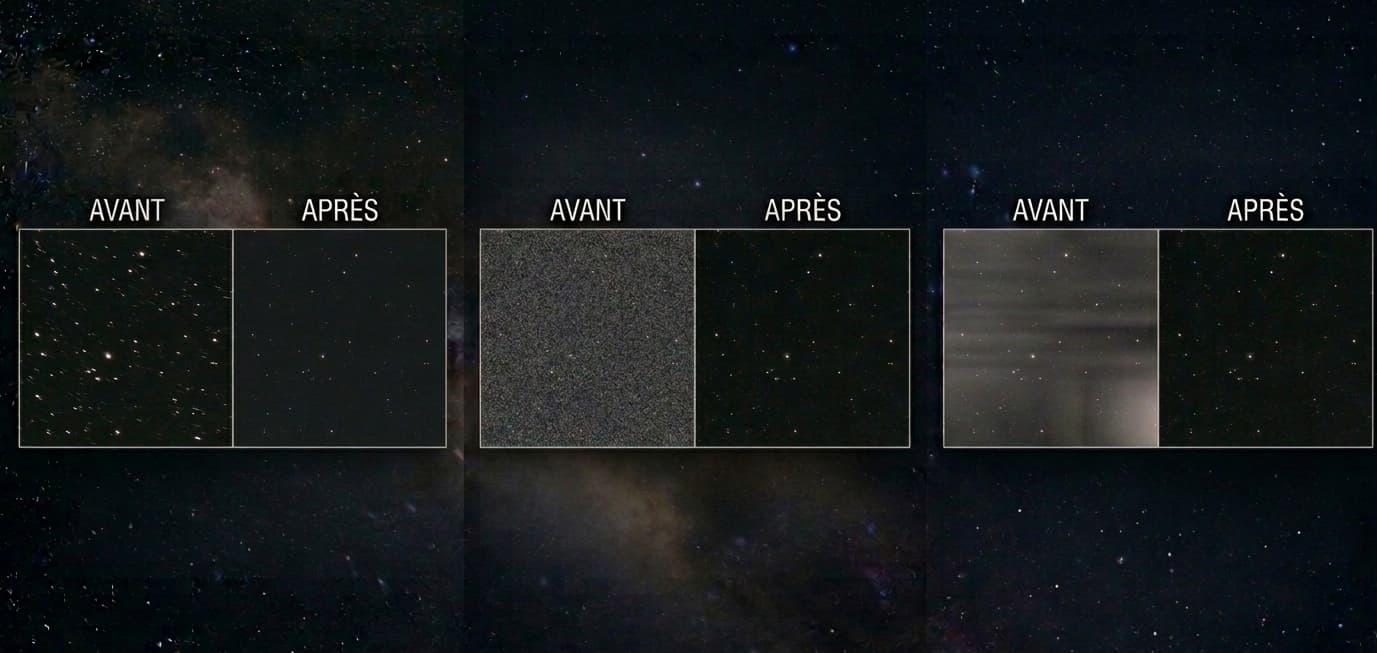
The rest is healthy: very clean background (Bortle 2), a negligible 6% gradient easily removed in processing, acquisition settings suited to narrowband. The priority to improve is clearly mechanical, not optical or photometric.
Priority actions
- Enable and tune autoguiding to eliminate the tracking drift (target RMS < 0.8")
- Redo a careful polar alignment before the next session
- Adjust sensor orthogonality (tilt plate) to equalize FWHM across the 4 corners
- Accumulate integration: the Bortle 2 site and Hα signal justify a long integration