Astrophotography diagnosis of M 45: Sensor tilt
Raw120s18 août 2026
The Doc examined this image of M 45 (raw, 120s). Estimated overall technical quality: 7/10. 1 defect found: Sensor tilt (severity 2/5).
&w=1920&q=75)
Info
- Cible
- M 45
- Date
- 18 août 2026, 02:45
- Lune
- Gibbeuse décroissante 69.1% (sous l'horizon)
- Site
- Bortle 2 · rural typique (VIIRS)
- Position
- 3h46m50s · +24°09'40"
Very favorable conditions. Bortle 2 means a naturally dark sky background, which explains the low median and the absence of any strong gradient: the background map only shows a 4% plane amplitude with no light pollution signature. The Moon, gibbous at 69% but below the horizon during the exposure and 152 degrees from the target, plays no role at all. For M45, an open cluster with reflection nebulosity, this sky is exactly what is needed: the blue nebulosity being broadband continuum, it fully benefits from a dark sky and would suffer badly under a high Moon. No reason to reschedule, this window is worth reusing.
Setup
- Type d'image
- Brut
- Télescope
- EQMod Mount
- Caméra
- ZWO ASI585MM Pro
- Exposition
- 120s
- Phase de lune
- Premier croissant (25 %)
- FOV
- 3.36°
Coherent setup but undersampled for the detail you are chasing. At 190 mm focal length and 2.9 um pixels you sit at 3.15 arcsec/px: the 3.36 degree field frames M45 comfortably with margin around the cluster, which is the right call, but each star is only 1.4 px FWHM, so sampling limits resolution more than seeing does. That is an accepted wide-field tradeoff. On settings, gain 180 on the ASI585MM is high but consistent with short subs, offset 15 is sufficient (0% dark clipping), and -18C is healthy cooling. The background to black point margin of 2.29 shows you are not sky-limited yet: on this Bortle 2 sky that is normal, but stretching to 180-240s would improve signal to noise on the reflection nebulosity, provided tracking allows it.
The diagnosis in detail
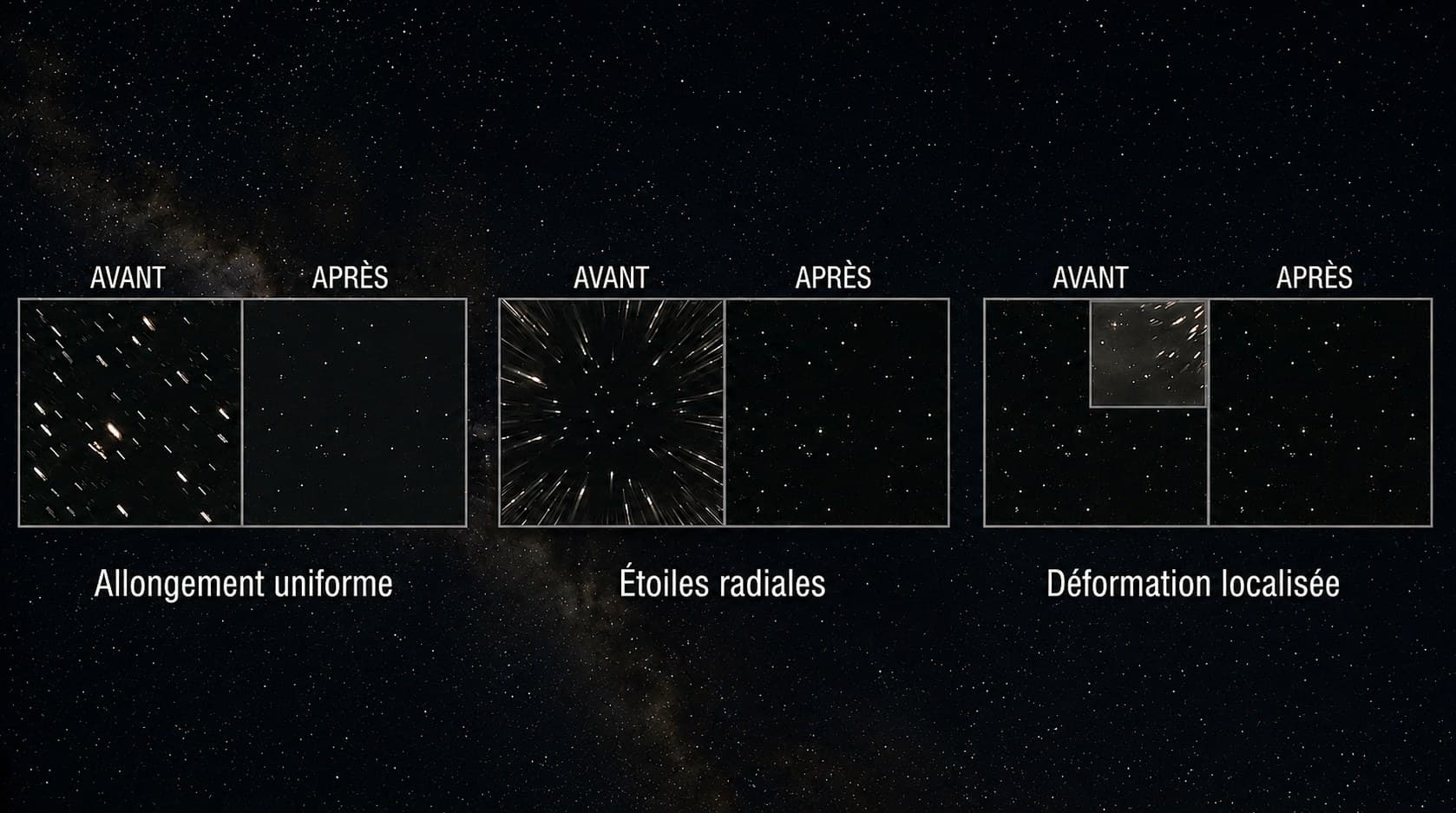
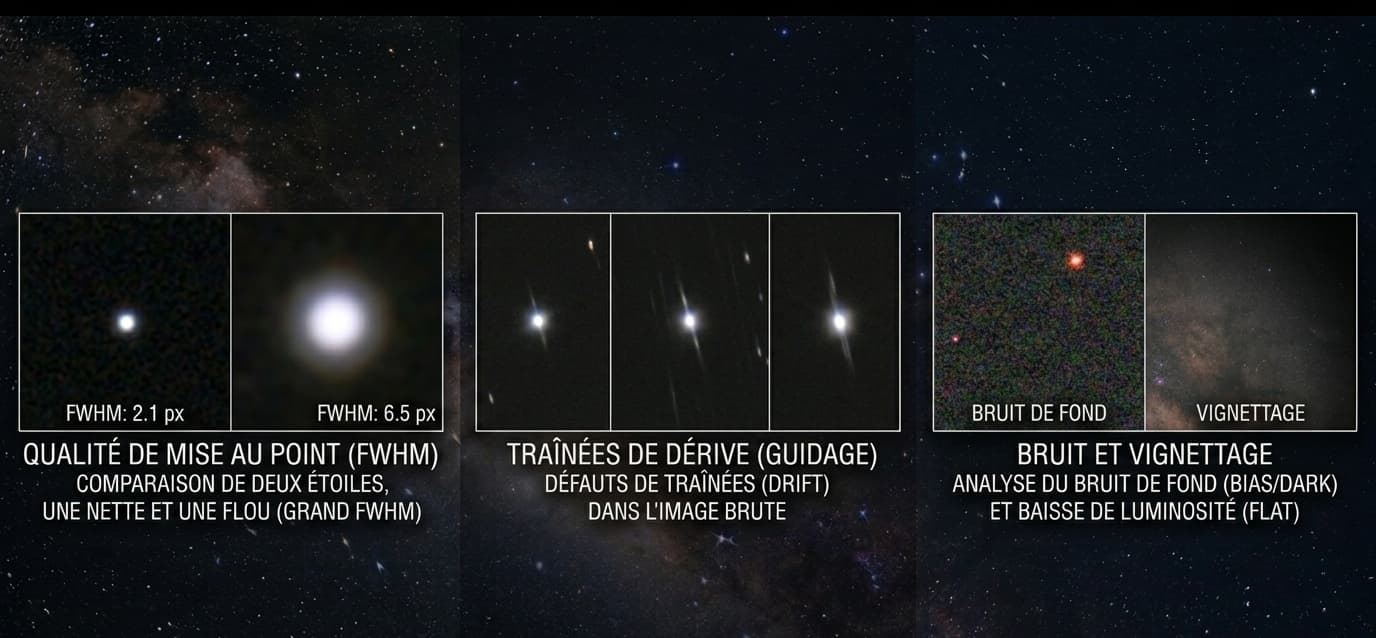
The sub is technically good. Stars measure 1.35 to 1.6 px FWHM across eight of nine zones, with elongations between 1.15 and 1.29 against a field floor of 1.15: that is round PSF with no tracking signature. The 36.6 degree PA dispersion confirms there is no preferred elongation direction, so no drift, no periodic error and no guiding oscillation on this 120s exposure.
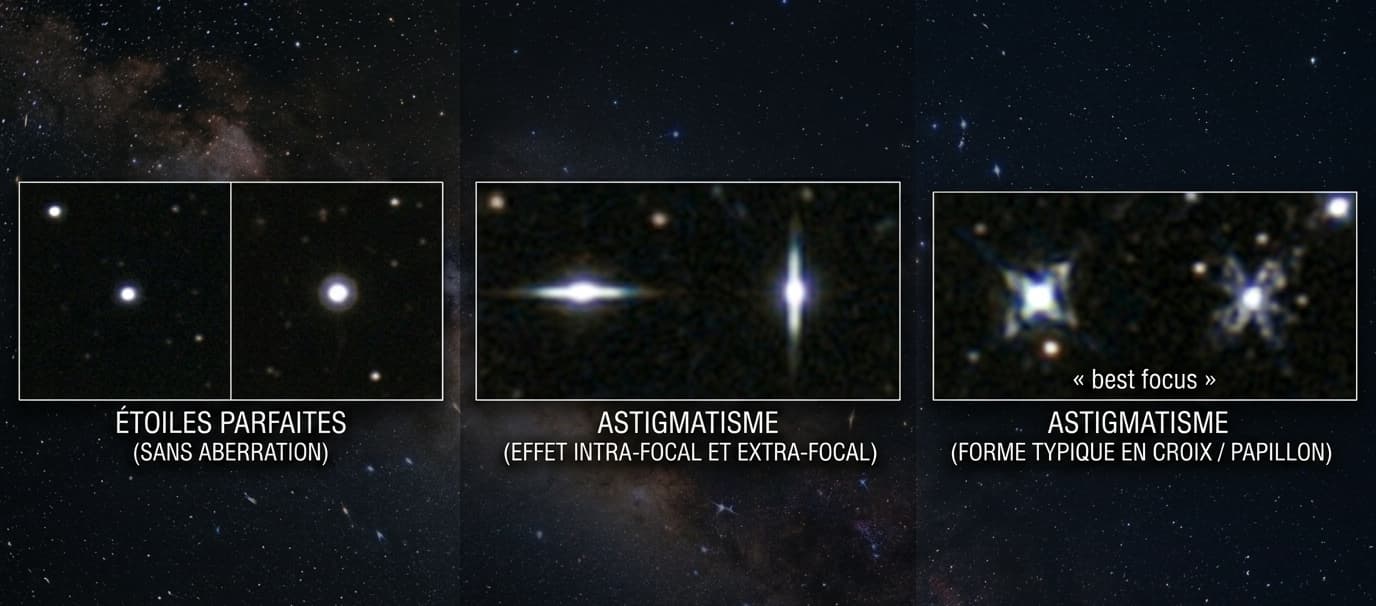
The one point of attention is the inter-zone asymmetry. The top edge zone comes out at 2.75 px FWHM and 1.84 elongation while the right corners stay at 1.35-1.4 px. This one-axis degradation with a sharp center is the signature of a tilted focal plane rather than field curvature, which would degrade all four corners symmetrically. The amplitude stays low and the frame is perfectly usable, but over a long stack this defect does not average out, it sets the final edge quality.
The sky background is healthy: barely 2% radial profile, 4% plane with R squared of 0.62, near zero anisotropy, no dark clipping and 0.05% saturated pixels that simply correspond to the cores of the main Pleiades. Nothing to fix on calibration at this stage, flats and darks will handle the rest.
Priority actions
- Check optical train coplanarity and evenly retighten the fittings to remove the top edge PSF asymmetry
- Confirm the tilt on a second sub before any mechanical intervention, since the measured amplitude stays low
- Extend the single exposure toward 180-240s to become sky-limited and better capture M45 reflection nebulosity
- Keep this moonless Bortle 2 window for the bulk of the integration