Astrophotography diagnosis of M 45_Uhc: Tracking drift, sensor tilt and 2 others
Raw120s02 oct. 2026
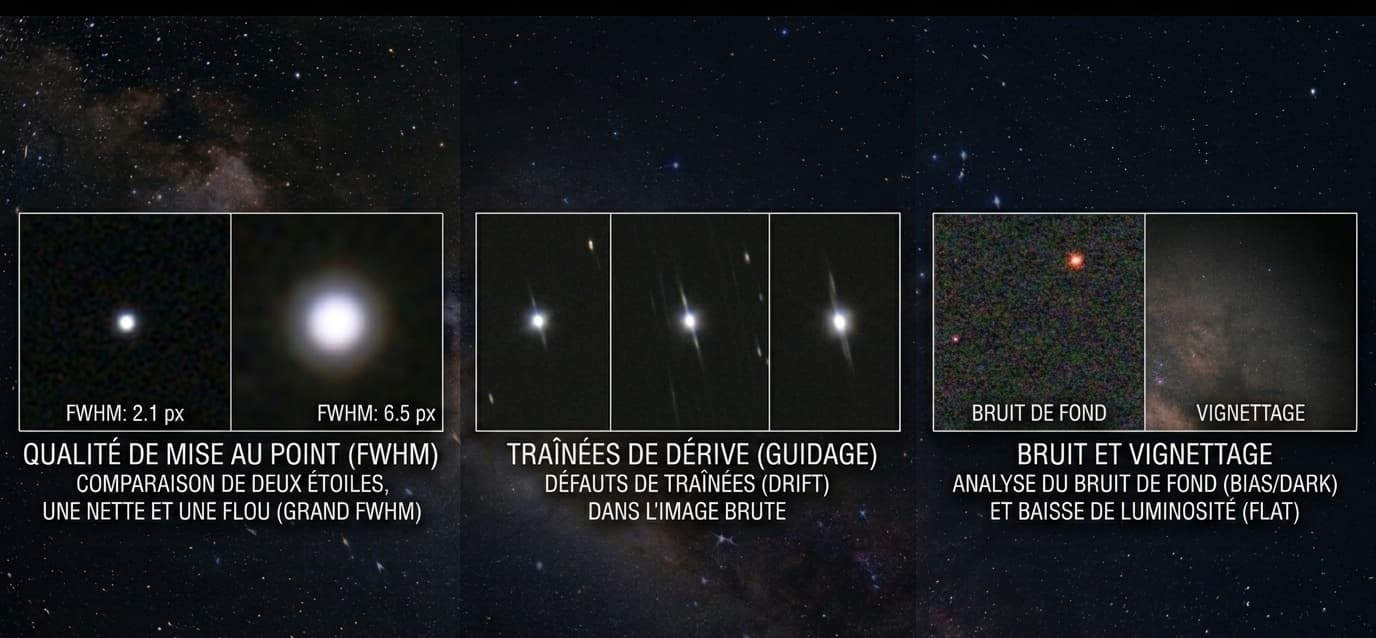
The Doc examined this image of M 45_Uhc (raw, 120s). Estimated overall technical quality: 6/10. 4 defects found: Tracking drift (severity 3/5), Sensor tilt (severity 3/5), Light pollution gradient (severity 2/5), Clipped stars (severity 2/5).

Info
- Cible
- M 45_Uhc
- Date
- 02 oct. 2026, 23:25
- Lune
- Croissant croissant 43.9% (21.5° d'alt., 32.4° de la cible)
- Site
- Bortle 2 · rural typique (VIIRS)
- Position
- 3h46m50s · +24°09'40"
Bortle 2 is a major asset for a faint reflection nebula target like M45: the weak signal around Merope and Alcyone is already visible in a single 120s sub. The drawback is the Moon: a 43.9% crescent, still 21.5 degrees above the horizon and only 32.4 degrees from the target. At that separation, atmospheric scattering lifts the background and partly explains the measured 13% tilted plane. On a broadband target like M45, no filter will save this. The real gain would be shifting acquisition until after moonset, or simply waiting another hour or two into the night, to fully exploit this exceptional sky.
Setup
- Type d'image
- Brut
- Télescope
- EQMod Mount
- Caméra
- ZWO ASI585MM Pro
- Exposition
- 120s
- Phase de lune
- Dernier quartier (60 %)
- FOV
- 3.36°
Target to field match is good: 3.36 degrees wide for a cluster spanning roughly 2 degrees, M45 fits entirely with room for the outer nebulosity. The image scale at 3.148 arcsec/px is clearly undersampled though, which explains the very low measured FWHM (1.5 to 3 px): the PSF is described by only two or three pixels at center, which limits sharpness and makes shape measurement sensitive. Gain 160 on the ASI585MM is reasonable but combined with 120s it burns the bright members. Offset 15 is sufficient (no dark clipping). Sensor temperature at -20C is healthy. The background to black point margin of 2.36 is low, but that is expected under Bortle 2 with a UHC filter.
The diagnosis in detail
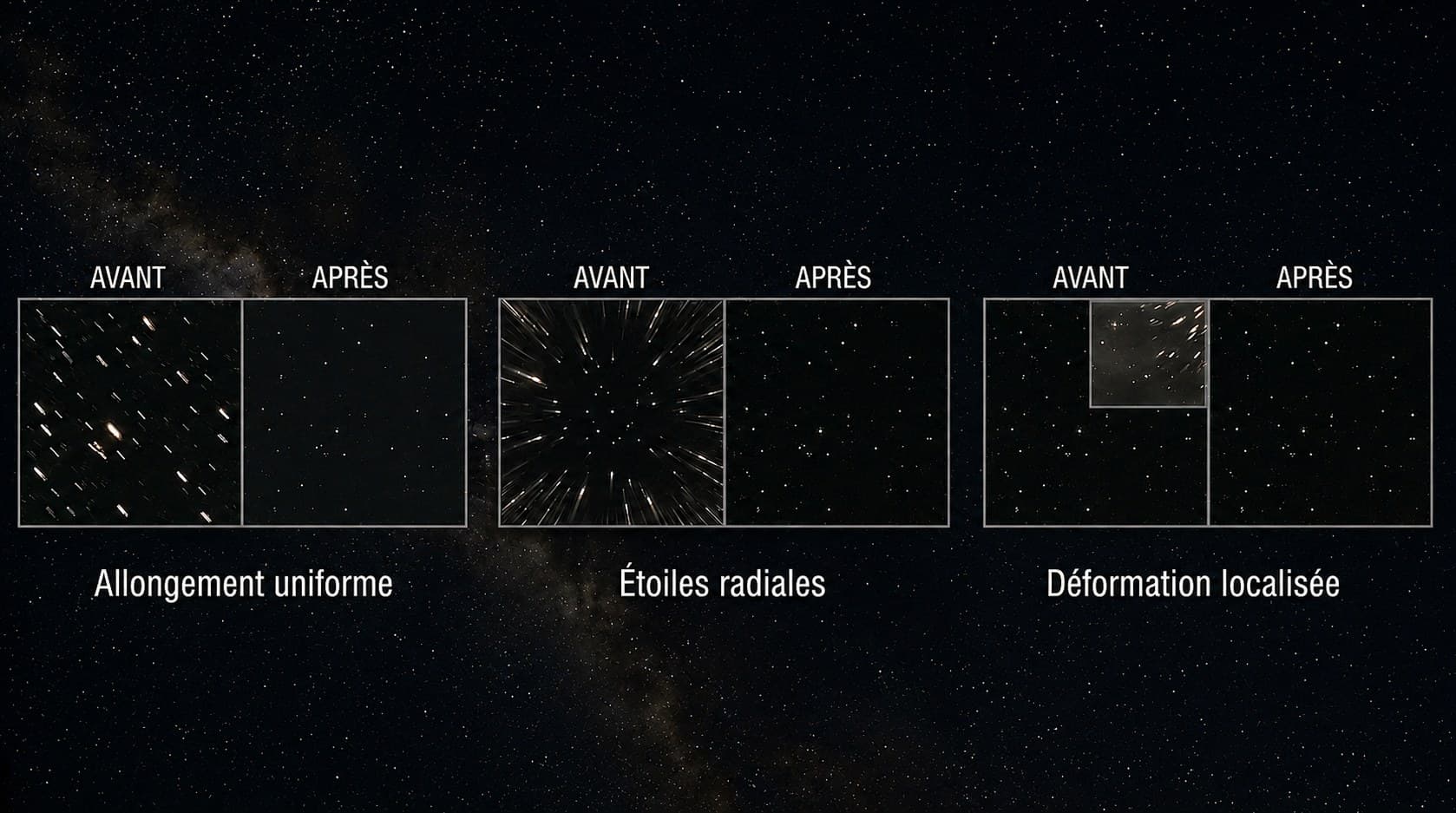
The core of the diagnosis is that two distinct causes overlap on star shape. The first is mechanical: elongation is already present at the field center (1.28 against a 1.09 floor), with a consistent position angle across all zones (13.8 degree scatter). An optical aberration always leaves the center clean; here it is not, so tracking is genuinely drifting during the 120 seconds.
The second is optical and reads along the horizontal axis: the left half of the field is tight (FWHM around 2.2 px, elong 1.09 to 1.10) while the right half collapses (TR 3.02 px elong 1.44, R 2.84, BR 2.90). The measured horizontal asymmetry (0.182) is more than double the vertical one (0.077), the signature of a tilted focal plane rather than field curvature, which would be symmetric across all four corners.
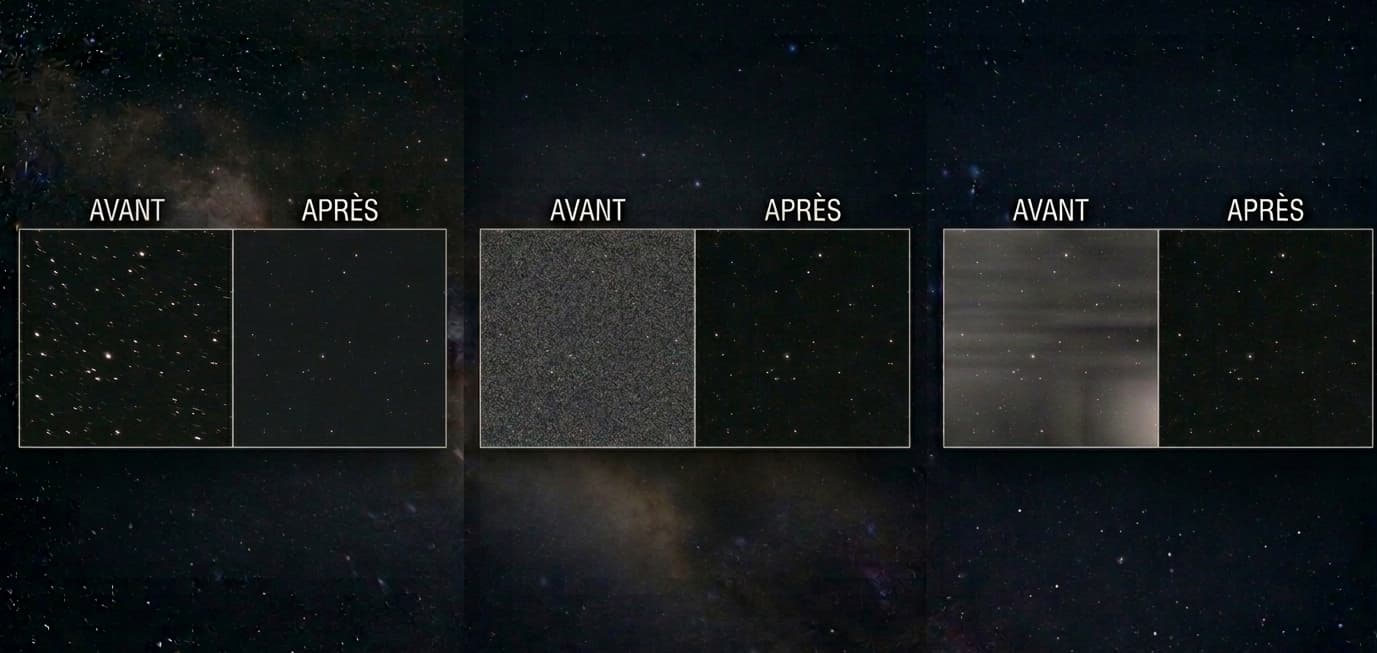
The rest is secondary: a 13% tilted plane on the background, perfectly removable in processing, and clipped cores on the bright members, inherent to a 120s exposure on such a luminous cluster. Nothing here condemns the session: fixing tilt and tracking would gain a full step in sharpness.
Priority actions
- Fix the imaging train tilt on the right side of the sensor, it is the most structural defect and will persist across the whole session
- Refine polar alignment and guiding, or drop to 60-90s subs to remove the central drift
- Add a short exposure set (5-15s) to recover the bright Pleiades cores through HDR blending
- Shift acquisition until after moonset to fully exploit the Bortle 2 sky
- Remove the background gradient after stacking with GraXpert or DBE