Astrophotography diagnosis of M 85: Tracking drift and sensor tilt
RawL300s17 mars 2026
The Doc examined this image of M 85 (raw, L, 300s). Estimated overall technical quality: 6/10. 2 defects found: Tracking drift (severity 3/5), Sensor tilt (severity 3/5).
&w=1920&q=75)
Info
- Cible
- M 85
- Date
- 17 mars 2026, 22:26
- Lune
- Pleine lune 98.4% (sous l'horizon)
- Site
- Bortle 1 · ciel pristine (VIIRS)
- Position
- 12h25m37s · +18°12'08"
Excellent conditions: Bortle 1 and the Moon below the horizon, so no lunar pollution is possible and the sky background is remarkably dark, which the measurement confirms (median 0.01, weak plane gradient at 10% and poorly fitted with R-squared 0.12). For a broadband luminance galaxy like M85 this is the ideal case: it is exactly the kind of target that demands a dark sky, since a light pollution filter would not help on a continuum spectrum. The only caveat is the background-to-black-point margin of 2.19, below the sky-limited threshold of 5-10: under such a dark sky at 0.709 arcsec/px this is expected, but you can lengthen the exposure or raise the gain slightly to better dominate read noise.
Setup
- Type d'image
- Brut
- Télescope
- Mewlon 250CRS
- Caméra
- Artemis-M PRO
- Filtre
- L
- Exposition
- 300s
- Phase de lune
- Nouvelle lune (0 %)
- FOV
- 48.3'
The setup is coherent for M85. At 1350mm on a 4144x2824 sensor, the 0.80 degree field leaves M85 and NGC 4394 comfortably placed with generous margins and no risk of clipping. Sampling at 0.709 arcsec/px is fine-grained, though, oversampled for typical seeing: the measured FWHM of 4.3 to 5.4 px corresponds to roughly 3 to 3.8 arcsec on sky, so resolution is limited by atmosphere and tracking, not by the sensor. Binning 2 in processing would gain signal without losing anything. On the settings side, gain 120 and -15C are healthy; offset 4 causes no dark clipping (0%), so it holds. The 300s exposure is reasonable but demands flawless guiding at this focal length.
The diagnosis in detail
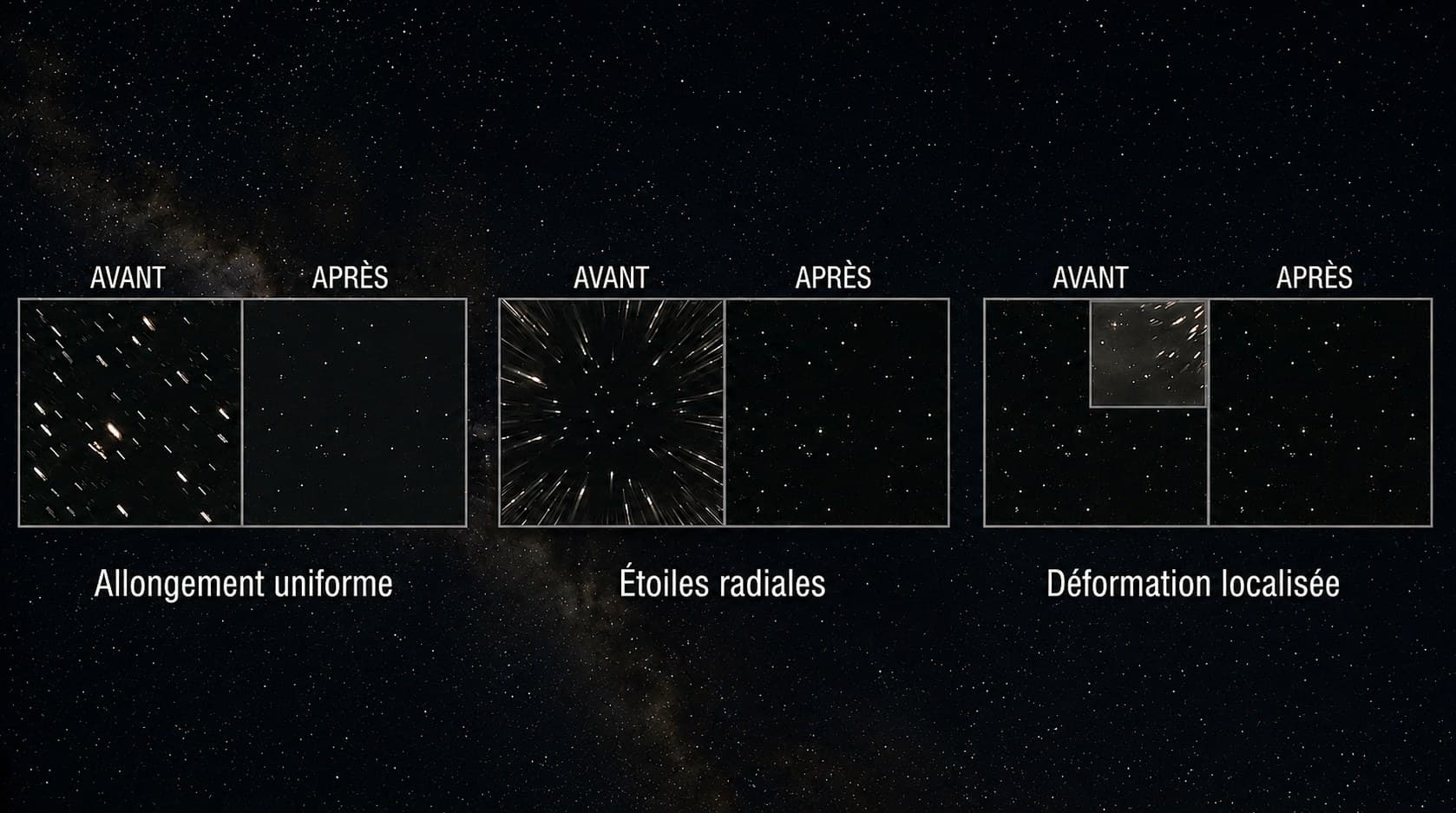
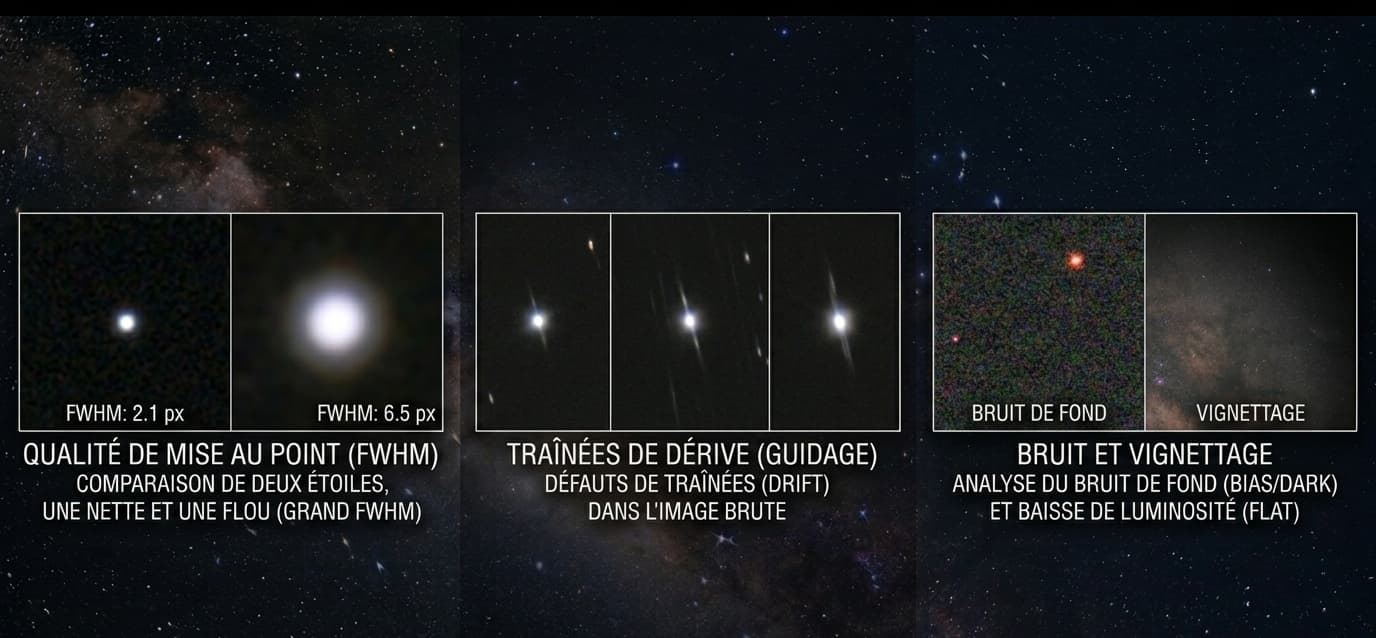
This sub is well executed on background and target, but the star shapes betray two distinct causes stacking up. The first is dynamic: the inspector measures a nearly identical elongation direction everywhere, with a PA dispersion of only 2.6 degrees, which rules out a field optical aberration (which would give varying radial orientations) and points to a tracking drift over the 300s. The central elongation figure of 9.1 should be taken cautiously: the C thumbnail sits on M85's halo, a steeply sloped background that corrupts the Moffat fit. What is measurable at the edges is more modest, with elongations of 1.13 to 1.30.
The second cause is mechanical: the top row stays at 4.3 px FWHM while the bottom row rises to 5.3 px, about 24% spread on a single axis, with no equivalent on the horizontal axis (asymmetry 0.025). That is the classic signature of a tilted focal plane, not of field curvature, which would be symmetric. At 1350mm and 0.709 arcsec/px the mechanical tolerance is tight: a few tens of microns are enough to produce this spread.
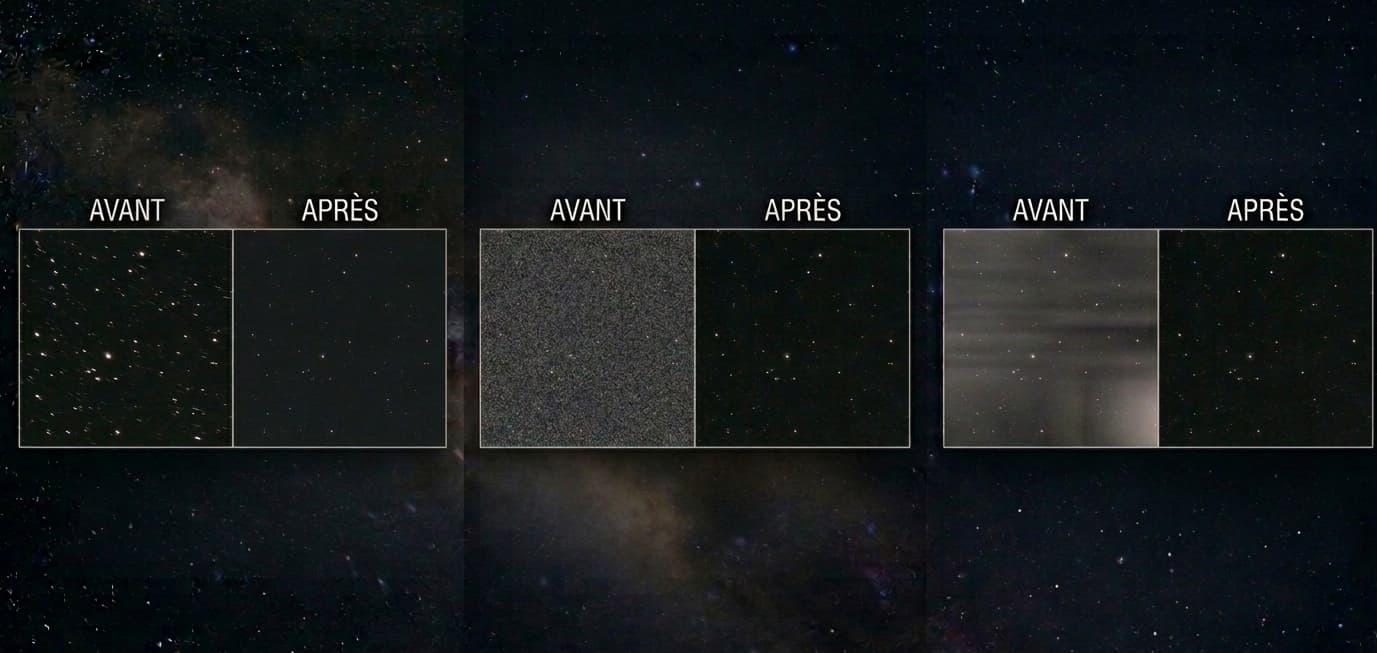
Finally, the 21% radial falloff of the background is purely instrumental, rotationally symmetric, and absent from the DSS. On a sub this is the expected behavior before flats: it does not hurt the exposure quality, but it is a reminder that the flat series must be shot in the exact configuration of the night, tilt included.
Priority actions
- Check polar alignment and PHD2 guiding curves before the next session, targeting total RMS under 0.4 arcsec at 1350mm
- Shorten subs to 120-180s as long as tracking cannot hold 300s without visible drift
- Revisit the imaging train parallelism (adapter screws, filter drawer) and validate with an aberration inspector test after rotating the camera 180 degrees
- Shoot a flat series in the exact session configuration to correct the 21% radial falloff
- Consider binning 2 in processing, since 0.709 arcsec/px sampling is finer than seeing allows