Astrophotography diagnosis of M 92: Tracking drift
Raw30s18 sept. 2026
The Doc examined this image of M 92 (raw, 30s). Estimated overall technical quality: 7/10. 1 defect found: Tracking drift (severity 2/5).

Info
- Cible
- M 92
- Date
- 18 sept. 2026, 19:45
- Lune
- Dernier quartier 50.6% (7.5° d'alt., 71.8° de la cible)
- Site
- Bortle 2 · rural typique (VIIRS)
- Position
- 17h15m37s · +42°42'26"
Very favorable conditions. Under Bortle 2 the sky background sits almost at the floor (median 0.01, dark clipping 0.02%) and the measured gradient stays low. The Moon at 50.6% is only 7.5 degrees above the horizon and 71.8 degrees from the target, so its impact is marginal, the scattered light staying confined near the horizon. For a globular cluster like M 92, a high contrast stellar target, this sky is ideal and no light pollution filter is useful here. With such a site, the real gain lies in extending total integration to dig out the cluster's outer stars.
Setup
- Type d'image
- Brut
- Télescope
- EQMod Mount
- Caméra
- ZWO ASI585MM Pro
- Exposition
- 30s
- Phase de lune
- Premier quartier (46 %)
- FOV
- 3.36°
The setup is a bit short on resolution for this target. At 190mm focal length and 3.15 arcsec/px, M 92 fills only a tiny fraction of the 3.36 degree field: the cluster is undersampled and its stars will never resolve finely, no matter how much you stack. This pairing is made for wide fields, not for a globular. On the settings side there is nothing to fault: gain 60 and offset 15 do not clip the shadows (0.02%), no saturated pixels, and a sensor at -19.5C keeps dark current negligible on the ASI585MM. The 2.7 background to black point margin is low, but that is expected under Bortle 2 at 30s: the sky is simply very dark.
The diagnosis in detail
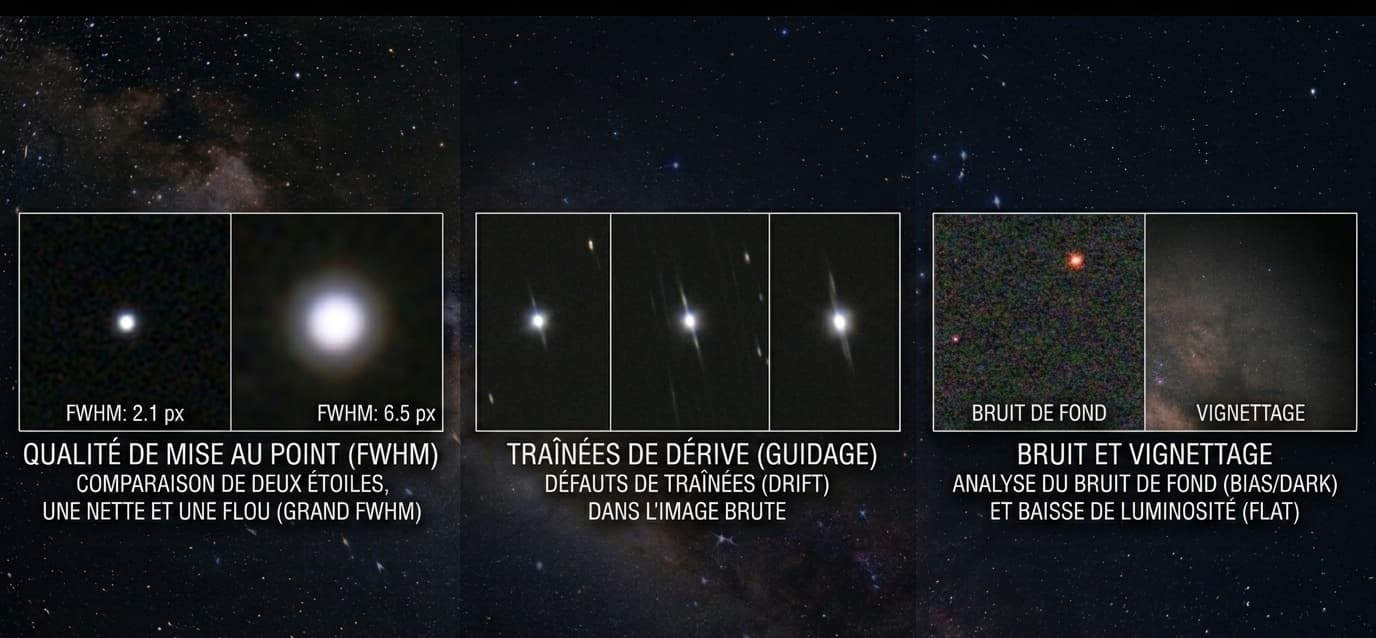
This sub holds up well. The Moffat measurements give a consistent FWHM between 2.0 and 2.4 px across the nine zones, with a corner/center ratio of only 1.071 and horizontal and vertical asymmetries of 0.062 and 0.021. In other words, the field is flat and the imaging train is well set: no tilt, no backfocus error, no usable coma at this focal length.
The only real signal is the 1.14 elongation measured at the center, above the 1.05 field floor, with a 19.7 degree PA spread between zones. A field aberration always spares the center; here the center is affected as much as the edges, and the direction is broadly the same everywhere. That is the signature of tracking drift during the 30 second exposure. The amplitude stays small, around 10% elongation, so it is perfectly recoverable at stacking.
The background is clean: no pattern, no overwhelming hot pixels, and the plane gradient measured at 13% stays too modest to be flagged as a defect under Bortle 2, especially since flats and background extraction will absorb it. At this stage, this is a perfectly stackable sub.
Priority actions
- Refine polar alignment to remove the residual 1.14 center elongation
- Enable guiding, or drop exposures below 20s if the setup stays unguided
- Extend total integration to make the most of the Bortle 2 sky on this low surface brightness target
- Consider a longer focal length to actually resolve M 92 (3.15 arcsec/px is too coarse)