Astrophotography diagnosis of m1: Sensor tilt, framing issue and 1 other
RawLuminance30s13 août 2026
The Doc examined this image of m1 (raw, Luminance, 30s). Estimated overall technical quality: 6/10. 3 defects found: Sensor tilt (severity 3/5), Framing issue (severity 3/5), Light pollution gradient (severity 2/5).
&w=1920&q=75)
Info
- Cible
- m1
- Date
- 13 août 2026, 21:12
- Lune
- Pleine lune 98.3% (sous l'horizon)
- Site
- Bortle 1 · ciel pristine (VIIRS)
- Position
- 20h57m25s · +50°05'03"
Very favourable conditions: Bortle 1 and a 98% full Moon but below the horizon, so no lunar pollution is possible on this frame. The measured 13% gradient therefore does not come from the Moon, more likely local stray light or a low target. Under a sky this good, a 30s luminance is short: the measured sky-to-black-point margin of 2.26 and 29.5% dark clipping confirm you are not sky-limited. On such a dark site, lengthen the sub exposure substantially (120 to 300s depending on tracking) to lift the background off the black point, otherwise read noise dominates and you waste the site quality.
Setup
- Type d'image
- Brut
- Télescope
- Vinzoographe
- Caméra
- Moravian USB Camera 1 (64 bit) (ASCOM)
- Filtre
- Luminance
- Exposition
- 30s
- Phase de lune
- Nouvelle lune (0 %)
- FOV
- 59.5'
Sampling of 1.742"/px at 876mm f/4.5 is coherent and well matched to typical seeing, and the 1.44 px central FWHM shows you were actually undersampled that night, the sky was excellent. The 0.99 deg field on a square 2056 px sensor stays tight, though: M1 would fit comfortably, which makes the nebula's absence all the more telling of a pointing problem. The Luminance filter is the right call under Bortle 1. Cooling at -14.6C is healthy. The setting to revisit is the 30s exposure, too short for this site, plus the 29.5% dark clipping which also suggests checking the camera offset.
The diagnosis in detail
The core of this sub is excellent: FWHM 1.44/1.33 px at the centre, elongation 1.08 against a field floor of 1.04, PA dispersion of 36 deg, so round stars and flawless tracking over 30 seconds. There is no drift, no guiding oscillation, no focus error.
The degradation is purely geometric and localised. The 1.39 corner/centre FWHM ratio spreads diagonally: top-right 2.21 px and bottom-left 2.09 px against top-left 1.67 px and bottom-right 1.59 px. That single-axis signature, with a sharp centre, is the mark of a sensor not perpendicular to the optical axis, not symmetric field curvature nor coma. It is mechanical and therefore fixable once and for all.
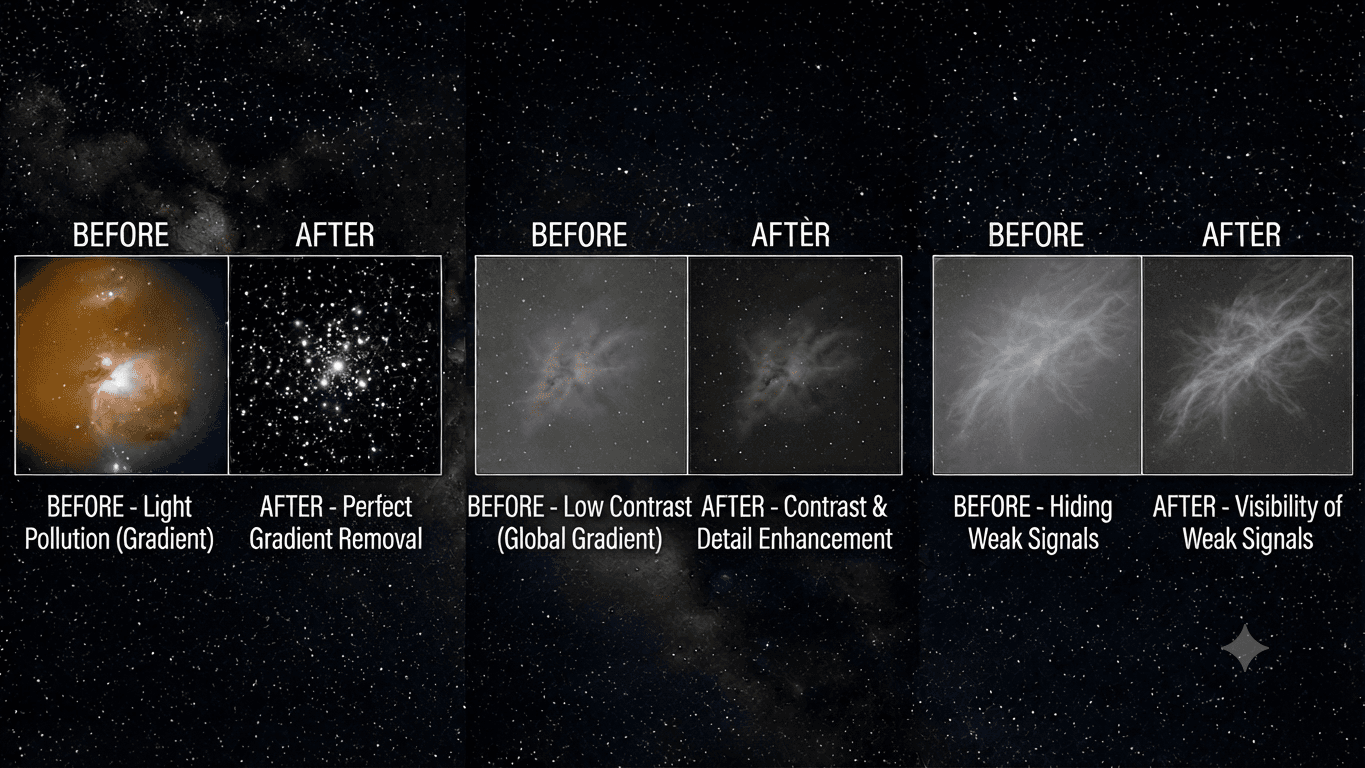
The rest is about the session rather than the optics: a background gradient oriented at 80 deg with 13% amplitude, independent of the Moon since it sits below the horizon, and above all a 30s exposure that leaves the background stuck against the black point under a Bortle 1 sky. Finally, no trace of the M1 remnant in the field, which points to a pointing or framing issue to fix before any long run.
Priority actions
- Check pointing with a plate solve and recentre on M1 before restarting a run
- Correct the sensor tilt by retightening the imaging train then iterating on a tilt plate until the corner/centre ratio drops below 1.15
- Lengthen the sub exposure to 120-300s to become sky-limited under this Bortle 1 sky
- Check the camera offset to eliminate the 29.5% dark clipping
- Remove the background gradient in processing with GraXpert or DBE after stacking