Astrophotography diagnosis of m16: Sensor tilt, clipped stars and 1 other
Processed
The Doc examined this image of m16 (processed). Estimated overall technical quality: 7/10. 3 defects found: Sensor tilt (severity 3/5), Clipped stars (severity 2/5), Background chroma noise (severity 2/5).
&w=1920&q=75)
Info
- Cible
- m16
- Position
- 18h18m46s · -13°48'20"
A 27 percent waning crescent has almost no impact on narrowband imaging of M16, since narrow filters reject most scattered moonlight. The image background confirms it: clean, with no oriented gradient. These conditions are perfectly usable for this emission target, and you could even push longer subs without fear of raising the background. On a broadband target or a faint galaxy this crescent would matter more, but here it costs nothing. The real limiting factor remains M16's altitude, so shoot as close to meridian transit as possible to limit turbulence.
Setup
- Type d'image
- Traitée
- Télescope
- 80ed
- Caméra
- asi533 mm
- Phase de lune
- Dernier croissant (27 %)
- FOV
- 33.0'
The 80ED plus ASI533MM pairing suits M16 well: the 0.55 degree field frames the nebula and its Pillars with comfortable margins around the extensions. Central FWHM of 3.85 px is decent, but the 1.47 corner/center ratio shows the imaging train is not extracting the scope's full potential, and that is where the clearest gain lies. The histogram gives a background-to-black-point margin of 1.26, low in absolute terms but normal in narrowband where the background stays naturally dark: do not read it as underexposure. No shadow clipping, so the offset is adequate.
The diagnosis in detail
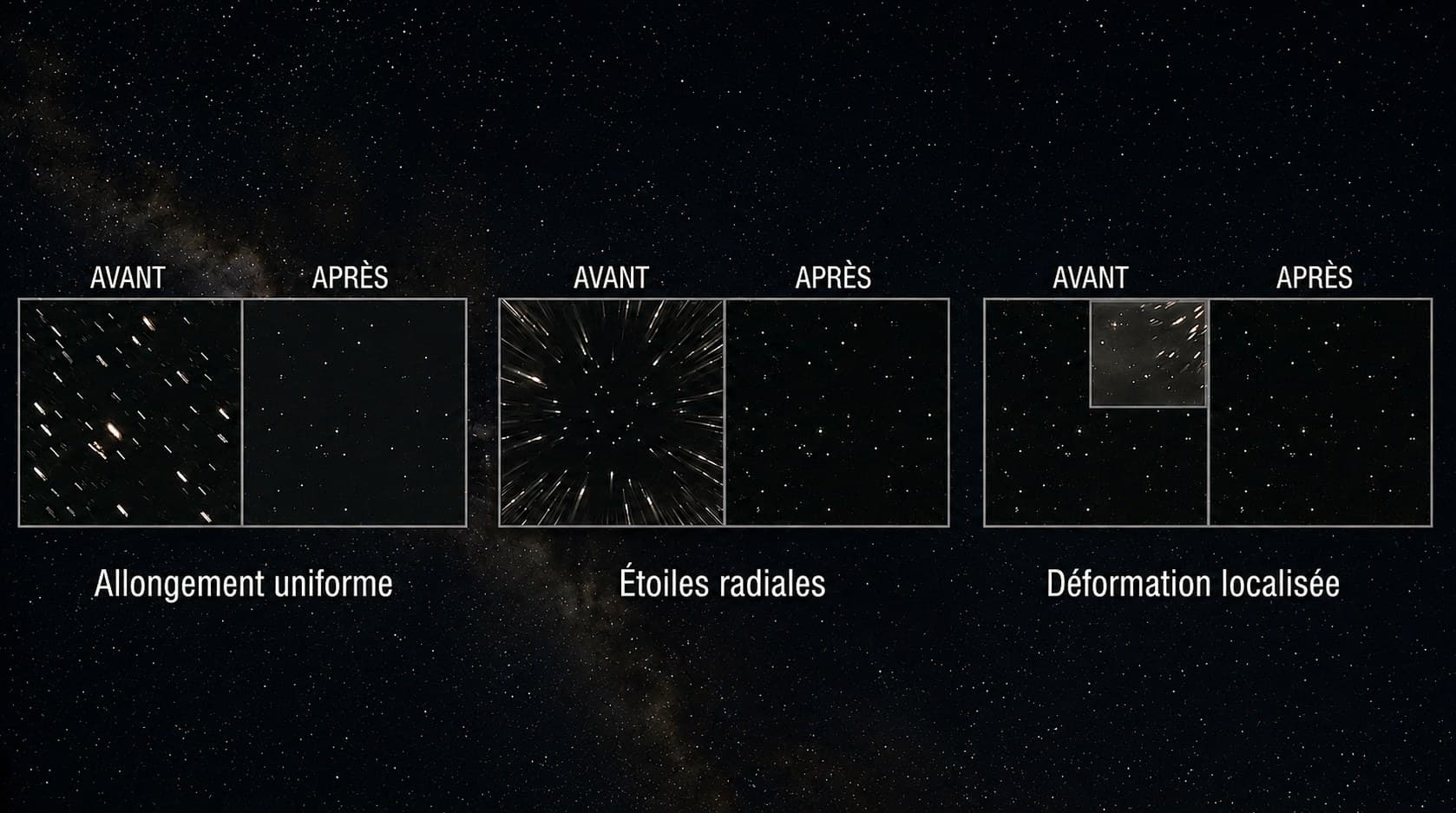
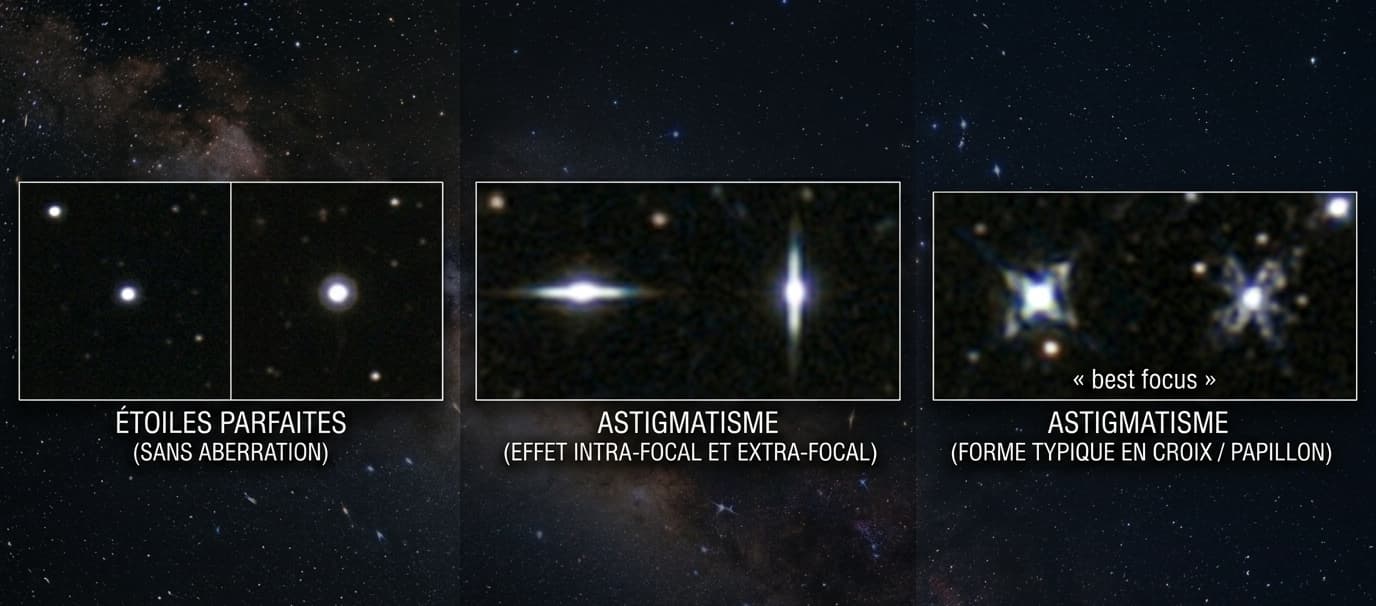
The aberration inspector is unambiguous: the field center is the sharpest point at 3.85/3.35 px FWHM, while the bottom-right corner climbs to 5.54/5.01 px and the top-left stays at 4.66/4.53 px. This single-axis asymmetric degradation (horizontal asymmetry 0.149 against 0.002 vertically) is the signature of tilt, not a backfocus error, which would have degraded all four corners symmetrically. The 44.5 degree PA dispersion and the low elongation everywhere also confirm there is no tracking component: the stars are round, the mount did its job.
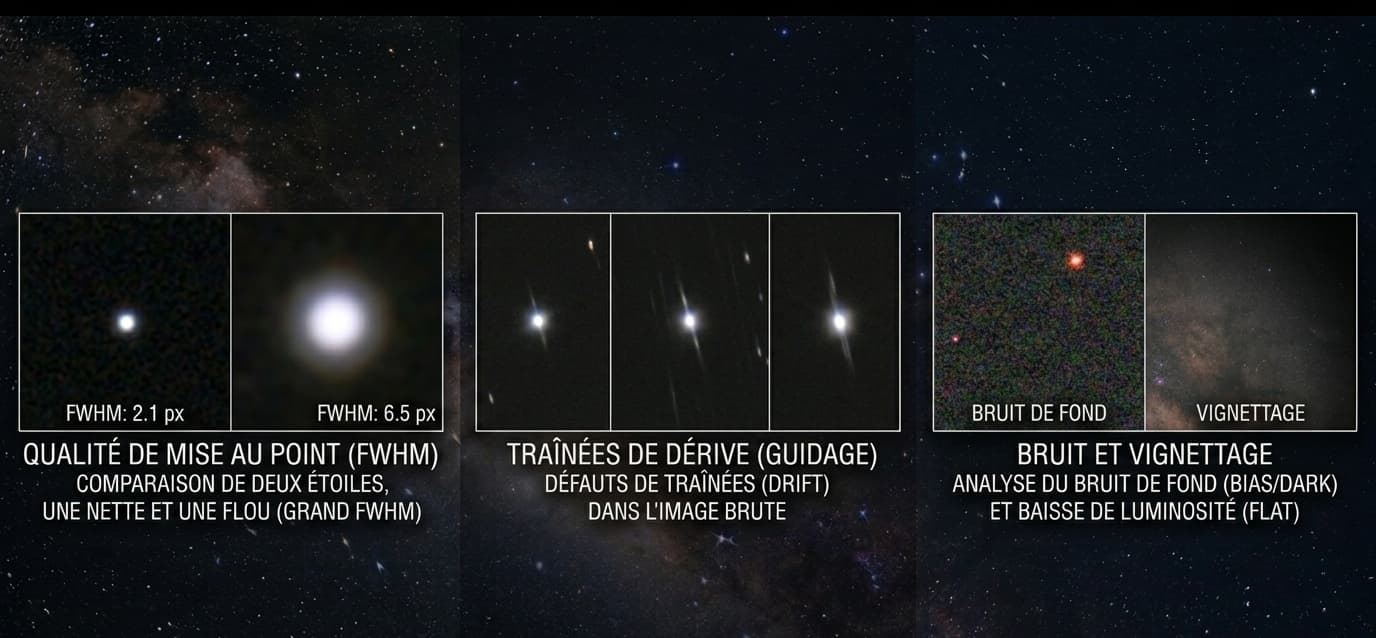
The remaining points are post-processing matters. The bright star cores in NGC 6611 are clipped to pure white, the result of an aggressive stretch without highlight protection, which robs the image of the color contrast of the cluster's young stars. In the dark background areas, color mottling remains, a sign of a global saturation boost applied to signal that is still somewhat short on certain channels.
None of this is disqualifying: the structure of the Pillars, the fine detail and the agreement with the DSS reference all point to a healthy acquisition. Fixing the tilt and then refining the stellar stretch would lift this image a clear notch.
Priority actions
- Fix the imaging train tilt: tighten every threaded connection evenly, then check with the Aberration Inspector until the corner/center ratio drops below 1.2
- Redo the stretch with highlight protection, or process stars separately to recover the saturated cores
- Apply masked chroma noise reduction to the background, and only boost saturation afterwards
- Increase integration on the noisiest channel to clean up the background before processing