Astrophotography diagnosis of M27: Astigmatism, light pollution gradient and 1 other
ProcessedBaader CMOS UV/IR Cut (420-685nm)43x60
The Doc examined this image of M27 (processed, Baader CMOS UV/IR Cut (420-685nm), 43x60). Estimated overall technical quality: 7/10. 3 defects found: Astigmatism (severity 2/5), Light pollution gradient (severity 2/5), Clipped stars (severity 2/5).
&w=1920&q=75)
Info
- Cible
- M27
- Site
- Bortle 5 · banlieue résidentielle (saisi)
- Position
- 19h59m36s · +22°43'12"
Favorable conditions. Moon at 11%: negligible influence, ignored. Bortle 5 on a bright planetary nebula like M27 stays comfortable in broadband UV/IR Cut, SNR on the target is good; the only cost is the measured 6% background gradient, easy to remove in post. The declared 3.0" seeing is consistent with the measured FWHM (4-4.5 px at center). Nothing in the conditions significantly limited the session.
Setup
- Type d'image
- Traitée
- Télescope
- Skywatcher Quattro 150P
- Caméra
- Player One Ares-C Pro
- Filtre
- Baader CMOS UV/IR Cut (420-685nm)
- Monture
- EQ6-R Pro
- Exposition
- 43x60
- Phase de lune
- 11%
- Seeing
- 3.0”
- FOV
- 1.00°
Setup well matched to the target. The Quattro 150P (600mm) with the Ares-C Pro gives about 1"/px, comfortable sampling under 3" seeing and consistent with measured FWHM. The 1.0deg field keeps M27 (~8') well centered with a wide starfield margin, good framing. The broadband UV/IR Cut filter is a sound choice on a bright planetary at Bortle 5. Only hardware caveat: the edge astigmatism suggests revisiting corrector spacing and Newton collimation.
The diagnosis in detail
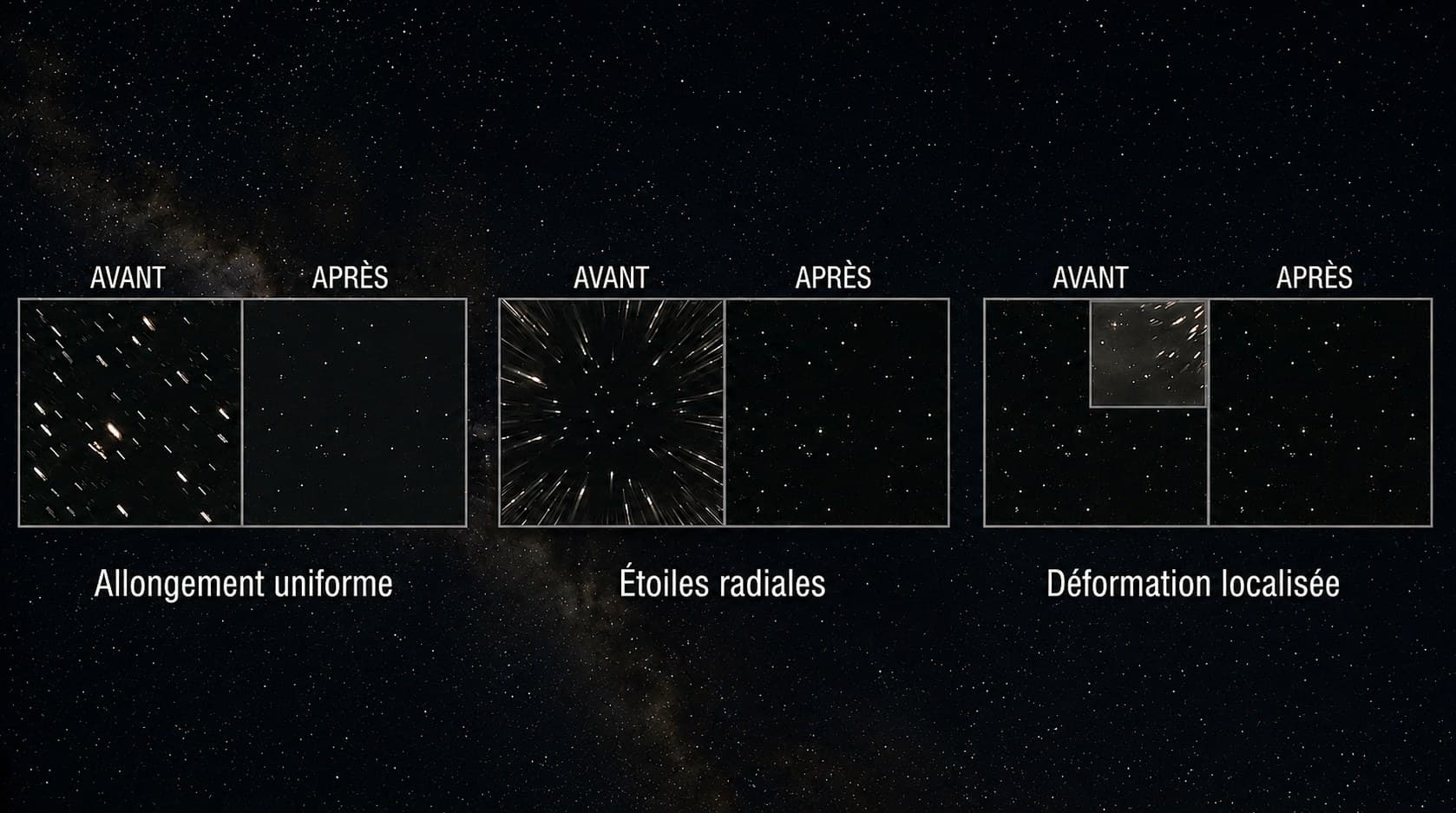
The image is solid. Moffat metrics show a round center (elong 1.09 against a 1.03 field floor) and 25deg PA dispersion, with no coherent directional elongation: EQ6-R tracking is good, no notable drift or periodic error. Center FWHM of 4 to 4.5 px matches the 3" seeing.
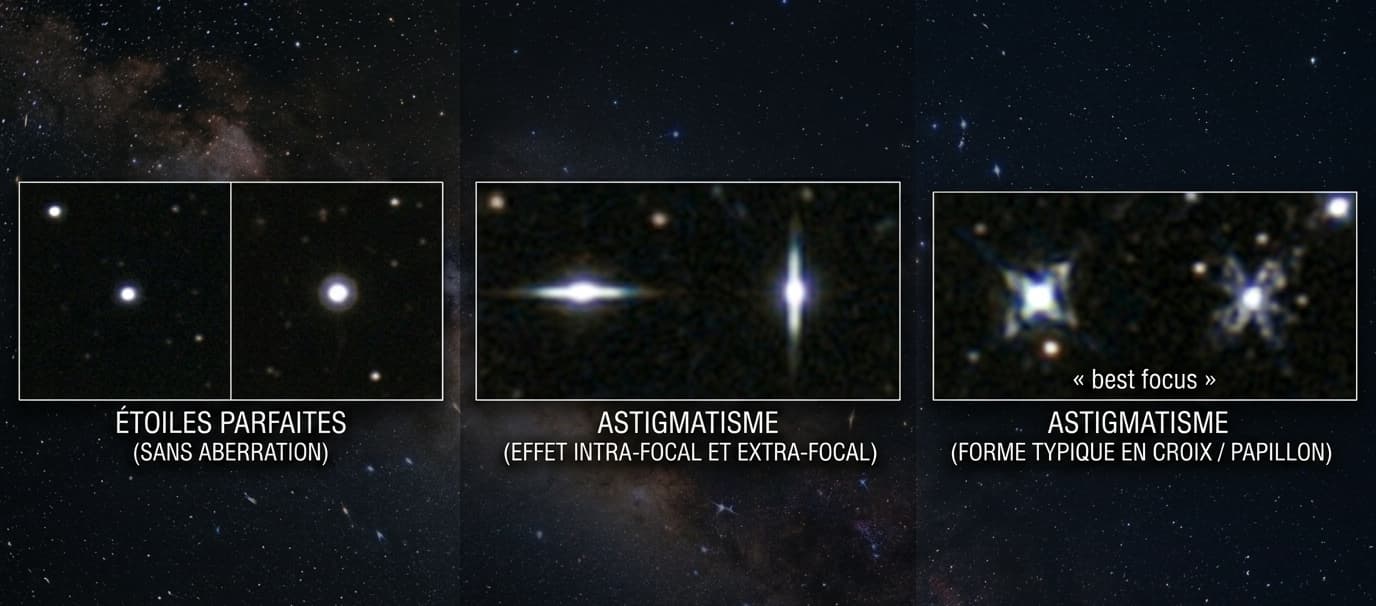
The only real optical defect is field astigmatism: elongation climbs to 1.25 on the right edge (R) and 1.13 at BR while the left and top corners stay near circular. This asymmetry points to corrector spacing or imperfect collimation rather than plain focus error. It is mild and does not hurt the overall look.
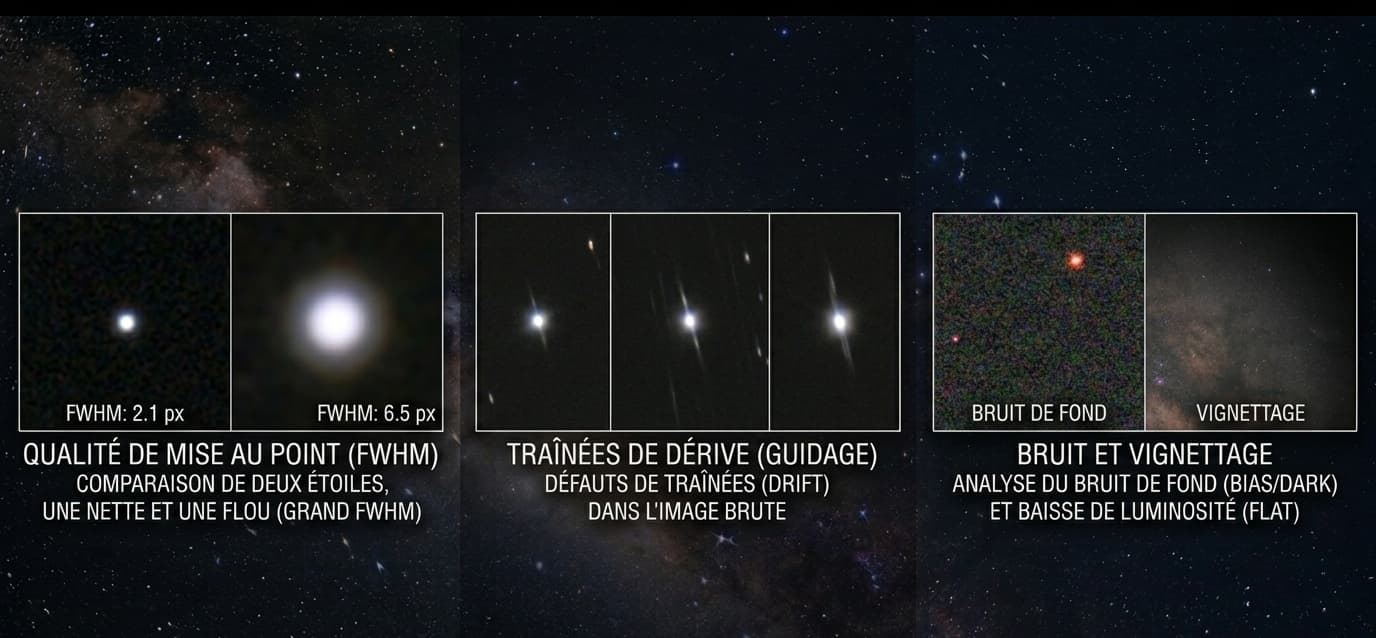
On background and processing, the measured gradient (6%, dominant plane) is a light-pollution residual confirmed against the DSS (no extended IFN here), to flatten in the linear stage. Finally, a few bright stars have white-clipped cores from the 60s sub and the stretch; a stellar HDR would recover them. Background noise stays under control.
Priority actions
- Remove the light-pollution gradient (GraXpert or DBE/ABE) on the linear image
- Check Newton collimation and coma-corrector spacing to resolve the edge astigmatism
- Add short subs for a stellar HDR to recover the clipped cores