Astrophotography diagnosis of m27: Tracking drift, noise / underexposure and 2 others
Processed150s · ISO 80004 août 2026
The Doc examined this image of m27 (processed, 150s · ISO 800). Estimated overall technical quality: 2/10. 4 defects found: Tracking drift (severity 5/5), Noise / underexposure (severity 3/5), Astigmatism (severity 2/5), Green cast (severity 2/5).

Info
- Cible
- m27
- Date
- 04 août 2026, 22:57
- Position
- 19h59m36s · +22°43'12"
A last-quarter Moon at 59 percent illumination is not ideal but explains none of what we see here: the background stays dark and even, and no lunar gradient was measured. On a bright planetary nebula like M27, rich in OIII and Ha, a 59 percent Moon remains tolerable in broadband if it is far from the target, and fully manageable with a dual-band filter. The real limiting factor this session is mechanical, not celestial. In other words, you can keep this lunar window, just not this tracking quality.
Setup
- Type d'image
- Traitée
- Télescope
- 50mm
- Caméra
- Canon Canon EOS 1100D
- Exposition
- 150s · ISO 800
- Phase de lune
- Dernier quartier (59 %)
- FOV
- 1.20°
A 50 mm lens giving a 1.20 degree field on this Canon 1100D is very wide for M27: the nebula spans only a few arcminutes, occupies a tiny fraction of the frame here, and cannot show its dumbbell structure. This target calls for a much longer focal length, typically 400 mm and up. On settings, 150 s at ISO 800 is too long for this tracking: the background-to-black-point margin of 1.88 shows you are not sky-limited, so nothing forces such long subs. Drop to 30-60 s, you will lose fewer frames and stars will go back to being points.
The diagnosis in detail
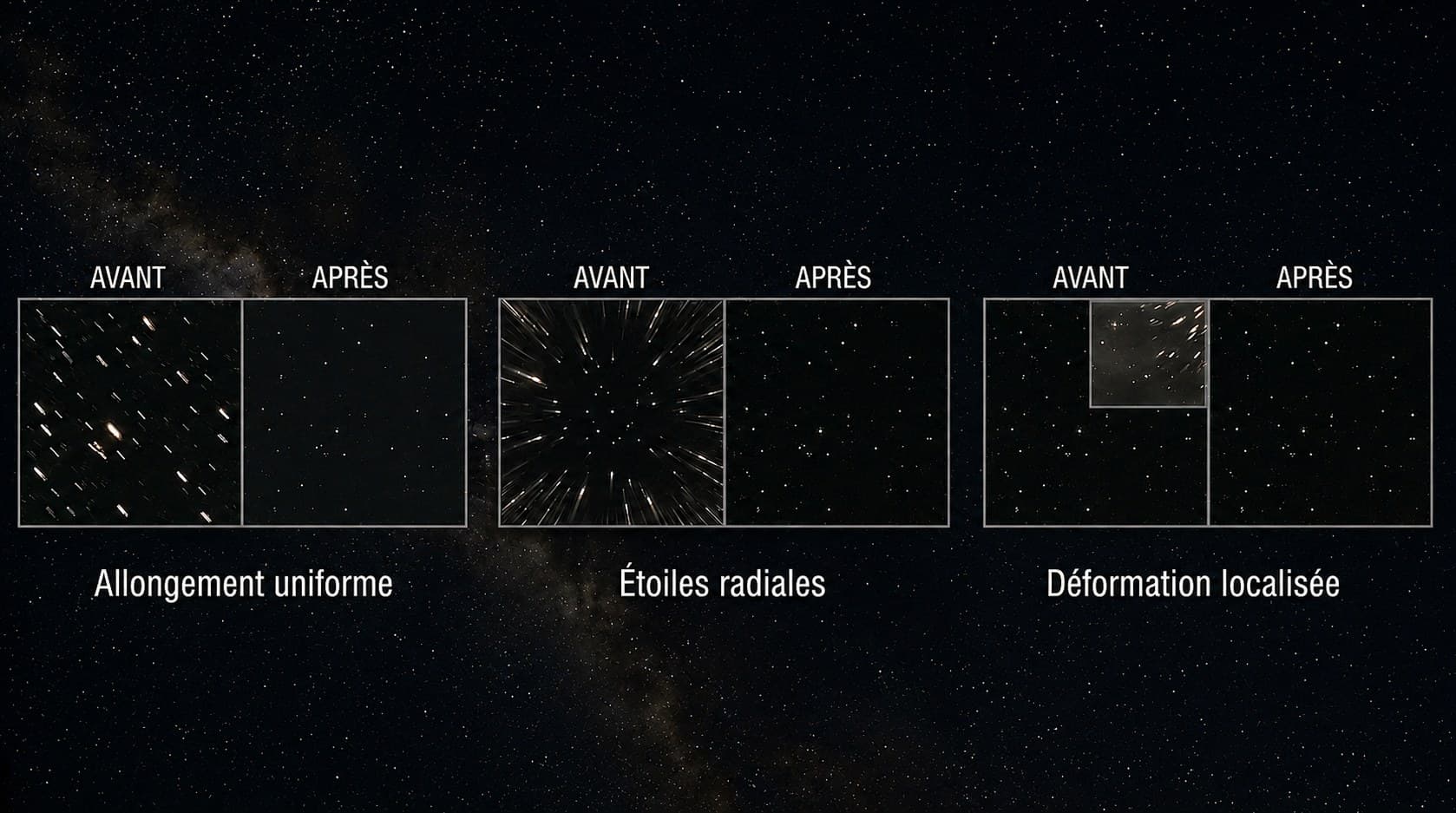
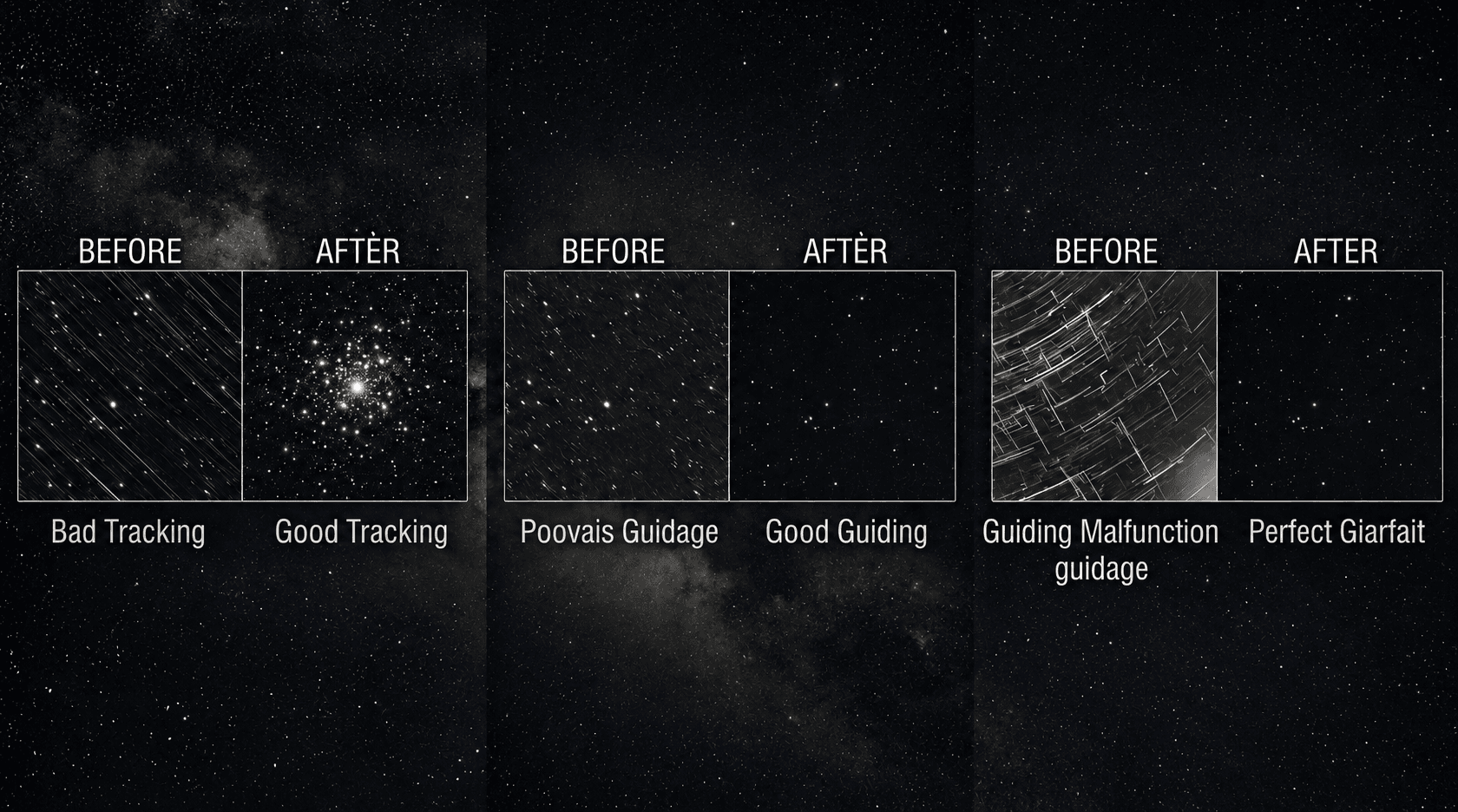
The diagnosis is dominated by a single defect, and everything else follows from it. Stars are not points but straight segments, all oriented the same way and of comparable length from center to corners. That uniformity is the signature of tracking drift, not of an optical fault: a field aberration always spares the center, yet here the central tile of the PSF panel shows a star just as stretched as those at the edges.
The knock-on effects are visible. The signal from each star and from M27 is spread over several pixels, which collapses point signal-to-noise: the nebula shows as a fuzzy blob without its dumbbell profile, and the background stays grainy despite a margin of only 1.88 above the black point. The field astigmatism measurement (elongation rising to 1.28 at the bottom without an FWHM increase) is plausible on this 50 mm optic, but the trails contaminate the Moffat fit and the 27 degree PA scatter calls for caution: revalidate it on clean short exposures.
Finally, the color rendition needs reworking: M27 comes out a monochrome green-cyan when it normally shows an OIII green-blue core rimmed by a red Ha halo. A photometric calibration would set that straight.
Priority actions
- Redo polar alignment with the drift method before any new session
- Cut exposures to 30-60 s as long as there is no autoguiding, stacking more frames instead
- Move to a longer focal length (400 mm minimum) so M27 actually fills the frame
- Raise total integration to 1-2 h and add darks and flats
- Apply a photometric color calibration then a light green SCNR