Astrophotography diagnosis of m31: Tracking drift and backfocus error
RawLuminance30s13 août 2026
The Doc examined this image of m31 (raw, Luminance, 30s). Estimated overall technical quality: 7/10. 2 defects found: Tracking drift (severity 2/5), Backfocus error (severity 2/5).
&w=1920&q=75)
Info
- Cible
- m31
- Date
- 13 août 2026, 21:13
- Lune
- Pleine lune 98.3% (sous l'horizon)
- Site
- Bortle 4 · transition rural/banlieue (VIIRS)
- Position
- 20h57m25s · +50°05'02"
Favorable conditions: the Moon is 98% full but below the horizon, so no lunar contribution is possible, and a Bortle 4 sky stays comfortable for broadband luminance on a star field in the M31 region. The measured background confirms that quality: no dominant light pollution, just a mild oriented gradient. With this sky, you can afford longer sub exposures without saturating the background, which would clearly help here. If you are aiming at the galaxy itself and its faint outer regions, Bortle 4 with no Moon is exactly the window to prioritize.
Setup
- Type d'image
- Brut
- Télescope
- Vinzoographe
- Caméra
- Moravian USB Camera 1 (64 bit) (ASCOM)
- Filtre
- Luminance
- Exposition
- 30s
- Phase de lune
- Nouvelle lune (0 %)
- FOV
- 59.5'
Sampling at 1.74"/px for 876 mm at f/4.5 is consistent with typical seeing, even slightly undersampled given the measured FWHM around 1.5 px, which explains the very compact stars. The 0.99° field, however, is very tight for M31, which overflows it by far: this image shows a star field, not the galaxy, so either go for a mosaic or change target. On settings, a sensor temperature of -14.6°C is healthy, but the 30s exposure leaves a background-to-black-point margin of only 2.26 with 28% dark clipping: you are read-noise-limited. Move to 120-180s in luminance under this sky, or raise the offset.
The diagnosis in detail
This is a well-made sub. Stars are tight and the Moffat fit sits correctly on nearly every thumbnail of the inspector panel, which lends credibility to the numbers. Two signatures stand out, and they do not share a cause.
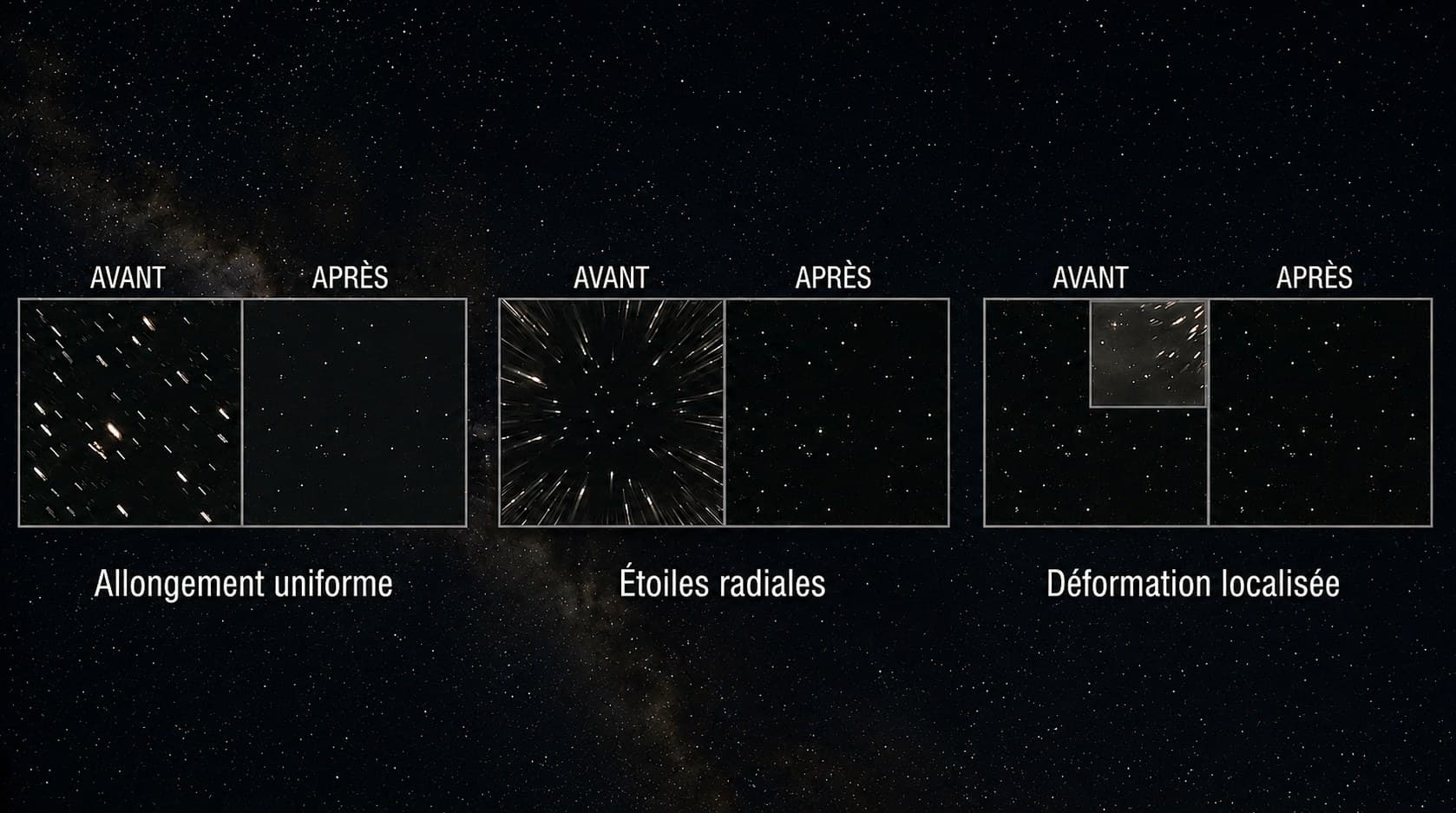
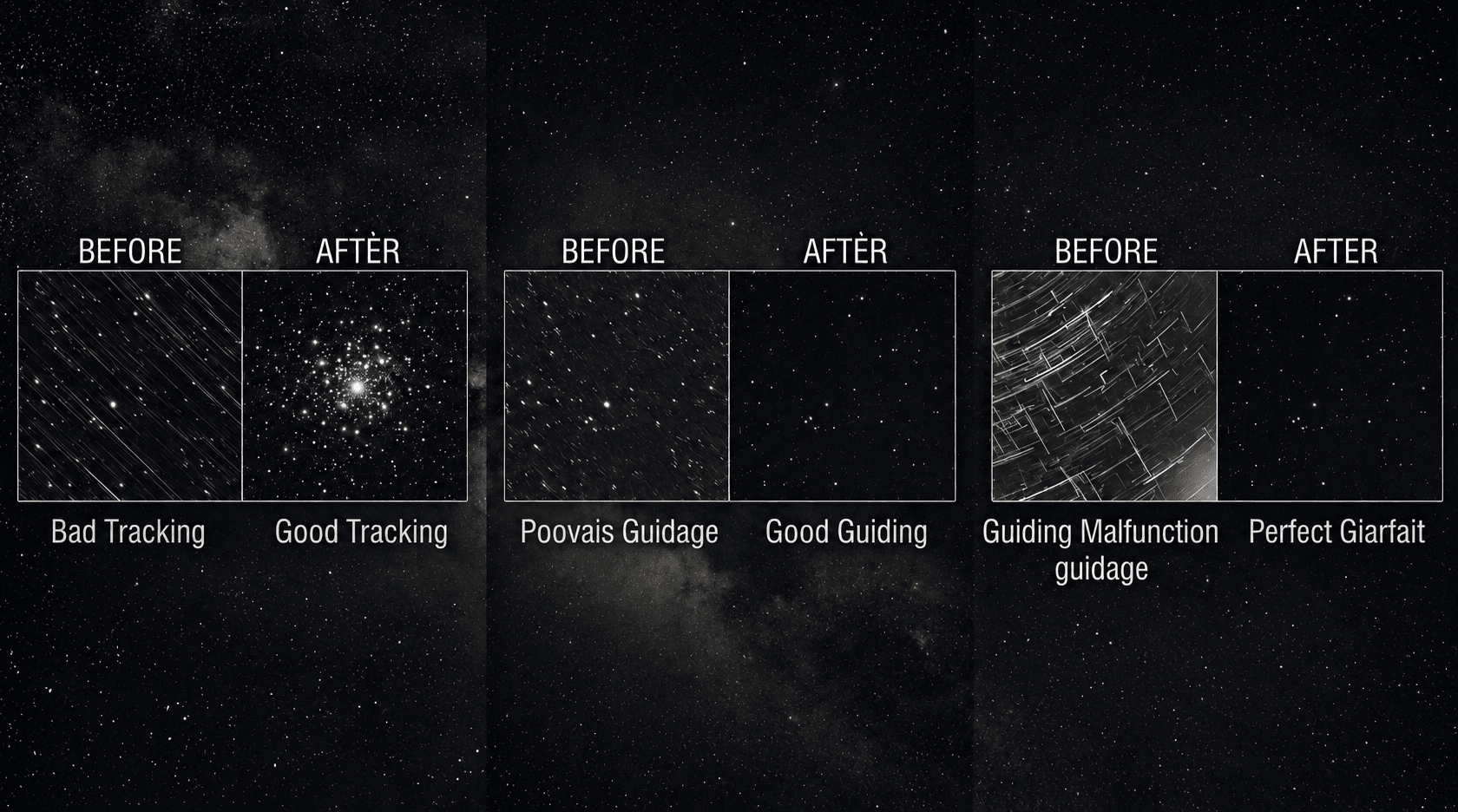
The first is mechanical. Elongation reaches 1.20 at the center while the field floor is 1.09, and the major axis points in the same direction everywhere, around -30°. An optical aberration does not elongate the center of the field: so the mount is moving during the 30s. The amplitude stays small and the sub is usable, but on longer exposures, which your Moonless Bortle 4 sky allows, this drift would become the limiting factor.
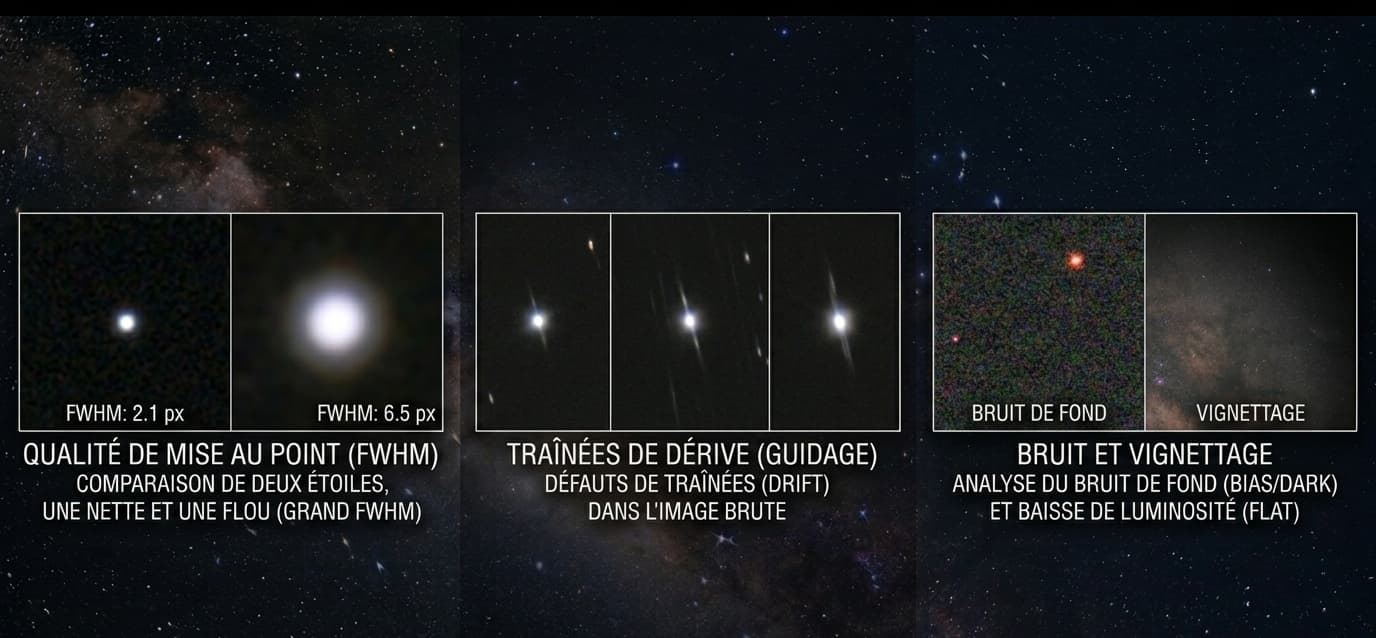
The second is optical and more subtle. FWHM rises from 1.48 px at center to about 1.75 px in the diagonal corners, symmetrically and with no measurable horizontal or vertical asymmetry. That is the signature of slightly off backfocus, not sensor tilt. The effect stays moderate at this level of sharpness, but it is worth fixing before lengthening exposures.
Finally, the histogram shows clear underexposure: the background sits against the black point. That is not an image defect, it is a setting to revisit.
Priority actions
- Redo polar alignment and enable or tighten autoguiding before moving to long exposures
- Lengthen sub exposure to 120-180s in luminance under this Bortle 4 sky to lift the background off the black point
- Check and adjust corrector backfocus in 0.5 mm steps, filter included in the calculation
- Reconsider framing: a 0.99° field is too tight for M31, plan a mosaic or another target