Astrophotography diagnosis of m31: Oversaturation, backfocus error and 3 others
Processed103x180
The Doc examined this image of m31 (processed, 103x180). Estimated overall technical quality: 7/10. 5 defects found: Oversaturation (severity 3/5), Backfocus error (severity 2/5), Tracking drift (severity 2/5), Residual vignetting (severity 2/5), Clipped stars (severity 2/5).
&w=1920&q=75)
Info
- Cible
- m31
- Position
- 0h42m53s · +41°15'23"
Favorable conditions: the Moon is only a first crescent at 7% illumination, so its sky background contribution is negligible and lunar gradient is a non-issue here. For a galaxy like M31 shot in broadband, this is exactly the window to aim for, since broadband RGB is far more Moon-sensitive than an emission nebula shot in narrowband. The histogram measurement shows a background barely lifted off the black point (e_margin 1.04), which reflects a dark sky and 180 s subs that are short relative to read noise rather than a light pollution problem. Nothing in the supplied data allows the site's light pollution level to be qualified.
Setup
- Type d'image
- Traitée
- Télescope
- 80ed
- Caméra
- ZWO ASI2600MC Air
- Exposition
- 103x180
- Phase de lune
- Premier croissant (7 %)
- FOV
- 2.37°
A coherent combination for M31: with a 2.37° field, the galaxy and its companions M32 and M110 fit the frame with comfortable margins, the classic framing and well executed here. The 80ED does remain marginal on an APS-C sensor, which the measurement confirms: the center is excellent at 1.75 px FWHM while corners climb to 2.4 px, a gap typical of field curvature that proper backfocus setting should absorb. The 103 subs of 180 s make about 5 h of integration, correct but not generous for M31's faint outer extensions; the very low background to black point margin (1.04) suggests you could lengthen exposures or stack more to lift further off read noise.
The diagnosis in detail
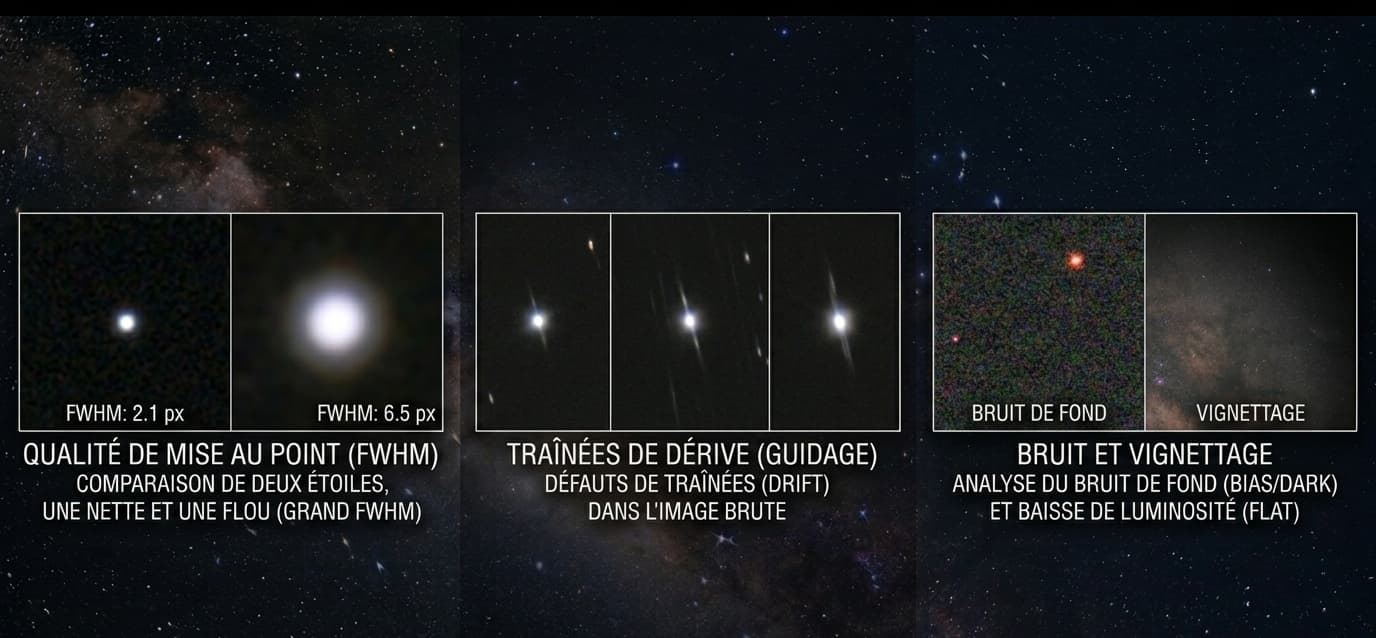
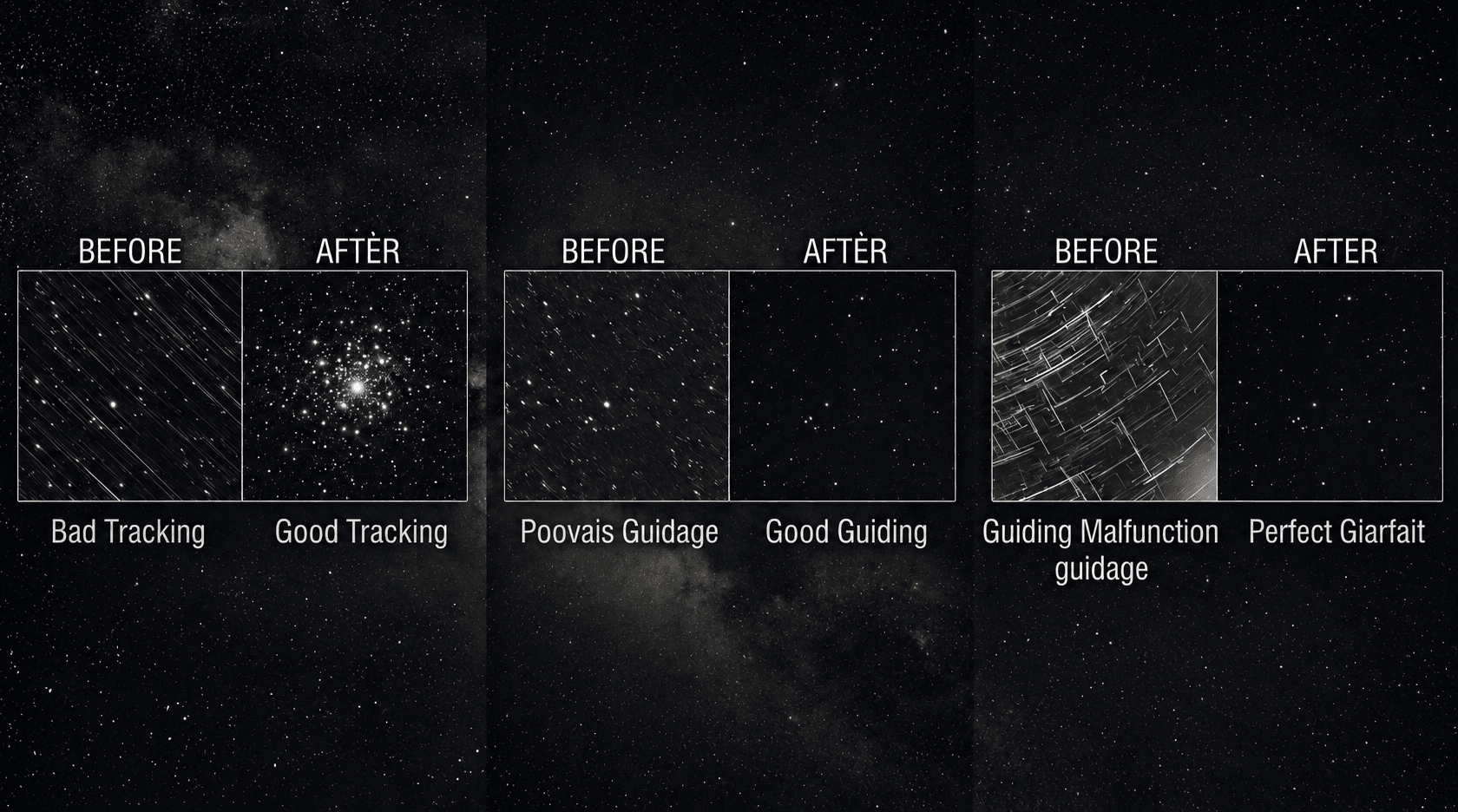
The diagnosis splits cleanly into two families. On acquisition, the PSF panel is telling: the center is the sharpest point in the field (1.75 px) but also the most elongated (1.23 against a 1.03 floor), with position angles consistent from zone to zone (8.4° spread). Elongation present all the way to the center is never optical, it is tracking drift, most likely imperfect polar alignment over 180 s subs. In parallel, FWHM rises symmetrically in all four corners (1.49 ratio) with no diagonal asymmetry: that is field curvature, so a backfocus setting to refine, not sensor tilt.
On the background, the illumination map measures a 39% radial falloff with rotational symmetry and no preferred orientation. Comparison with the DSS shows no real structure at that location: this is genuine residual vignetting, a flats problem, not a sky one.
On processing, finally, the M31 bulge is clipped to neutral white while the DSS still holds tint and structure in the same place, and several bright stars have lost their color. This is the most visible issue to the eye and also the easiest to fix, since it only takes a short exposure layer and a better masked stretch.
Priority actions
- Redo the M31 bulge stretch with a highlight protection mask to restore the core's gradient and tint
- Reshoot a flat series on the complete optical train to remove the 39% radial falloff toward the edges
- Refine backfocus in 0.5 to 1 mm steps until corner FWHM matches the center
- Improve polar alignment and check guiding RMS to remove the residual 1.23 central elongation
- Add a few 10 to 20 s exposures to rebuild the cores of bright stars and the nucleus