Astrophotography diagnosis of m31: Tracking drift, sensor tilt and 2 others
Processed300s · ISO 160011 août 2026
The Doc examined this image of m31 (processed, 300s · ISO 1600). Estimated overall technical quality: 4/10. 4 defects found: Tracking drift (severity 4/5), Sensor tilt (severity 3/5), Noise / underexposure (severity 3/5), Clipped stars (severity 2/5).

Info
- Cible
- m31
- Date
- 11 août 2026, 00:59
- Position
- 0h43m34s · +41°14'49"
Moon conditions are ideal: last crescent at 5%, negligible contribution to sky background, no lunar pollution to blame here. So the milky background measured (median 0.31 against a 0.18 black point) comes from the site or the integration, not the Moon. On a broadband galaxy like M31 this is exactly the case where you need dark skies: unlike an emission nebula, you cannot compensate with a narrowband filter. Use these moonless nights to pile up time, it is the only lever that will lift the outer arms out of the noise.
Setup
- Type d'image
- Traitée
- Télescope
- 50mm
- Caméra
- Canon Canon EOS 1100D
- Exposition
- 300s · ISO 1600
- Phase de lune
- Dernier croissant (5 %)
- FOV
- 3.55°
Target and field match well: 3.55 degrees wide for M31 which spans about 3 degrees, the galaxy fits with margin and both M110 and M32 are in frame. Framing does place M31 fairly left of centre though, composition could be improved. At 50mm on an APS-C sensor, sampling is very coarse (several arcseconds per pixel), so seeing is never the limit: your 7 px FWHM at centre can only come from the mount, not the atmosphere. ISO 1600 on a 1100D is a reasonable compromise, but 300s unguided is clearly beyond what this mount can hold. Shorten the exposure and multiply the subs.
The diagnosis in detail
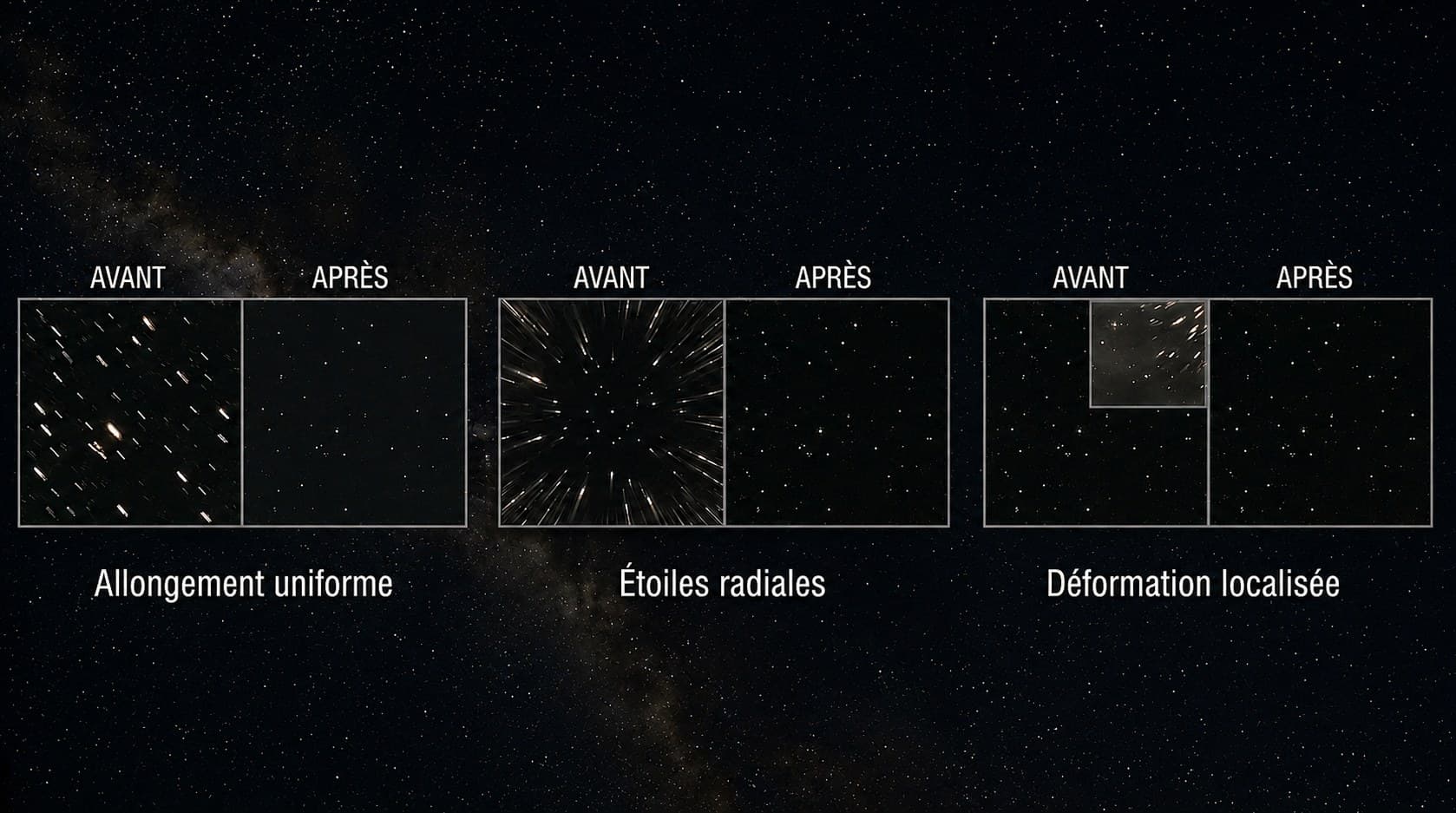
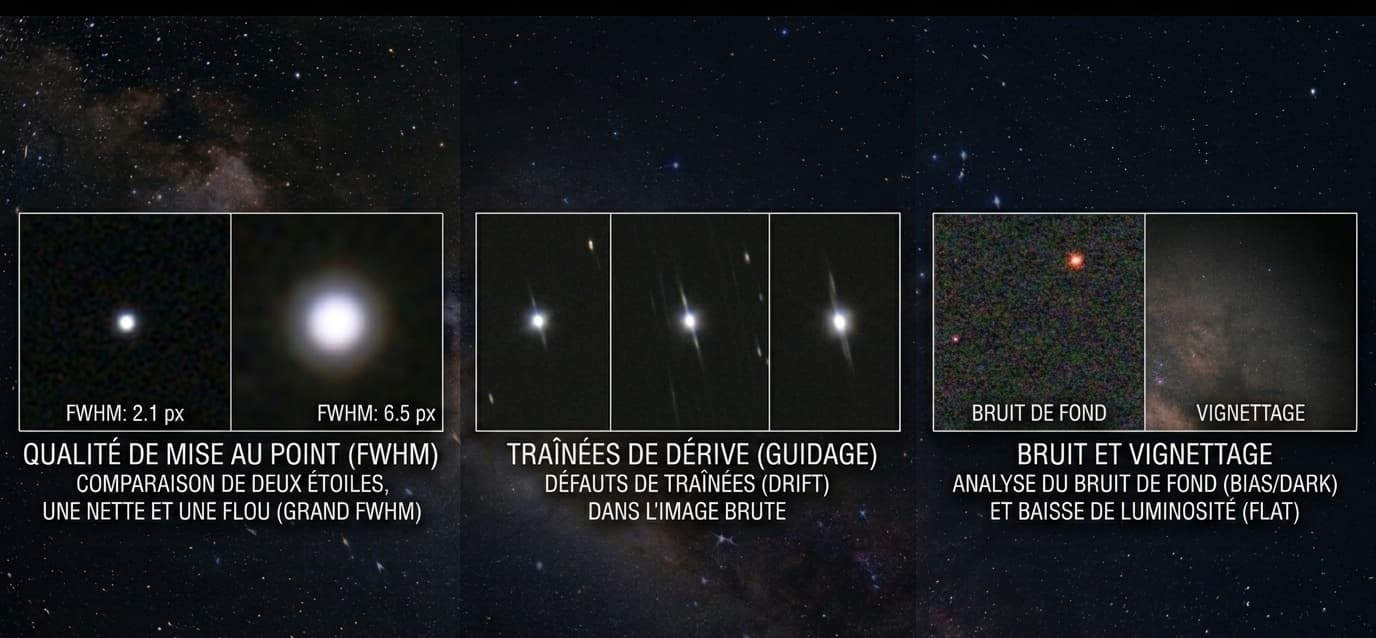
It all starts at the mount. The PSF measurement gives 3.32 elongation at field centre against a measured floor of 1.08: when the centre itself is stretched, the optics are off the hook, it is image motion during the exposure. The directional consistency (PA scatter of only 19 degrees, PA near 85-88) and the straight streaks readable in the C, T and B panels point to a steady drift rather than guiding oscillation or periodic error. Over 300s unguided, that is expected.
A second, independent effect sits on top: the left/right asymmetry. Left corners stay pinpoint (TL elong 1.08, FWHM 2.2 px, L 1.7 px) while the right side is clearly bloated (R 9.1/6.3 px, BR 9.5/5.5 px). Drift alone would affect the whole field equally, so this single-axis horizontal asymmetry of 0.98 points to a tilt of the sensor plane relative to the optical axis, most likely at the body/lens adapter.
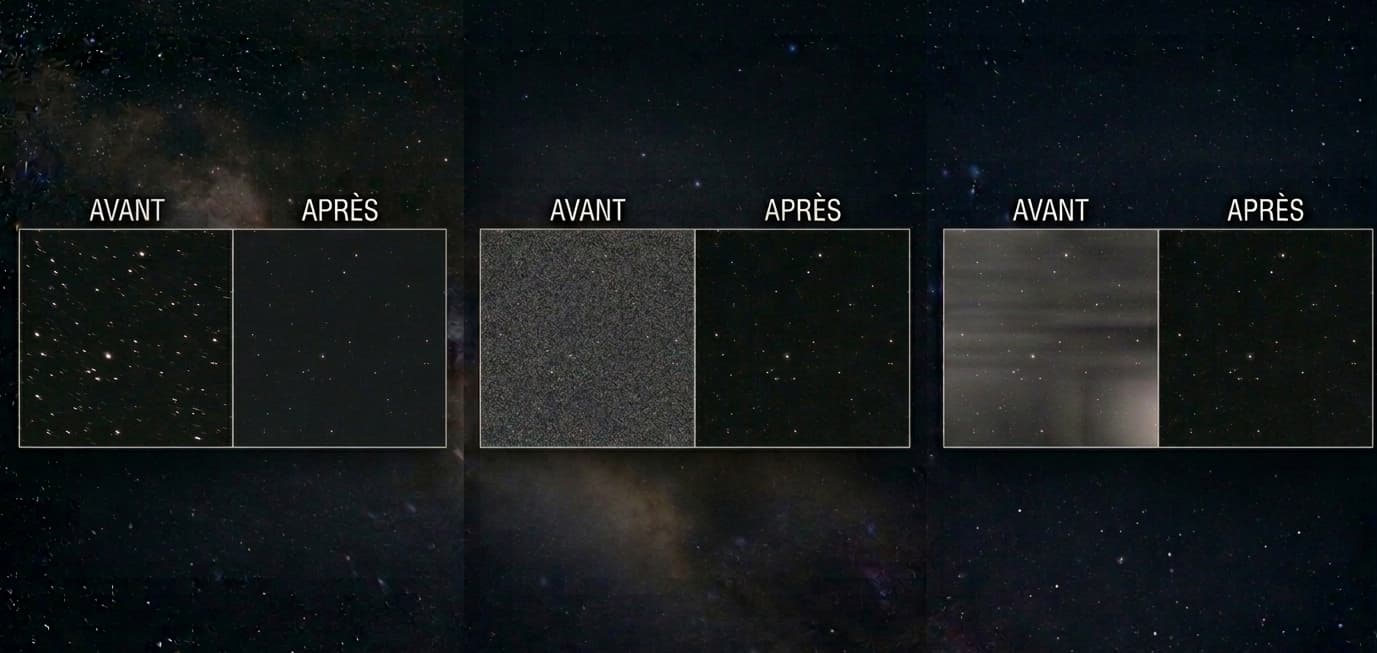
The rest follows from the lack of signal. The DSS comparison is telling: dust lanes and well defined arms exist at the same location in the reference but stay drowned in your frame, while the bulge and a few bright stars flatten out to pure white. More integration time and a gentler highlight stretch will fix both points, once tracking is cleaned up.
Priority actions
- Fix tracking first: careful polar alignment plus autoguiding, or drop exposures to 60-90s
- Check flatness and clamping of the body/lens adapter to remove the left/right field asymmetry
- Accumulate far more total integration on M31 to lift the arms and dust lanes above the noise
- Filter subs by elongation (PixInsight SubframeSelector or Siril frame sorting) before stacking
- Soften the highlight stretch, or add short exposures to rebuild the bulge in HDR