Astrophotography diagnosis of M8 (Lagoon Nebula): Tracking drift
MasterH100s30 juil. 2025
The Doc examined this image of M8 (Lagoon Nebula) (master, H, 100s). Estimated overall technical quality: 6/10. 1 defect found: Tracking drift (severity 3/5).
&w=1920&q=75)
Info
- Cible
- M8 (Lagoon Nebula)
- Date
- 30 juil. 2025, 21:23
- Lune
- Gibbeuse décroissante 65.6% (0.7° d'alt., 71.5° de la cible)
- Site
- Bortle 3 · rural peu pollué (VIIRS)
- Position
- 18h03m46s · -24°18'25"
Excellent conditions for this target. Bortle 3 guarantees a dark sky background and good SNR on the nebulosity, confirmed by the rendering (fine filaments, low-pollution background). The gibbous Moon at 65.6% is only 0.7° above the horizon and 71.5° from M8: its impact is negligible, especially since the narrowband Hα filter rejects most of the scattered light. M8 is an ideal emission nebula for this setup and these conditions, so you could safely push total integration without fear of a lunar gradient.
Setup
- Type d'image
- Master
- Télescope
- SkyWatcher 150 PDS Quattro
- Caméra
- ZWO ASI585MM Pro
- Filtre
- H
- Exposition
- 100s
- FOV
- 1.21°
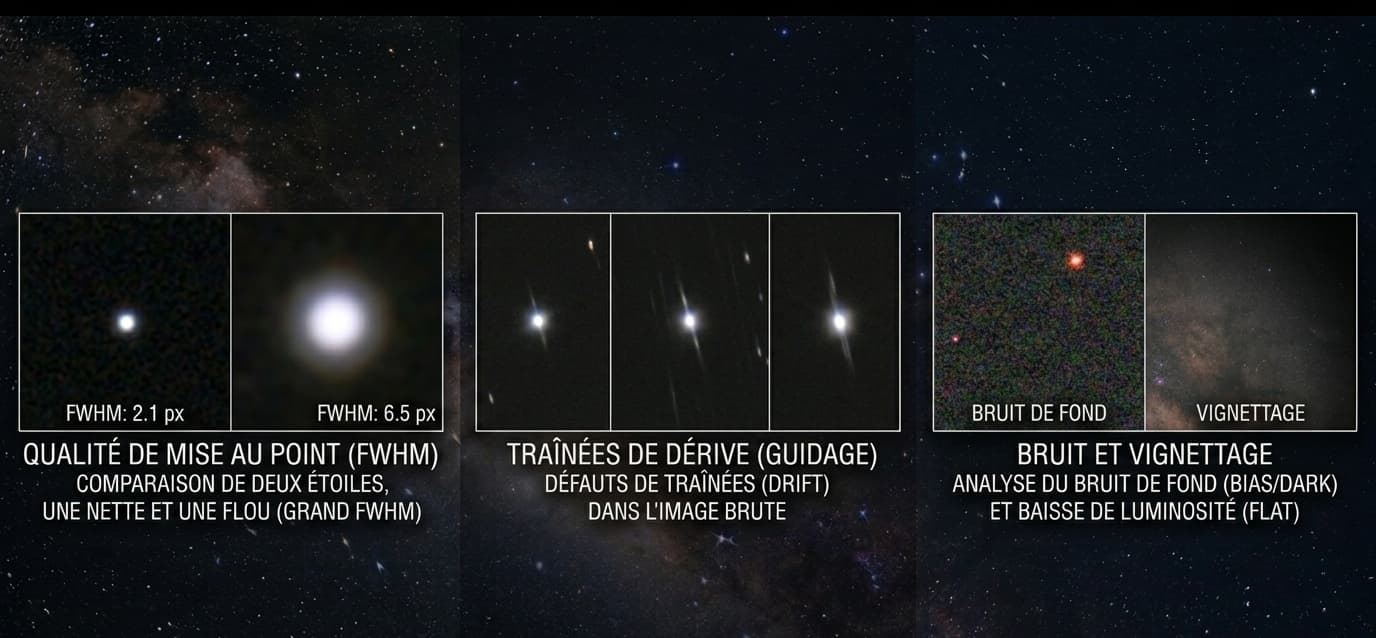
Setup consistent with the target. The 150 PDS Quattro (600mm focal length) with the ASI585MM Pro gives a 1.21° field that frames M8 comfortably, with core and extensions fitting in the frame. The Hα filter is perfectly suited to this emission nebula and explains the high contrast on a dark background. Measured FWHM around 5 to 6.7 px stays acceptable for an f/4 Newton on 100s; at 100s in Hα the low background exposure (e_margin 0.91) is normal and not penalizing. The only lever remaining is tracking, to be made reliable to fully exploit this tube's resolution.
The diagnosis in detail
The image is a quality Hα master of M8: the PSF panel shows stars generally well fitted by the Moffat ellipse, with no field aberration signature. The corner/center FWHM ratio of 0.99 and low horizontal/vertical asymmetry (0.058 / 0.038) rule out tilt, backfocus or coma: this Newton's optics are correctly set for this frame. The nebulosity, compared to DSS, is real (same filaments, same dark globules), so no instrumental gradient or vignetting to report despite the peripheral luminosity falloff, which is the object itself.
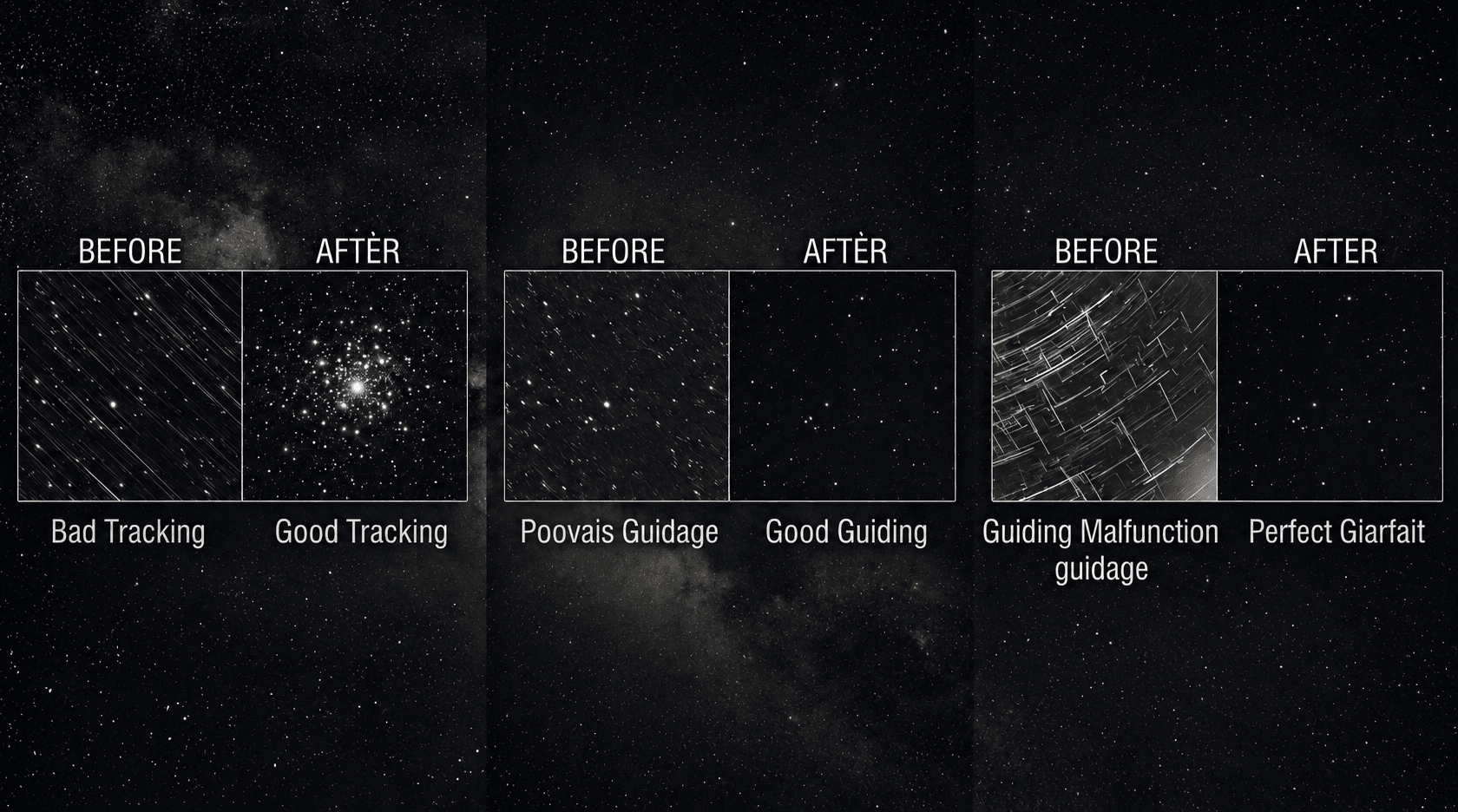
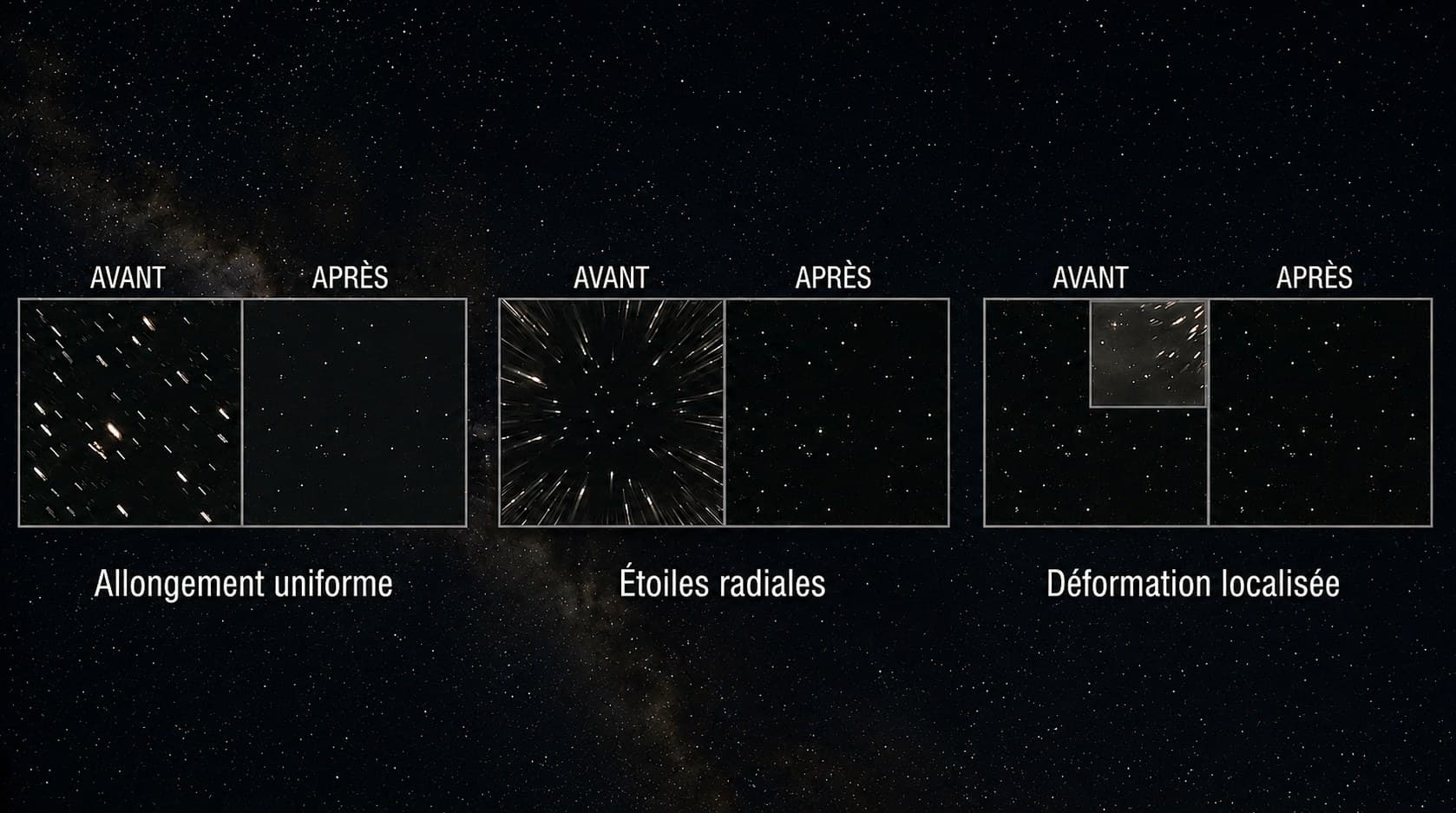
The only objective defect is a tracking drift: the elongation is global (elong 1.24 down to the center, above the field floor 1.06) with a consistent orientation (PA dispersion 21°, dominant axis near -80°/-66° on the left and top zones). This is typical of uncorrected tracking drift or marginal guiding on these 100s frames. The rounder right-side zones (R, BR) suggest a not perfectly uniform drift, possibly slight flexure.
The clipped nebula core at the center is the expected behavior of a raw unstretched, unprocessed integration, not a defect to fix here. Priority: make the mount/guiding reliable to tighten the stars.
Priority actions
- Improve tracking: fine polar alignment then calibrated autoguiding (RMS < 1 px)
- If guiding stays marginal at 100s, shorten sub exposures
- Check balance and optical train tightening to limit differential flexure