Astrophotography diagnosis of NGC 6960_2-2: Tracking drift, backfocus error and 1 other
Raw300s04 juil. 2026
The Doc examined this image of NGC 6960_2-2 (raw, 300s). Estimated overall technical quality: 6/10. 3 defects found: Tracking drift (severity 3/5), Backfocus error (severity 2/5), Satellite trail (severity 1/5).
&w=1920&q=75)
Info
- Cible
- NGC 6960_2-2
- Date
- 04 juil. 2026, 01:22
- Lune
- Croissant croissant 14.8% (24.3° d'alt., 48.3° de la cible)
- Site
- Bortle 2 · rural typique (VIIRS)
- Position
- 20h46m24s · +31°30'01"
Very favorable sky conditions: Bortle 2 gives a near-black background, ideal for capturing the Veil's faint filaments, as confirmed by the nebular signal visible even on a single sub. The Moon is not an issue here: a ~14.8% crescent, 24° high and 48° from the target, its background contribution is marginal, especially since a narrow Hα filter rejects most of that diffuse light. The low background-to-black-point margin (e_margin 1.89) is normal in narrowband at 300s and does not indicate underexposure. Nothing to fix on the conditions side: this is a night to exploit fully.
Setup
- Type d'image
- Brut
- Télescope
- EQMod Mount
- Caméra
- ZWO ASI585MM Pro
- Exposition
- 300s
- Phase de lune
- Gibbeuse décroissante (82 %)
- FOV
- 1.70°
Setup consistent with the target. At 375mm focal length, the 1.70° field frames a portion of the Veil well (here the Witch's Broom around 52 Cygni), with a mosaic still needed for the whole complex. The 1.60"/px sampling is comfortable and well matched to typical seeing, neither over- nor under-sampled. Gain 220 on the ASI585MM Pro is high but reasonable in narrowband to lift the signal above read noise, with no dark clipping (offset 15 is sufficient) or excessive saturation (0.01%). Sensor at -21°C is very healthy. The weak point is not the gear but the tracking: at 300s, well-tuned autoguiding is essential to make the most of this optic.
The diagnosis in detail
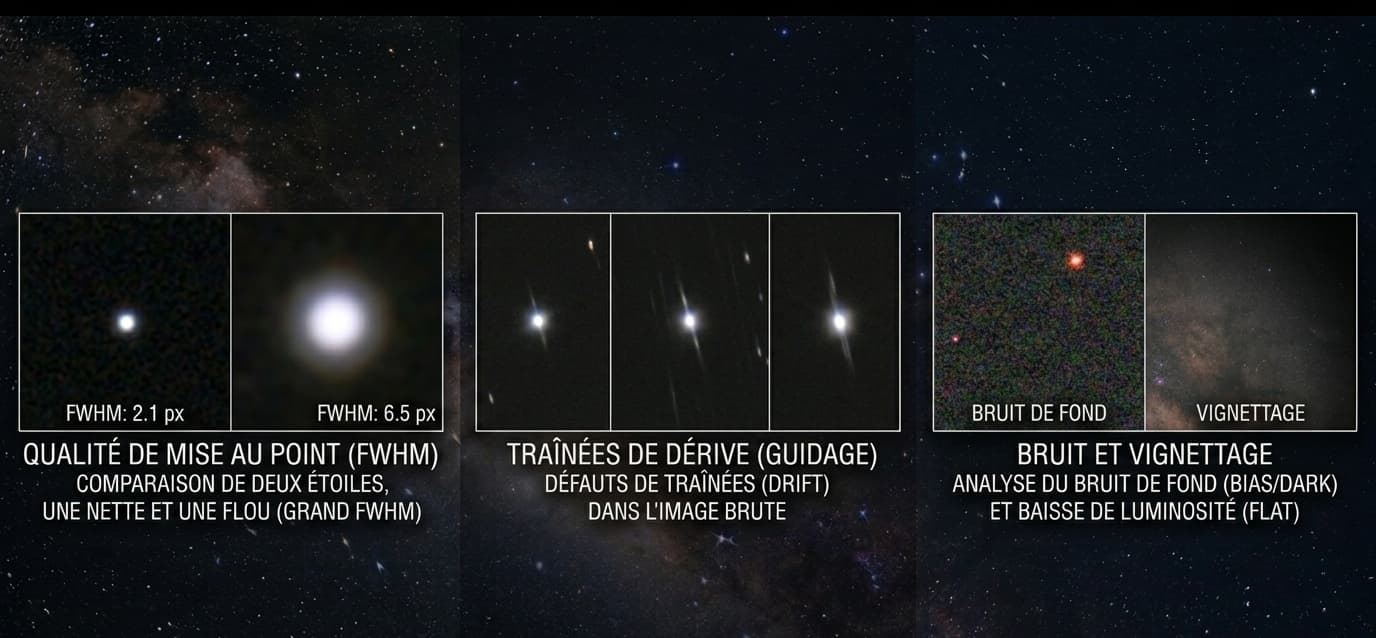
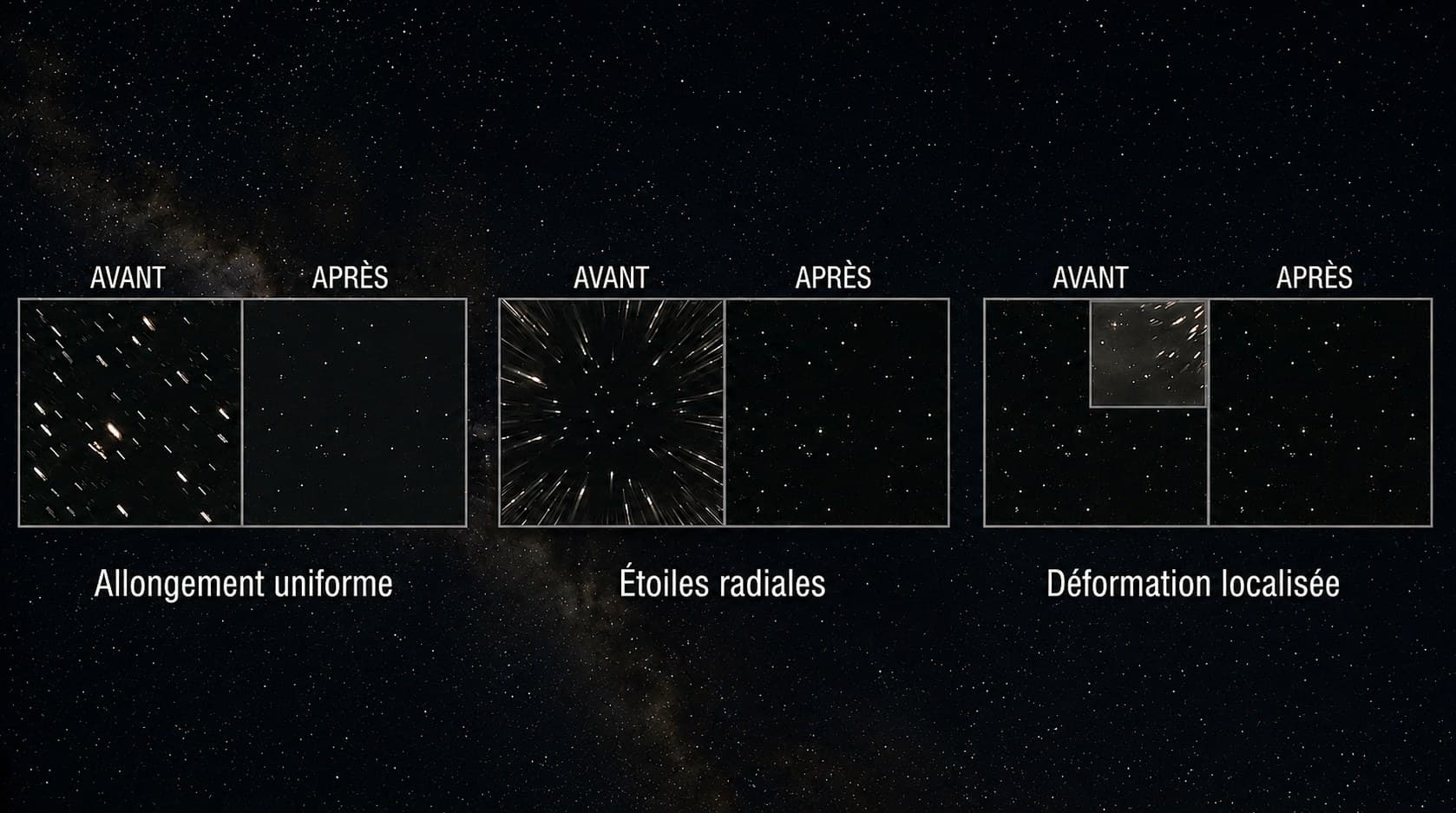
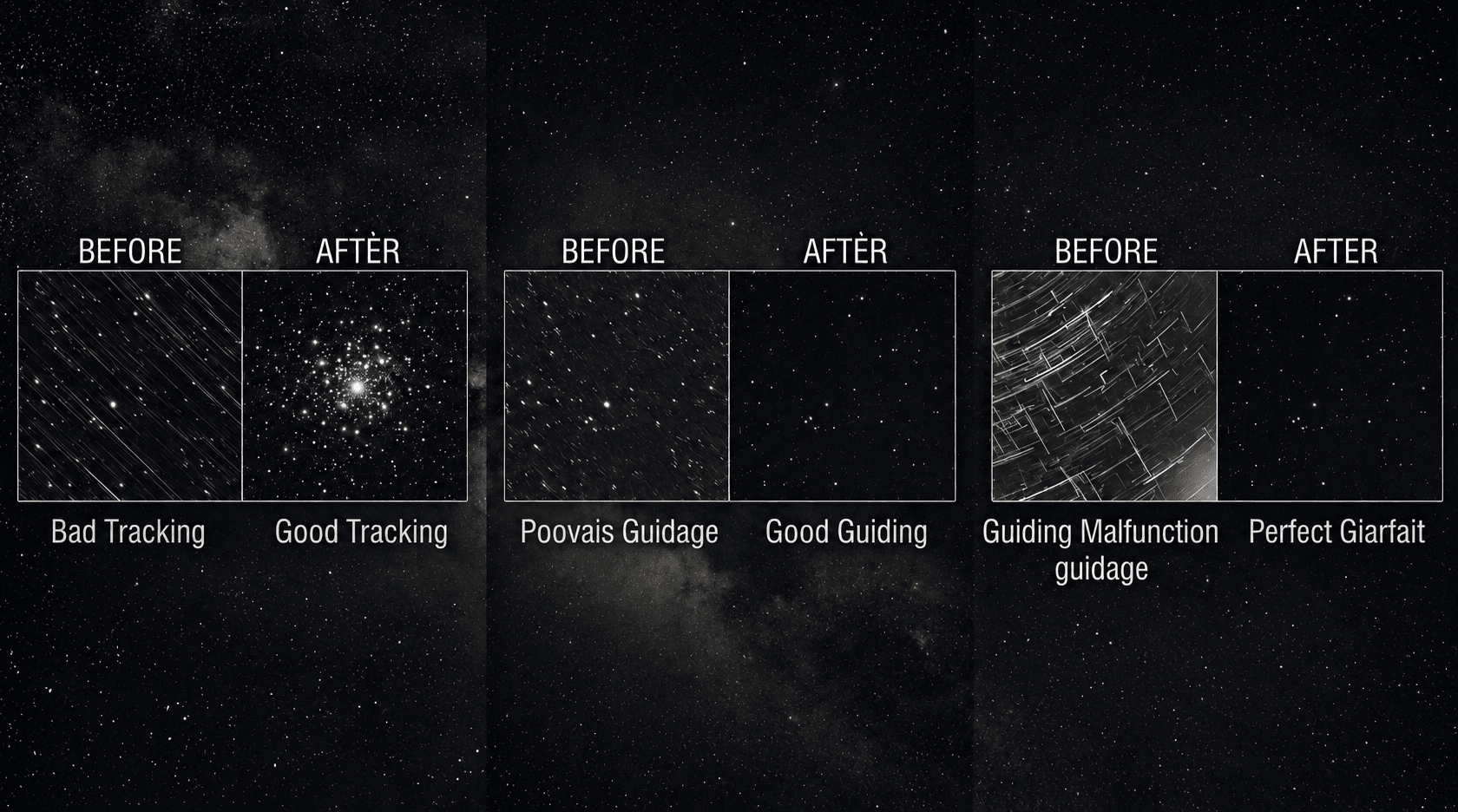
The verdict is clear: optics and sky are good, it is the tracking mechanics that limit this sub. The PSF plate is unambiguous: elongation is not confined to the corners, it reaches the field center (center elong 1.46 vs a measured floor of 1.14) with a consistent orientation across zones (PA spread 20.6°). That is the signature of tracking drift during the 300s, not a field-optics defect, which would leave the center pointlike.
On top of this drift sits a second, subtler component: FWHM grows fairly symmetrically toward the four corners (corner/center ratio 1.47, TL 5.0px), betraying a backfocus/field-curvature to optimize. The two effects combine and explain the strong corner elongations (TL 2.74, TR 2.07). The satellite trail in the right half is cosmetic: absent from the DSS, it will be removed at stacking by sigma rejection.
Positives to preserve: the Bortle 2 background is superb, the Veil's filaments already stand out, and the background map shows only a very mild gradient (9%) with no marked vignetting. So the priority is clear, in order: guiding, then backfocus.
Priority actions
- Make autoguiding reliable (careful polar alignment + total RMS < 0.8") to remove the tracking drift visible to the center
- Adjust backfocus to the tenth of a mm to reduce the radial corner elongation
- If guiding stays marginal, shorten the exposure to 120-180s and increase the number of subs
- Enable dithering so sigma rejection cleanly removes the satellite trail at stacking