Astrophotography diagnosis of NGC 6960_2-1: Tracking drift and backfocus error
Raw300s04 juil. 2026
The Doc examined this image of NGC 6960_2-1 (raw, 300s). Estimated overall technical quality: 6/10. 2 defects found: Tracking drift (severity 3/5), Backfocus error (severity 2/5).
&w=1920&q=75)
Info
- Cible
- NGC 6960_2-1
- Date
- 04 juil. 2026, 00:36
- Lune
- Croissant croissant 14.6% (20.2° d'alt., 46.9° de la cible)
- Site
- Bortle 2 · rural typique (VIIRS)
- Position
- 20h46m54s · +29°57'08"
Genuinely favorable conditions: Bortle 2 gives a very dark background and excellent SNR for an emission target like the Veil, and the Moon (14.6% crescent, barely 20° up, 47° from the target) adds no notable pollution here. The measured background is nearly flat (only 5% gradient). Nothing to fear on the sky side: you can run long series without worrying about lunar or urban gradients. The only limiting factor is mechanical (tracking), not atmospheric.
Setup
- Type d'image
- Brut
- Télescope
- EQMod Mount
- Caméra
- ZWO ASI585MM Pro
- Exposition
- 300s
- Phase de lune
- Gibbeuse décroissante (82 %)
- FOV
- 1.70°
The ASI585MM Pro + 375mm focal length gives 1.595"/px and a 1.70° field, a comfortable sampling under typical seeing and a well-suited framing for this Veil panel (the remnant fills the right half with decent margin). The 300s exposure at -20°C and gain 220 is coherent for mono on an emission nebula. Note, though: at 375mm without guiding, 300s is ambitious for the mount, which the measured drift confirms. The e_margin of 2.16 stays low, but that is normal for a mono sub under a very dark sky, not a sign of problematic underexposure.
The diagnosis in detail
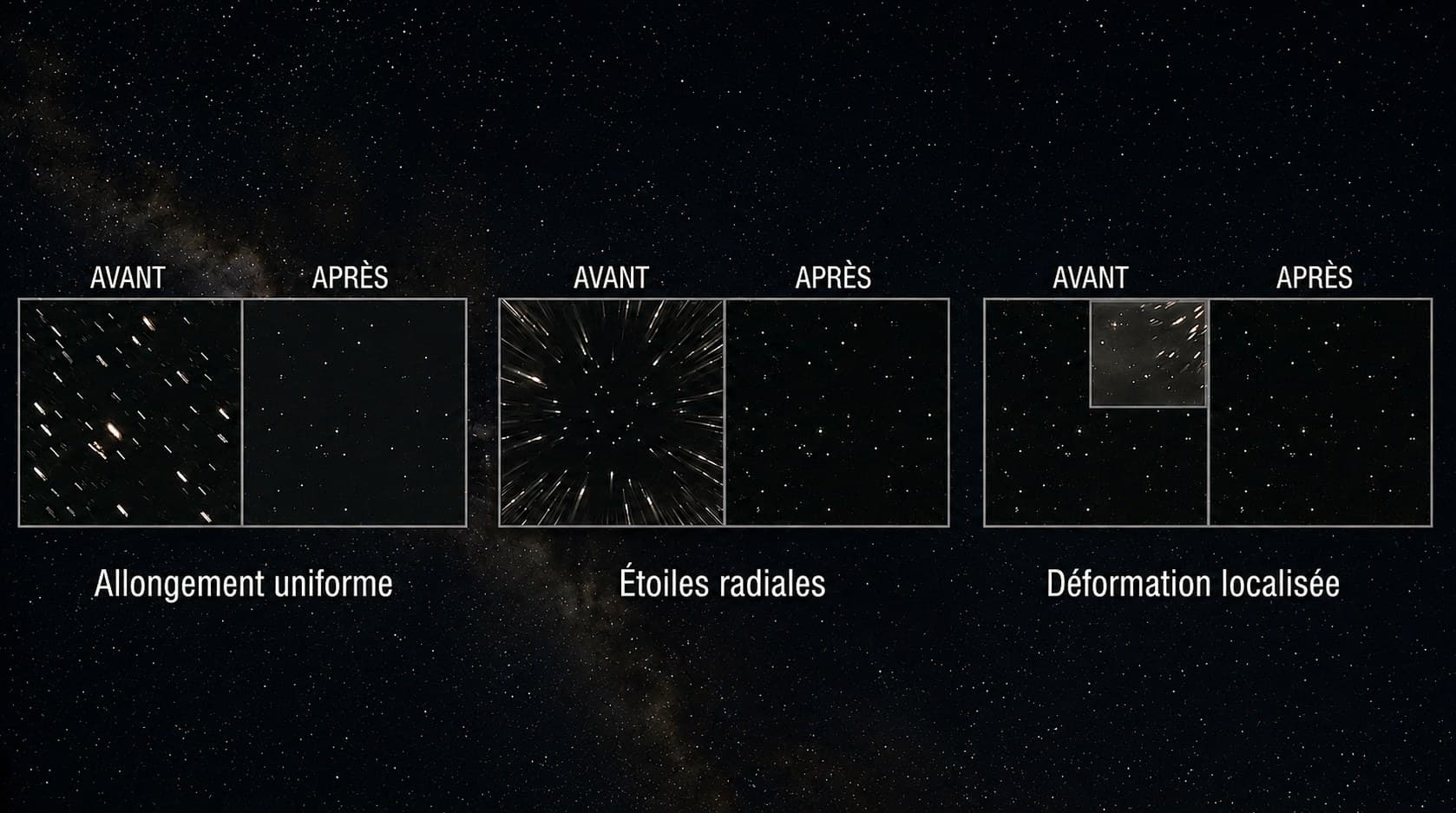
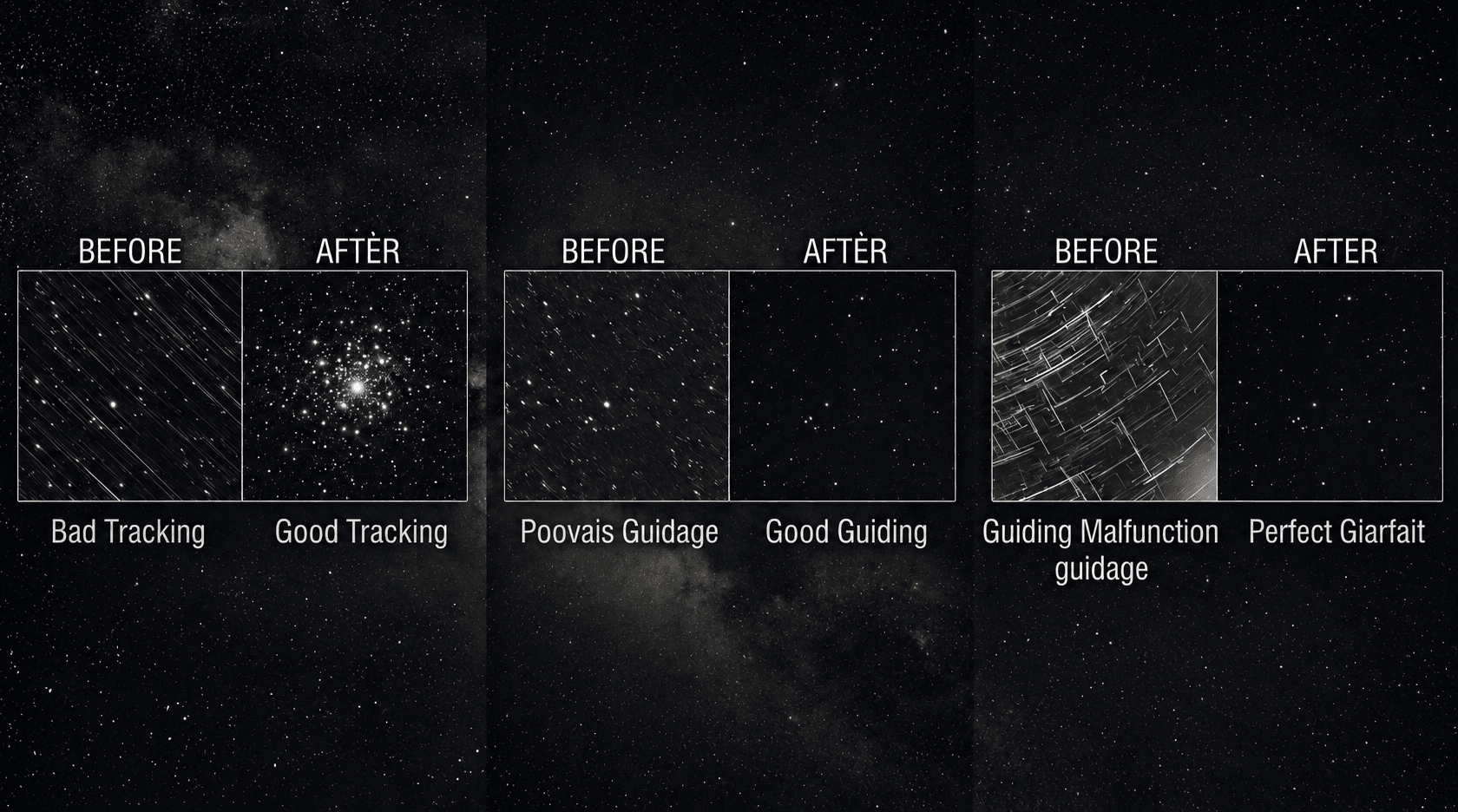
The image is a promising sub: under Bortle 2, the background is dark and homogeneous (plane gradient measured at 5%, clear radial symmetry), and the filaments of NGC 6960 are already legible, matching the DSS structure well, so no gradient artifact is to blame. The real issue is star shape. The PSF plate is unambiguous: the center itself is elongated (elong 1.71 vs a field floor of 1.26) with a nearly constant orientation (PA ~82°, dispersion of only 13.7°). That is the signature of tracking drift over the 300s, not a field-optics defect.
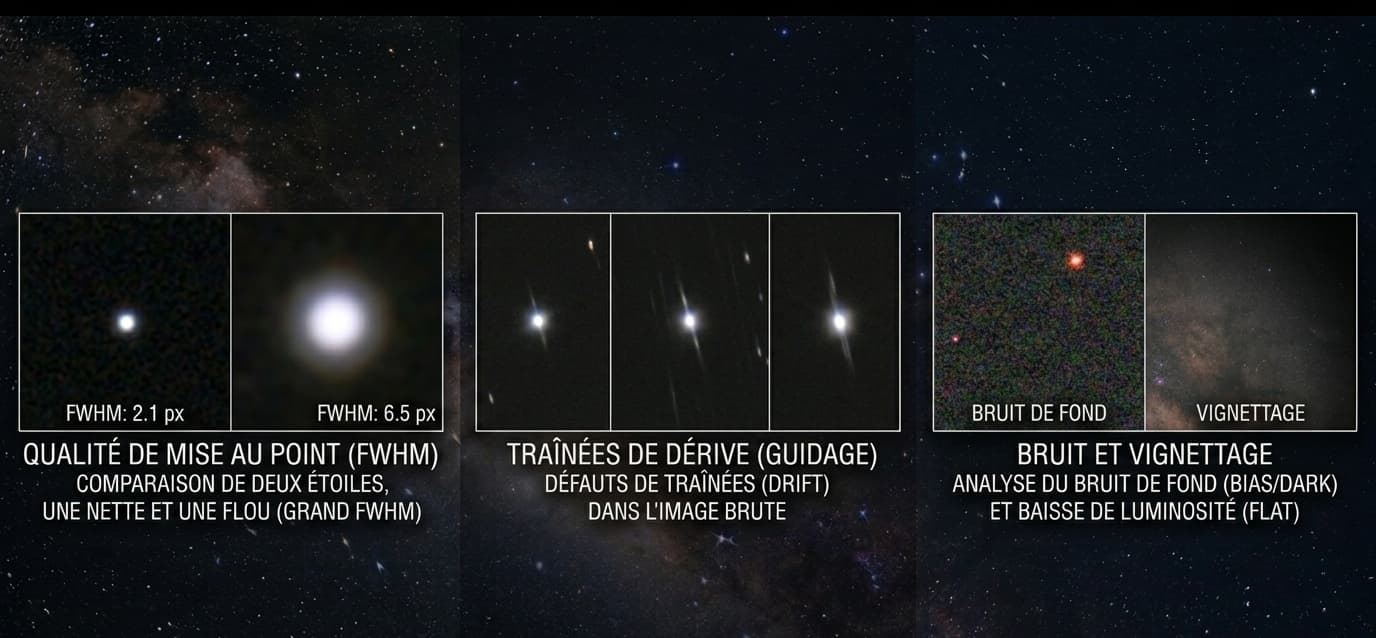
A second, purely optical component overlaps it: FWHM goes from 2.86 px at center to 5.78 px at the top-left corner, with a symmetric rise across the four corners (ratio 1.525). This radial edge broadening, independent of the central drift, points to backfocus/field curvature to correct. The two effects stack in the corners, explaining the extreme elong values (3.01 at TL).
In order: securing tracking (polar alignment + autoguiding) is the priority since it degrades the whole field; backfocus adjustment comes second, once the central stars are round again, to tighten the edges.
Priority actions
- Set up autoguiding (PHD2) and refine polar alignment to remove the drift on 300s exposures
- If guiding isn't immediately available, shorten the sub exposure to keep stars point-like
- Then adjust backfocus in small steps and revalidate on a star plate to tighten the corners