Astrophotography diagnosis of M92: Sensor tilt, tracking drift and 1 other
RawIr-Cut20s03 sept. 2026
The Doc examined this image of M92 (raw, Ir-Cut, 20s). Estimated overall technical quality: 6/10. 3 defects found: Sensor tilt (severity 3/5), Tracking drift (severity 2/5), Clipped stars (severity 1/5).
&w=1920&q=75)
Info
- Cible
- M92
- Date
- 03 sept. 2026, 18:57
- Lune
- Croissant croissant 44% (sous l'horizon)
- Site
- Bortle 6 · banlieue dense (VIIRS)
- Position
- 22h37m04s · +34°24'57"
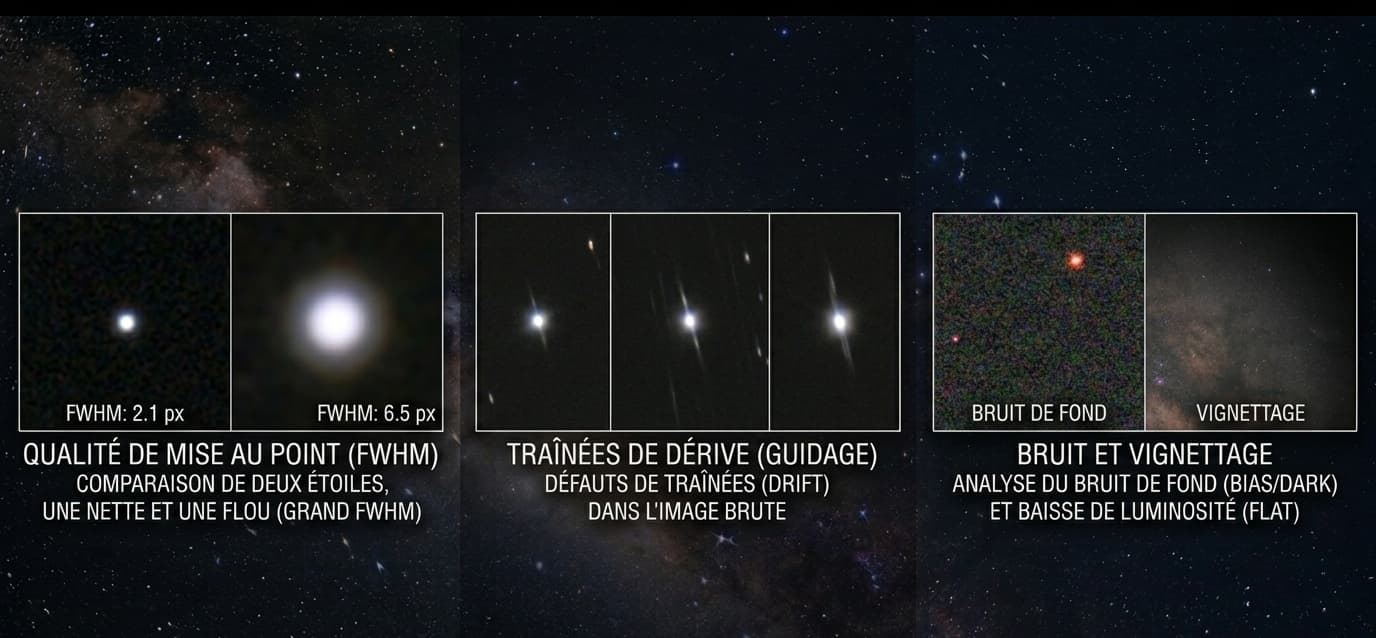
Favourable conditions for this target. The Moon is below the horizon and 69.8 degrees from M92, so there is no lunar contribution to the background, which the background map confirms (plane gradient of only 3%, R squared 0.28, with no marked orientation). Bortle 6 remains a nuisance for faint wide field work, but a globular cluster is a high surface brightness target: the signal to noise on stars is little affected by urban light pollution. The reported 2.5 arcsec seeing is consistent with the central FWHM of 3.75 px, about 1.65 arcsec, which is actually rather good. Nothing to change on the conditions side, you can keep shooting without waiting for a better window.
Setup
- Type d'image
- Brut
- Télescope
- C11
- Caméra
- ZWO ASI533MC Pro
- Filtre
- Ir-Cut
- Monture
- EQ6r pro
- Exposition
- 20s
- Phase de lune
- Dernier quartier (56 %)
- Seeing
- 2.5
- Notes
- F=6.3
- FOV
- 22.0'
A coherent but very demanding setup. At 1764 mm and 0.44 arcsec/px you are clearly oversampled for 2.5 arcsec seeing: software binning 2 would gain signal to noise without losing any real detail. The 0.37 degree field frames M92 with room to spare, so this focal length is the right choice for this cluster. On settings, gain 100 (unity on the ASI533) is healthy, but offset 20 still leaves 0.7% dark clipping, so you can raise it to 30-50 for safety. The background to black point margin of 2.9 shows that 20 s is not enough to be sky noise limited: move to 60 s if tracking allows. Finally, the sensor at 21.1 degrees C is not cooled, so enable cooling at -10 degrees C to cut dark current.
The diagnosis in detail
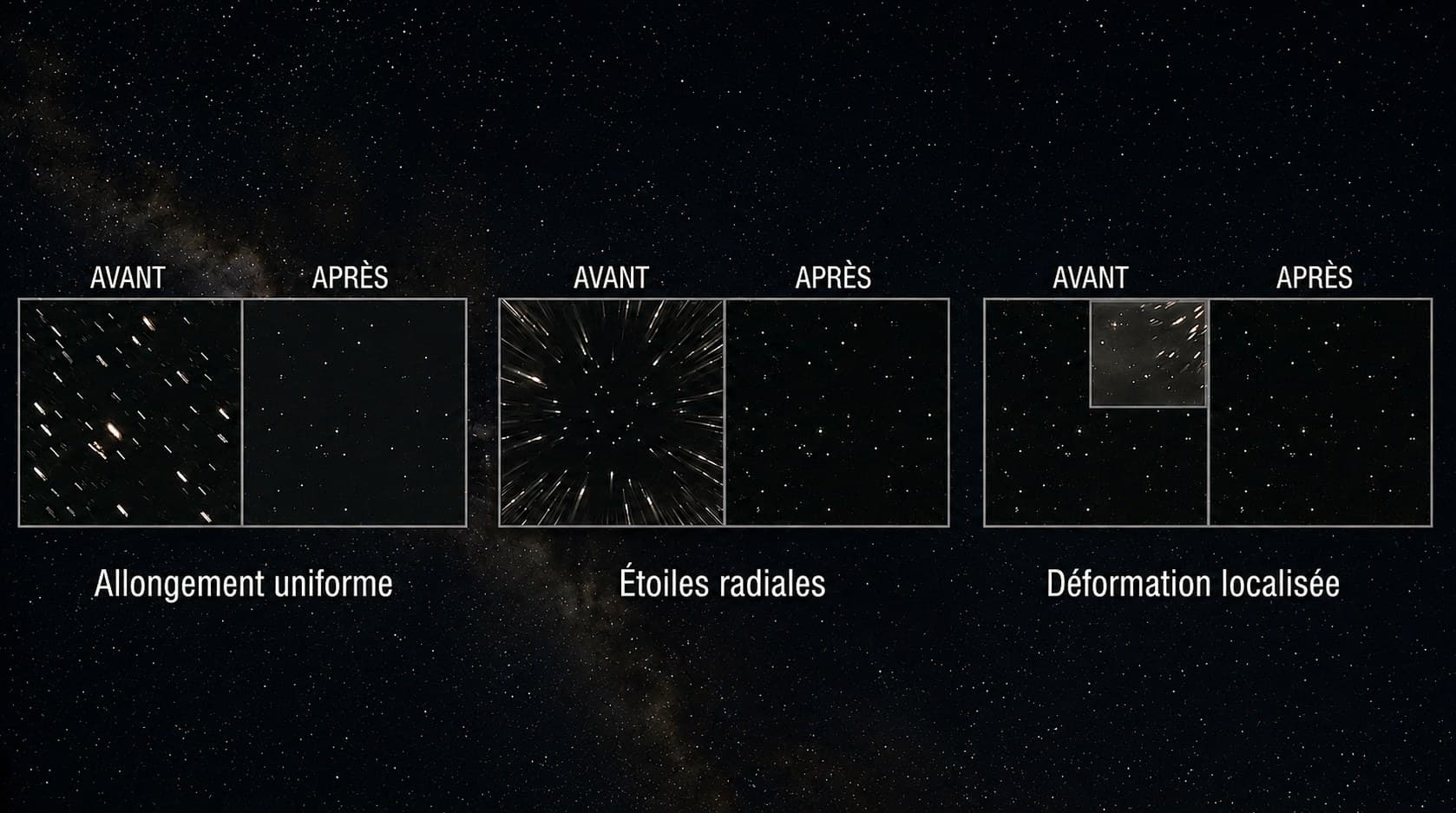
The two measured defects do not share a cause and must be handled separately. The first is mechanical and fixed: the FWHM asymmetry is almost entirely vertical (0.226 against 0.007 horizontally), with the top of the field twice as bloated as the bottom while the centre stays at 3.75 px. That is the classic signature of a tilted focal plane, not field curvature, which would degrade all four corners equally. On a C11 at f/6.3, with a heavy optical train and a rack and pinion focuser, a few tenths of a millimetre are enough at this sampling.
The second is temporal: the centre itself is elliptical at 1.19 when the instrumental floor of the field is 1.05, and the position angles stay grouped. A deformation present at the centre can only come from motion during the exposure. Over 20 s at 1764 mm, this reflects polar alignment or guiding still a little short, not a serious problem.
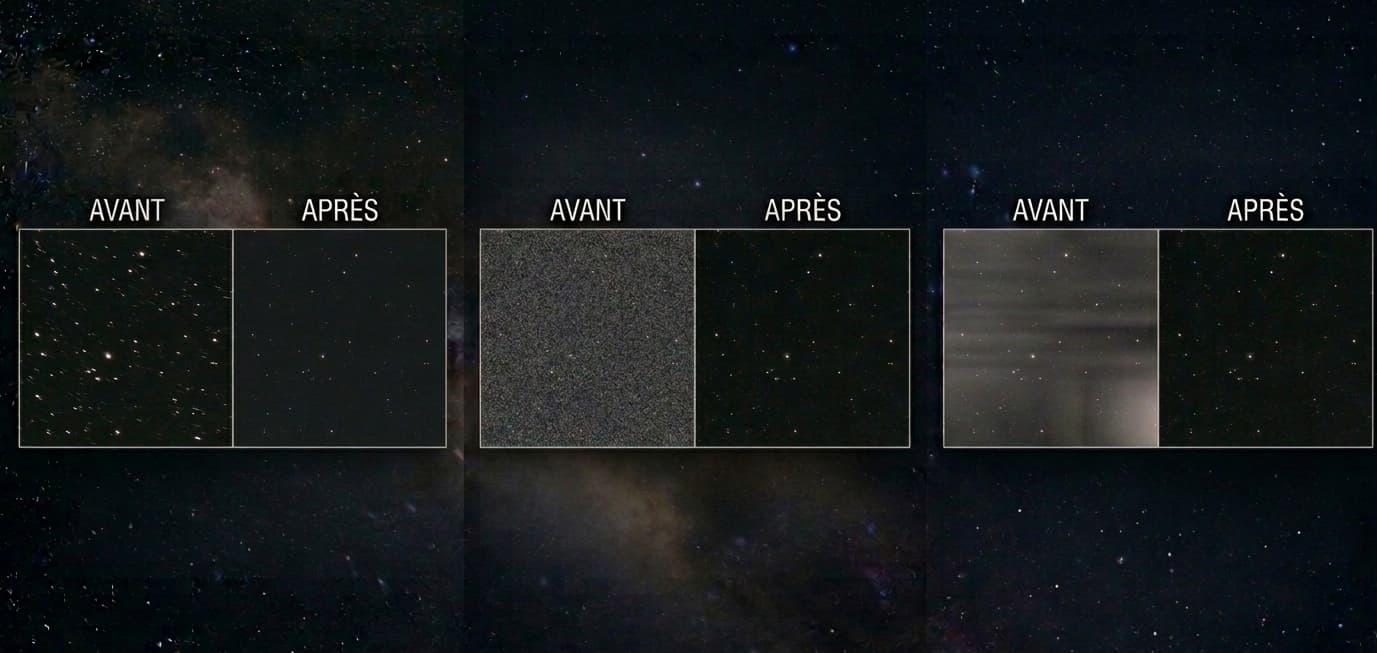
The rest is healthy: homogeneous background (0.01 anisotropy), no significant gradient, no amp glow residual, centred framing. The green cast and the lack of calibration are simply the expected state of a raw OSC sub.
Priority actions
- Track down and correct the optical train tilt: tighten the threaded connections, remove compression ring adapters, then re-check on a series of short subs
- Improve polar alignment and guiding to bring the central elongation back to the instrumental floor
- Lengthen the sub exposure to 60 s to get out of the read noise limited regime (background to black point margin of only 2.9)
- Enable cooling on the ASI533 at -10 degrees C instead of the current 21.1 degrees C
- Raise the offset to 30-50 to remove the 0.7% dark clipping