Astrophotography diagnosis of N?buleuse filamentaire: Sensor tilt, residual vignetting and 1 other
Mastermixed19×90s14 juin 2026
The Doc examined this image of N?buleuse filamentaire (master, mixed, 19×90s). Estimated overall technical quality: 6/10. 3 defects found: Sensor tilt (severity 3/5), Residual vignetting (severity 3/5), Background chroma noise (severity 2/5).
&w=1920&q=75)
Info
- Cible
- N?buleuse filamentaire
- Date
- 14 juin 2026, 01:02
- Lune
- Pleine lune 98.1% (sous l'horizon)
- Site
- Bortle 1 · ciel pristine (VIIRS)
- Position
- 20h45m39s · +30°42'25"
Near-ideal conditions: Bortle 1 and the Moon (98%) below the horizon at 95 degrees from the target, so no lunar pollution to fear and a naturally dark background. On a supernova remnant like the Veil, this dark sky is a real asset for catching faint filaments. The only limit is on your side: 19x90s (about 28 min) is too short for such an extended, low-surface-brightness nebula. Under a sky this pristine you can push much longer subs and stack several hours without gradient worries, which would cut the background chroma noise.
Setup
- Type d'image
- Master
- Télescope
- Bresser 200/1140
- Caméra
- SVBONY SV405CC
- Filtre
- mixed
- Exposition
- 19×90s
- Phase de lune
- Dernier croissant (1 %)
- Seeing
- 3
- FOV
- 57.8'
The 200/1140 Newtonian (f/5.7) yields 0.96 degrees of field, a coherent framing that fits the Witch's Broom and 52 Cygni without cropping the essentials. With the SV405CC (3.76um) you sample around 0.68"/px: oversampled for a seeing of 3", and the central FWHM of 4.9 px (about 3.3") confirms that seeing, not optics, limits the center. The real issue is the optical train: a corner/center ratio of 1.56 reflects tilt to be corrected with a ring. Gain 122/offset 15 at -10C are healthy; e_margin 1.76 shows a background barely lifted off the black point, normal for short subs and to be offset with more total time.
The diagnosis in detail
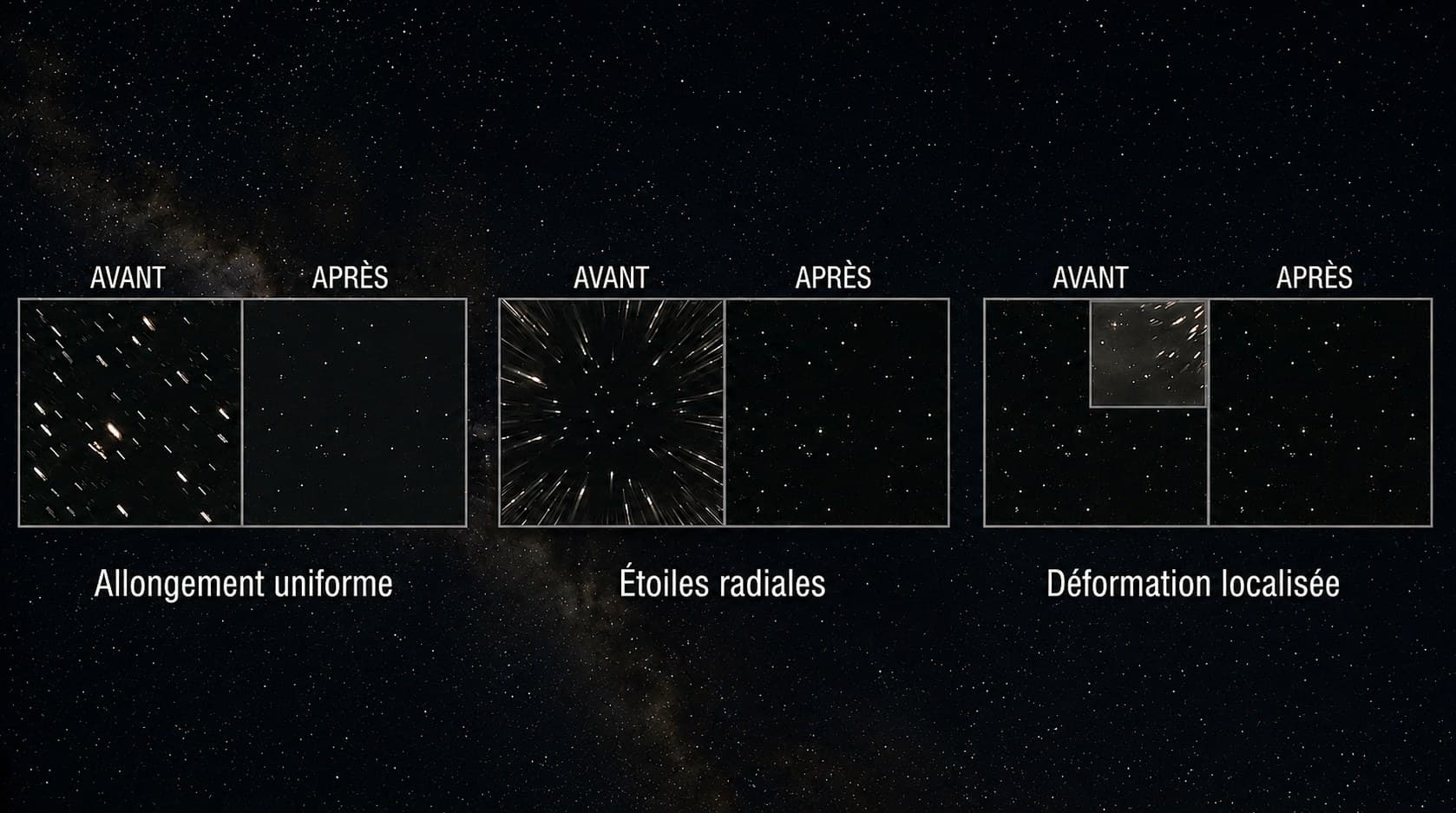
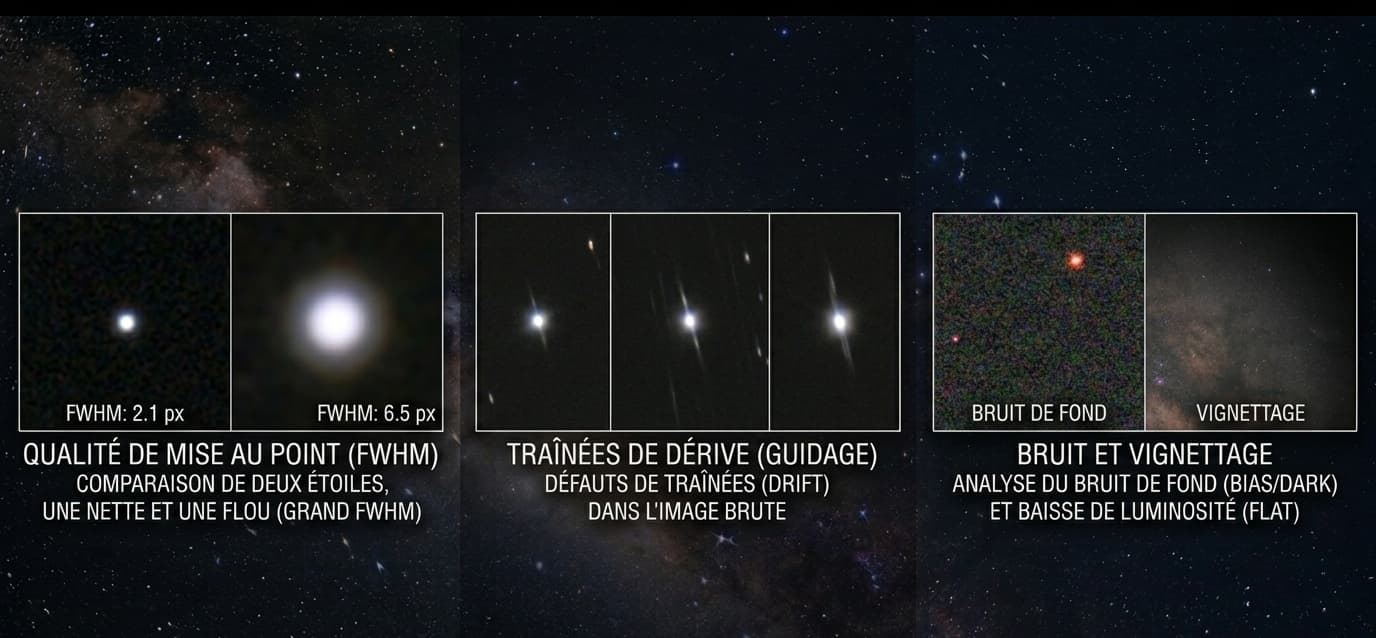
The image is fundamentally healthy on the acquisition side: Moffat metrics give elongation of 1.05 to 1.09 across the nine zones with scattered PA (45.9 degrees), ruling out any tracking drift, periodic error or guiding oscillation. Stars are round, the mount held well over 90s. The problem is purely optomechanical: the center peaks at 4.9 px FWHM while the right side reaches 8.9 px and the top-left corner 7.6 px, the bottom-right staying sharpest at 6.1 px. This asymmetry, mostly vertical, points to a tilted sensor rather than a simple symmetric backfocus error, hence the sensor-tilt diagnosis.
On the background, two calibration points: 48% radial vignetting (clear rotational symmetry, R2=0.87) not yet flattened, and background chroma noise as a direct consequence of the short integration. Comparison with the DSS confirms the colored nebulosity is real (NGC 6960 filaments), so no gradient or IFN to blame wrongly.
As a priority, fixing tilt and shooting good flats will markedly improve the result; the noise will resolve with more subs under this exemplary Bortle 1 sky. The violet halo and spikes around 52 Cygni are the nominal behavior of a Newtonian on a very bright star, not a defect.
Priority actions
- Correct sensor tilt with a tilt ring until the four corners' FWHM is equalized
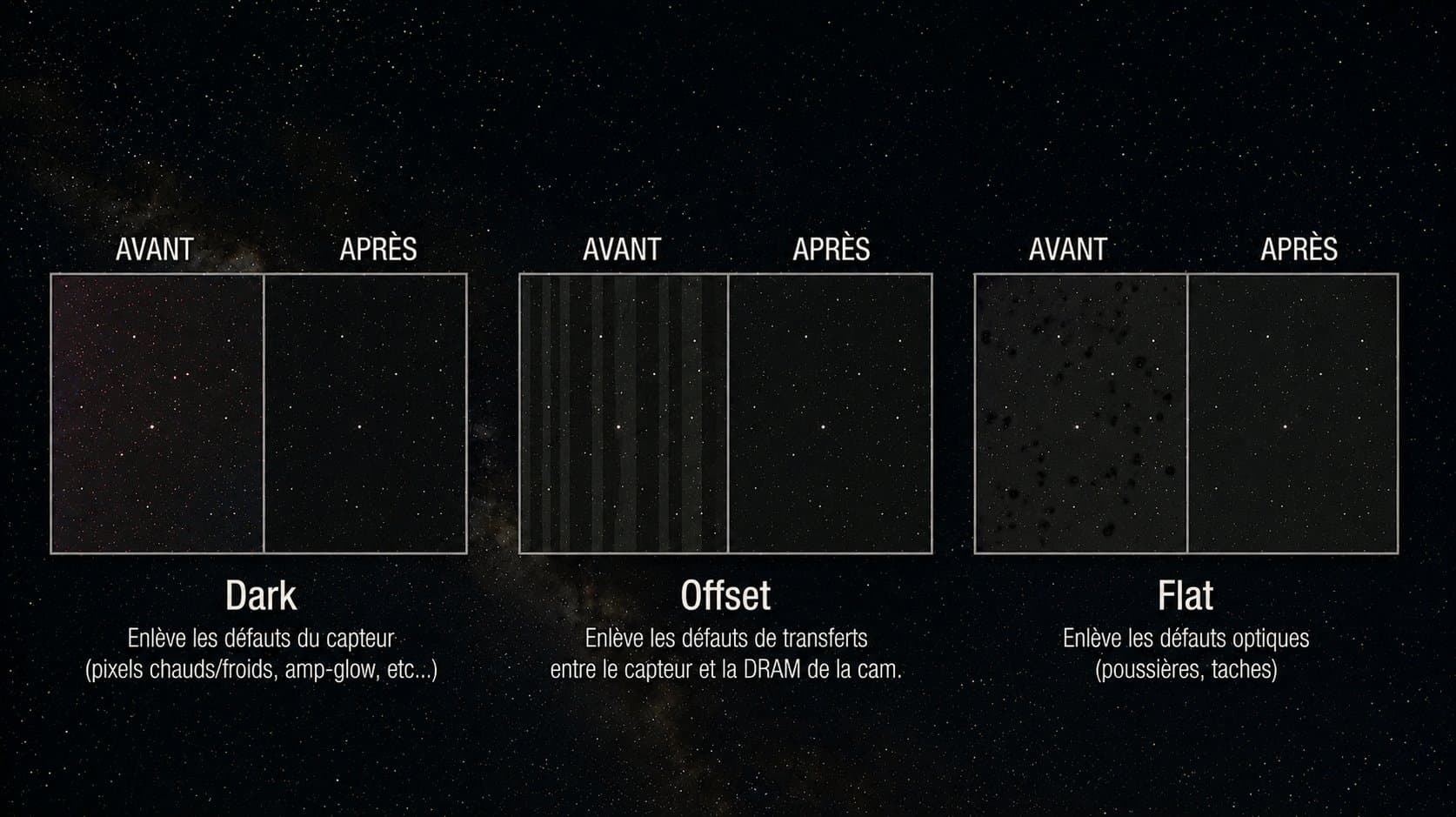
- Shoot and apply matched flats to remove the 48% vignetting
- Accumulate much more integration time (several hours) to bury the background chroma noise
- Enable generous dithering between subs to break correlated noise