Astrophotography diagnosis of NGC 206: Light pollution gradient
RawIr-Cut180s22 sept. 2026
The Doc examined this image of NGC 206 (raw, Ir-Cut, 180s). Estimated overall technical quality: 5/10. 1 defect found: Light pollution gradient (severity 2/5).

Info
- Cible
- NGC 206
- Date
- 22 sept. 2026, 00:42
- Lune
- Croissant décroissant 22.1% (sous l'horizon)
- Site
- Bortle 6 · banlieue dense (VIIRS)
- Position
- 0h40m33s · +40°44'04"
Conditions are rather favourable: the Moon is below the horizon and 86.9 degrees from the target, so its influence is nil despite a 22% crescent. The real limit is Bortle 6, which raises the sky background and produces the measured 16% gradient. NGC 206 is a star-forming region inside M31, hence a broadband target: a dual-band cannot rescue it, you have to compensate with integration time and clean gradient removal. Aim for meridian transit to cut air mass and gradient amplitude. At 180s and gain 100, several cumulative hours will be needed to bring out the dust lanes visible in the DSS.
Setup
- Type d'image
- Brut
- Télescope
- C11
- Caméra
- ZWO ASI533MC Pro
- Filtre
- Ir-Cut
- Monture
- EQ6r pro
- Exposition
- 180s
- Phase de lune
- Gibbeuse croissante (79 %)
- Notes
- Celestron 6.3 Lunette guide ES 60-250
- FOV
- 22.0'
Sampling at 0.44 arcsec/px is heavily oversampled: under typical seeing the C11 at f/6.3 spreads each star over far too many pixels, and software binning 2 at stacking would gain SNR without losing detail. The 0.37 degree field, on the other hand, suits NGC 206 well, which fits comfortably in the frame. On the settings side, gain 100 (unity) and offset 30 are healthy, dark clipping at 0.09% is negligible, and -5C is acceptable although -10C would be more comfortable. However e_margin=2.77 shows the background is not lifted far enough off the black point: you are not yet sky-limited, so longer subs or a slightly higher gain would improve the signal to read-noise ratio.
The diagnosis in detail
The PSF measurement is unambiguous about the field geometry. The centre is remarkable at 1.34/1.22 px with an elongation of 1.09, below the OSC floor, so both focus and tracking are good over 180s. The left and top zones follow (1.2 to 1.6 px), but the right edge and bottom-right corner jump to 6.4 px with an elongation of 1.7 and a consistent vertical orientation (PA 62-67 degrees). A sharp centre combined with only one side of the field degraded is the very definition of a tilted focal plane, not field curvature, which would hit all four corners symmetrically.
On a C11 with an f/6.3 reducer two causes usually combine: the adapter train introducing a tilt, and primary mirror play shifting the optical axis with mount orientation. This is the priority item, because no software treatment recovers a PSF five times wider over a third of the field.
The rest is healthy. The measured 16% gradient is that of a Bortle 6 sky, absent from the DSS reference so genuinely instrumental and atmospheric, but it removes easily. The background sitting close to the black point mainly signals that many subs will be needed on this faint target.
Priority actions
- Fix the optical train tilt on the right side of the sensor (tightening, tilt adapter) then revalidate with a test sub in the Aberration Inspector
- Lock the C11 primary mirror and reduce the cantilever of the adapter stack
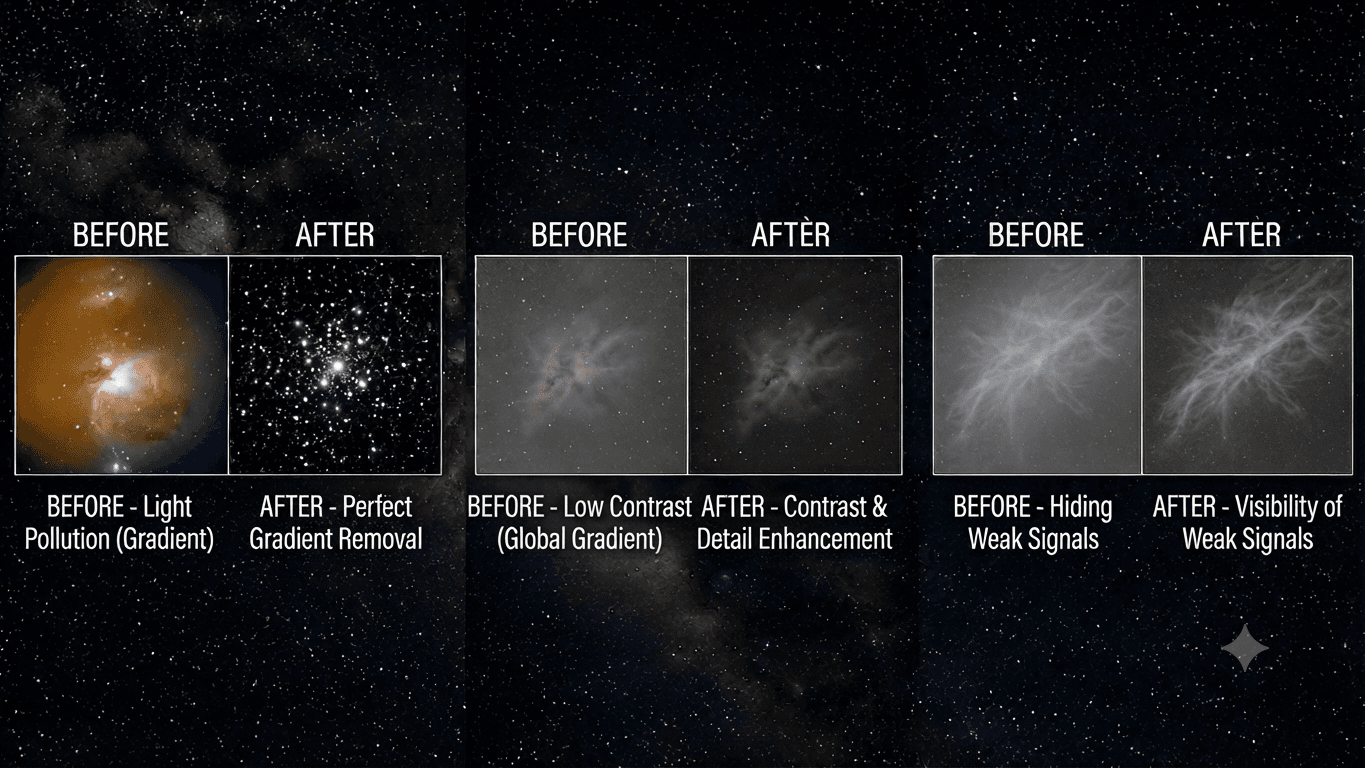
- Remove the background gradient at stacking with GraXpert or DBE
- Accumulate more subs or lengthen the exposure to become sky-limited (current e_margin 2.77)
- Consider binning 2 at stacking, since 0.44 arcsec/px is largely oversampled