Astrophotography diagnosis of NGC 281: Sensor tilt, clipped stars and 2 others
ProcessedL-Extreme30×240s
The Doc examined this image of NGC 281 (processed, L-Extreme, 30×240s). Estimated overall technical quality: 7/10. 4 defects found: Sensor tilt (severity 2/5), Clipped stars (severity 2/5), Background chroma noise (severity 2/5), Green cast (severity 2/5).

Info
- Cible
- NGC 281
- Position
- 0h52m54s · +56°37'03"
Very favourable conditions for this target. A 5 percent waxing crescent Moon is negligible, it contributes no usable gradient, and the image confirms it: no oriented ramp worth flagging. NGC 281 is an Ha-rich emission nebula, the ideal target for an L-eXtreme, which makes you nearly immune to residual light pollution. In that context the limiting factor is not the sky but the integration: 30 subs of 240 s makes 2 h, which is short for a clean bicolour background. Use nights like this one to double or triple total exposure rather than to switch targets.
Setup
- Type d'image
- Traitée
- Télescope
- Askar 700
- Caméra
- asi 533
- Filtre
- L-Extreme
- Monture
- AM5
- Exposition
- 30×240s
- Phase de lune
- Premier croissant 5%
- FOV
- 52.7'
A coherent, well-matched setup. At 0.88 degree of field width, NGC 281 fills about two thirds of the frame: the framing breathes, the nebula's faint extensions stay inside the image and the composition is balanced. The Askar 700 paired with the ASI533 gives a 3.3 px central FWHM, which is reasonable and points to clean focus with no penalising oversampling. The AM5 does its job, central elongation of 1.06 sits at the field floor. The L-eXtreme is the right call on this emission target. The only hardware item to revisit is imaging train rigidity, responsible for the measured tilt, and the 240 s subs that clip the bright stars: a complementary short-exposure set would settle that last point.
The diagnosis in detail
The diagnosis reads in two clearly separated layers: acquisition is sound, processing can be improved.
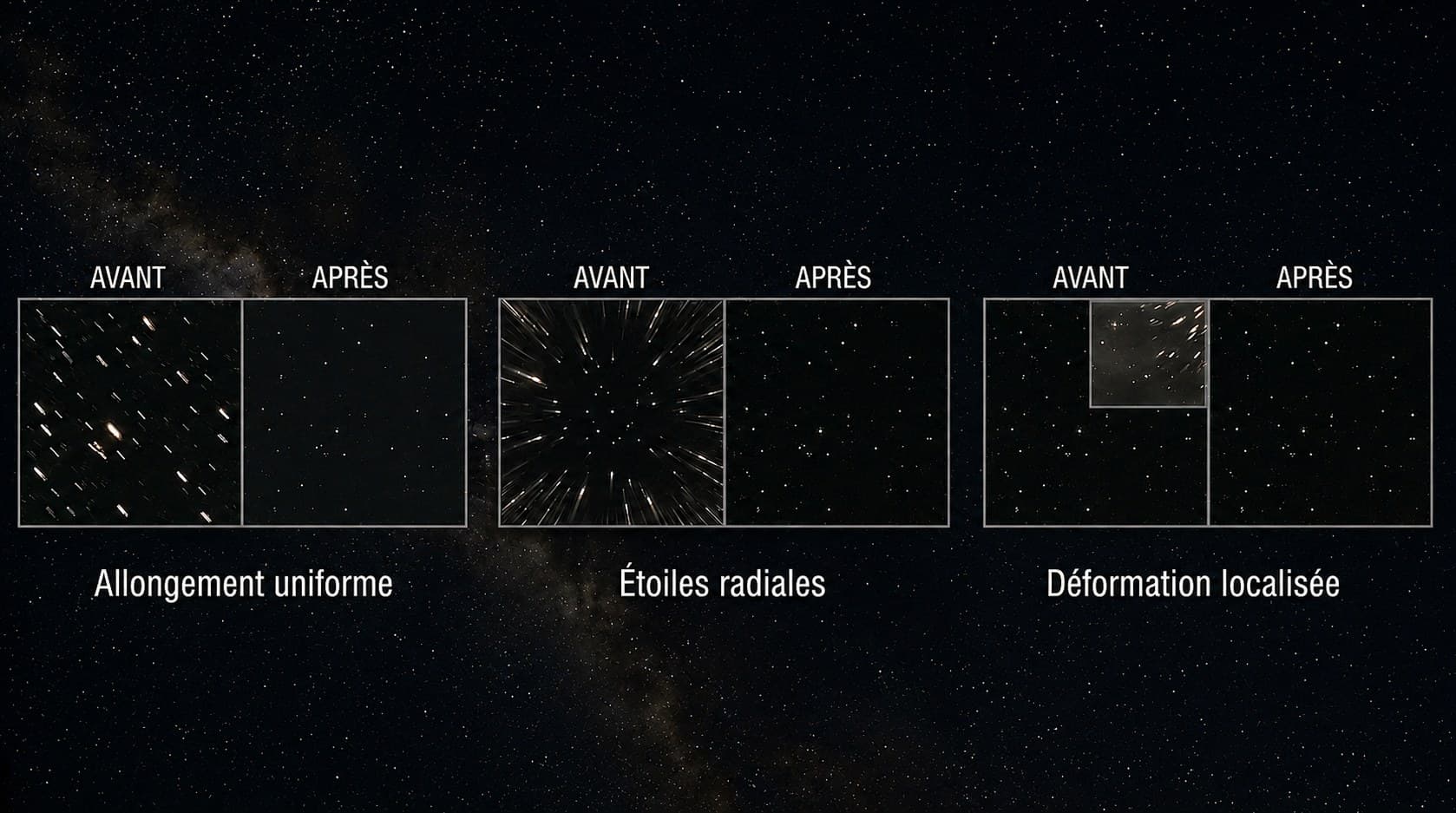
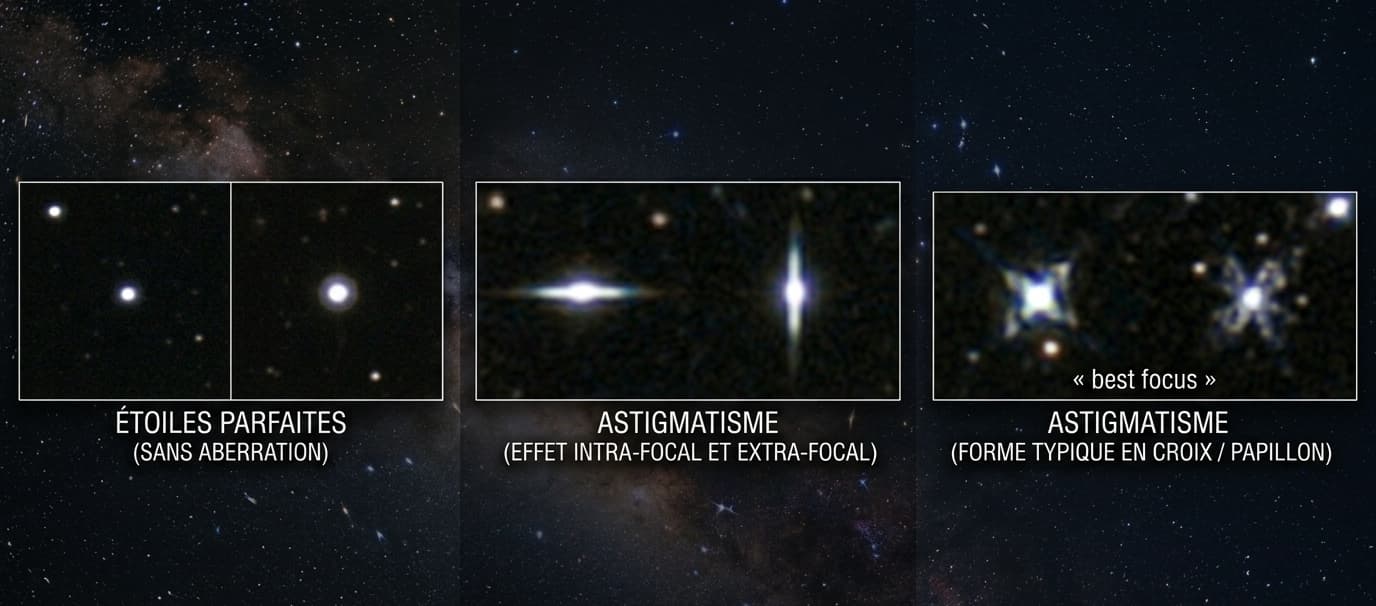
On acquisition, the measurements are reassuring. Field centre sits at 3.3 px FWHM for an elongation of 1.06, right at the measured floor of 1.03: the AM5 leaves no signature, no drift, no guiding oscillation, and focus is spot on. The only significant departure is the 1.35 corner/centre FWHM ratio, with asymmetry almost entirely horizontal (0.017 against 0.002 vertically). The left and right edges reach 4.8 and 4.7 px at elongation 1.12 while the bottom edge and the TR corner stay at 1.03. That single-axis profile signs a tipped focal plane, not a backfocus error, which would have ovalised all four corners symmetrically. The magnitude stays moderate and the image is perfectly usable, but it is the easiest sharpness gain to recover.
On processing, three points converge on the same lack of colour finishing over a still-short integration. The sky background sits very close to the black point (margin of 1.01), which lets patchy chroma noise show in the empty areas, amplified by the absence of background neutralisation. The green cast on the stars comes from the dual-band's unrecombined green channel, and a single SCNR pass removes it. Finally a few bright star cores are clipped to flat white, a consequence of the 240 s subs with no highlight protection during the stretch. Nothing fatal: everything is fixable in reprocessing except the tilt.
Priority actions
- Cross-tighten the whole imaging train and check focuser clamping to remove the measured tilt (corner/centre ratio 1.35)
- Apply SCNR Average Neutral then colour calibration to remove the green cast on the stars
- Neutralise the sky background then reduce chroma noise in chrominance only before the final stretch
- Extend integration beyond 2 h to lift the background off the black point (current e_margin 1.01)
- Add a short 10 to 30 s exposure set and blend star cores in HDR